START SELLING WITH BigBCC TODAY

Start your free trial with BigBCC today.

BLOG |

WW2 Battleship Tour Explores History, Weaponry of USS Massachusetts

WW2 Battleship Tour Explores History, Weaponry of USS Massachusetts

Table of Contents

  • The USS Massachusetts, a South Dakota-class battleship, earned 11 battle stars in World War II.
  • It fired the first US 16-inch shell of World War II, and the last 16-inch shell of the war overall.
  • The battleship is now a museum where visitors can tour once top-secret areas.

The USS Massachusetts fired America’s first 16-inch shell of World War II. It also fired the last.

In 1942, the 680-foot battleship fired the first US 16-inch projectile of the war in combat with French forces off the coast of Casablanca, Morocco, as part of Operation Torch. Three years later, the USS Massachusetts fired the last 16-inch projectile of World War II against Japanese forces in the final naval bombardment in Kamaishi, Honshu, Japan.

After the war, the decorated battleship was decommissioned and destined to become scrap metal until its former crew members stepped in to raise the funds to save it.

In 1965, the USS Massachusetts opened to the public as a museum and war memorial in the very state it was named for.

“The most important function here is that we serve to honor veterans and active duty personnel,” Christopher Nardi, Battleship Cove’s chief operating officer, told Business Insider.

Take a look inside the USS Massachusetts.

Commissioned in 1942 and decommissioned in 1947, the USS Massachusetts earned 11 battle stars in World War II.


The USS Massachusetts (BB-59) in 1942.

HUM Images/Universal Images Group via Getty Images

The USS Massachusetts was one of four battleships built as part of the South Dakota class, which was designed to be more compact than previous battleship classes.

The historic battleship is now a museum and war memorial at Battleship Cove in Fall River, Massachusetts.


The USS Massachusetts.

The USS Massachusetts at Battleship Cove.

Talia Lakritz/Business Insider

I visited Battleship Cove in January, when the museum operates with limited winter hours due to the frigid temperatures on board the ships. The full list of hours of operation can be found on Battleship Cove’s website.

General admission costs $25 per adult.

Battleship Cove has four self-guided tour paths aboard the ship centered on four themes: Below Deck, World War II, Crew, and Topside.


Color-coded tours on the USS Massachusetts.

Color-coded tours on the USS Massachusetts.

Talia Lakritz/Business Insider

The Below Deck tour takes visitors through the inner workings of the ship’s technology, including the engine room, the gun plotting and handling rooms, and the radio room.

The World War II-focused tour features historical exhibits about the war as a whole and spotlights some of the battle damage the ship endured.

The Crew tour brings visitors through spaces that were part of the sailors’ daily life on board, such as their bunks, galley, and laundry room.

The Topside tour explores the deck of the ship, including its many guns.

Color-coded arrows direct visitors along each of the routes.

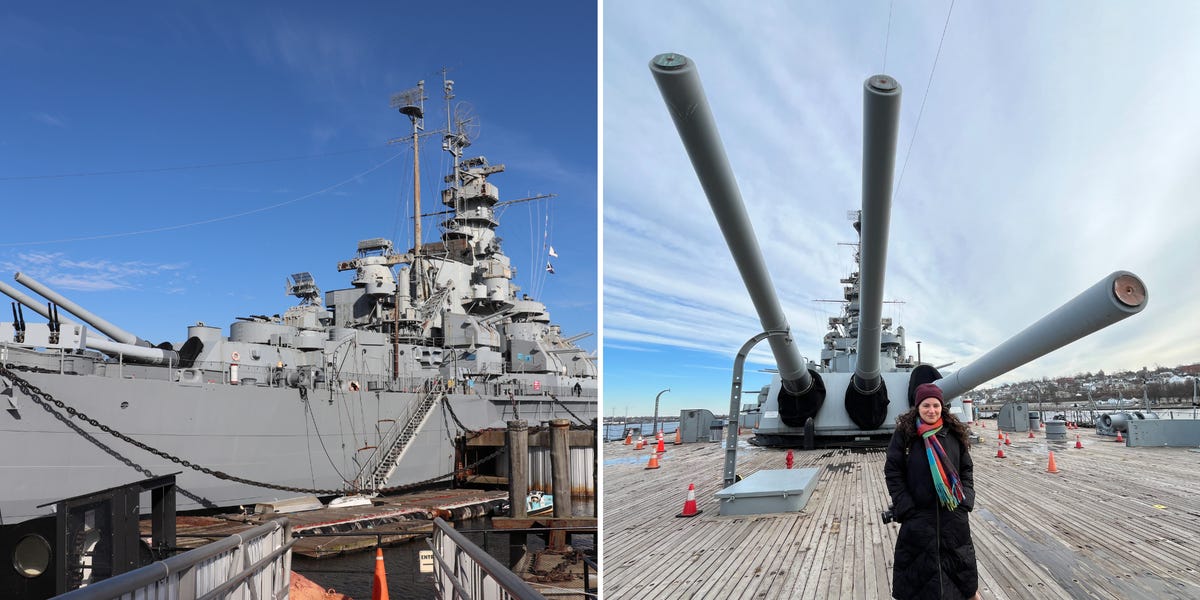
I started with the Topside tour and was immediately overwhelmed by the enormity of the 16-inch guns.


On the deck of the USS Massachusetts.

The 16-inch guns on the deck of the USS Massachusetts.

Devin Green for Business Insider

The ship has a total of nine 16-inch, 45-caliber Mark 6 guns: two three-gun turrets at the front of the ship (“forward”) and one three-gun turret at the back (“aft”). They could hit targets up to 23 miles away.

The 16-inch measurement refers to the bore diameter, or the size of the hole that the shell is fired through. The cannons themselves are over 60 feet long.

Even a single shell from the ship’s 40-millimeter Bofors guns could take down an enemy aircraft.


Bofors quad 40 mm antiaircraft guns on the deck of the USS Massachusetts.

Bofors quad 40 mm antiaircraft guns on the deck of the USS Massachusetts.

Talia Lakritz/Business Insider

The Bofors 40-millimeter guns featured a range of 6.25 miles and could fire between 120 and 160 rounds per minute.

At the height of World War II, the USS Massachusetts was outfitted with 72 40-millimeter guns.

The 20-millimeter Oerlikon autocannons served as another antiaircraft measure.


A 20 mm Oerlikon autocannon on the deck of the USS Massachusetts.

A 20-millimeter Oerlikon autocannon on the deck of the USS Massachusetts.

Talia Lakritz/Business Insider

The 20-millimeter Oerlikon autocannons featured a range of 2.75 miles.

The battleship was also outfitted with 20 5-inch guns that fired 55-pound projectiles with a range of 10 miles.


A Mark 12 5-inch/38 caliber gun on the deck of the USS Massachusetts.

A Mark 12 5-inch/38 caliber gun on the deck of the USS Massachusetts.

Talia Lakritz/Business Insider

Some of the ship’s 5-inch guns still work and are used for ceremonial gun salutes.

If you look closely, you can see the seagull that decided to perch on one of the guns when I visited.

The deck of the USS Massachusetts included the ship’s flag bag, which held the nautical flags used to signal and transmit messages to other ships.


The flag bag on board the USS Massachusetts.

The flag bag.

Talia Lakritz/Business Insider

Each nautical flag represents a letter or signal. For example, the flag representing the letter “O” can also mean “man overboard.”

The ship’s signal searchlight functioned as an additional communication device.


The signal searchlight on board the USS Massachusetts.

The signal searchlight.

Talia Lakritz/Business Insider

Crew members opened and closed the light’s shutter to send messages in Morse code.

Inside the ship, the wardroom, which once functioned as the officers’ dining room, has been converted into a lobby of sorts.


The wardroom on the USS Massachusetts.

The wardroom.

Talia Lakritz/Business Insider

When the ship was deployed, officers would have eaten their meals here off fine china.

The wardroom still features tables and seating for large groups.

Tours begin with the memorial room, which lists the names of over 13,000 service members from Massachusetts who died in World War II.


The memorial room on board the USS Massachusetts.

The memorial room.

Talia Lakritz/Business INsider

In addition to functioning as a museum, Battleship Cove is the official World War II memorial for the Commonwealth of Massachusetts.

The Crew tour took me through several rooms full of floor-to-ceiling bunks known as racks.


Crew bunks on board the USS Massachusetts.

Crew bunks, known as berthing.

Talia Lakritz/Business Insider

During World War II, the crew of the USS Massachusetts grew from its normal number of 1,793 enlisted men to 2,500. When the berthing rooms were full, the ship set up hammocks in other areas.

The ship’s post office, where sailors received letters from home, was crucial for maintaining crew morale.


The mail room on board the USS Massachusetts.

The mail room.

Talia Lakritz/Business Insider

Officers were in charge of censoring crew members’ letters to their loved ones, blacking out information like their location or even the weather.

In the blacksmith shop, crew members made parts for anything on the ship that needed repairs or replacements.


The blacksmith shop on board the USS Massachusetts.

The blacksmith shop.

Talia Lakritz/Business Insider

During the war, maintenance had to be performed while the ship was in the middle of the ocean.

Today, museum volunteers use 3D printers to create replacement parts.

The ship’s main galley was open 24 hours a day, seven days a week.


The main galley on board the USS Massachusetts.

The main galley.

Talia Lakritz/Business Insider

The galley prepared four meals per day: breakfast, lunch, dinner, and midnight rations known as “mid-rats.”

Crew members baked around 500 loaves of bread per day in the bakery.


The bakery on board the USS Massachusetts.

The bakery.

Talia Lakritz/Business Insider

The bakers’ work started at 3 a.m.

The laundry room was nicknamed “the harbor of lost clothes.”


The laundry room on board the USS Massachusetts.

The laundry room.

Talia Lakritz/Business Insider

Sailors labeled every item of their clothing, but some items still ended up in the lost-and-found, known as the “lucky bag.”

Sailors who disobeyed orders or neglected their duties were confined to the ship’s jail, known as the brig.


The brig on board the USS Massachusetts.

The brig.

Talia Lakritz/Business Insider

In the brig, sailors received only bread and water for meals.

Along the World War II-themed tour route, I encountered a section of the USS Massachusetts damaged by enemy fire.


Damage from World War II on board the USS Massachusetts.

Damage from World War II.

Talia Lakritz/Business Insider

During the Battle of Casablanca in 1942, an 8-inch projectile hit the main deck and exploded in a bunk room. No one was injured since all of the sailors were at their battle stations, but the ship sustained damage from the shrapnel.

The holes have since been repaired, but red outlines on the walls show where they once were.

The tour also passed through the sick bay, which included doctors’ offices, an operating room, and a dispensary.


The sick bay on board the USS Massachusetts.

The sick bay.

Talia Lakritz/Business Insider

The sick bay treated battle wounds as well as everyday ailments such as ear infections or athlete’s foot.

This long passageway on the third deck was known as Broadway. Now it’s part of the Below Deck tour route.


The longest hall on the USS Massachusetts known as "Broadway."

Broadway.

Talia Lakritz/Business Insider

On Iowa-class battleships like the USS New Jersey, Broadway is the longest, straightest passageway on the ship. On South Dakota-class battleships like the USS Massachusetts, Broadway is thinner and not built in a straight line since the class was designed to be more compact.

In the 5-inch lower handling room, gunner’s mates sent projectiles up to be fired from the 5-inch guns.


Ammunition hoists part of the 5-inch gun system on the USS Massachusetts.

Ammunition hoists part of the 5-inch gun system.

Talia Lakritz/Business Insider

Gunner’s mates loaded shells and powder cases into the hoists, which moved them up to the upper handling room and then up to the gun mounts.

The 16-inch gun turrets featured a similar setup, with a powder-handling room and hoists on the lower level.


The powder handling room on board the USS Massachusetts.

The powder handling room.

Talia Lakritz/Business Insider

Six powder bags were required to fire one 16-inch projectile.

The massive 16-inch guns were aimed and fired with instruments in the plotting room.


The plotting room in the USS Massachusetts.

The plotting room.

Talia Lakritz/Business Insider

A device called a Mark 8 Rangekeeper computed where to aim the 16-inch guns based on factors such as the ship’s course and speed and the direction of the wind.

The USS Massachusetts had four engine rooms.


The engine room on the USS Massachusetts.

The engine room.

Talia Lakritz/Business Insider

Eight boilers supplied steam to the ship’s four General Electric steam turbines, which drove its four propellers.

The ship reached a top speed of 27.5 knots, or around 31.6 miles per hour.

The ship’s electricity was managed from the distribution room.


The distribution room on board the USS Massachusetts.

The distribution room.

Talia Lakritz/Business Insider

In order to work in the distribution room, an electrician had to pass a test showing that he could get from his bunk to the distribution room and identify any circuit while blindfolded.

The ship’s communications took place in radio central, where radiomen received messages that came in from the air, land, and sea.


The radio room on board the USS Massachusetts.

Radio central.

Talia Lakritz/Business Insider

Radiomen were responsible for typing messages and passing them to supervisors.

Nardi told Business Insider that the equipment in radio central is still operational thanks to the work of volunteers who continue to maintain it.

Coded messages were deciphered in the top-secret code room stocked with three ECM II coding machines.


The code room on board the USS Massachusetts.

The code room.

Talia Lakritz/Business Insider

Canvas bags with lead bottoms were kept in the code room just in case any top-secret information had to be thrown overboard if the ship was compromised.

Even after spending most of the day at Battleship Cove, there was still more of the ship I didn’t get to see.


The USS Massachusetts at Battleship Cove.

The USS Massachusetts at Battleship Cove.

Talia Lakritz/Business Insider

Even with a map of the ship and color-coded arrows pointing the way, touring the USS Massachusetts was a dizzying experience full of ladders, hatches, and tight corners. On a battleship that big, there’s an endless amount of history to learn.

Nardi told me that touring historic battleships like the USS Massachusetts can provide insight into how modern Navy ships operate.

Basic navigational equipment looks and works largely the same as it did on World War II battleships, Nardi said. Some communication devices, such as sound-powered telephones that harness the electricity generated by the user’s voice, are also still widely used.

“I hear Navy personnel come on board and say, ‘Oh, that hasn’t changed much,'” Nardi said.

Battleships became obsolete as missiles took precedence over large deck guns. President Donald Trump wants to bring them back.


Battleship Cove, featuring the USS Joseph P. Kennedy Jr. (left), the USS Massachusetts (right).

Battleship Cove, featuring the USS Joseph P. Kennedy Jr. (left), the USS Massachusetts (right).

Talia Lakritz/Business Insider

In December, Trump announced a new “Trump-class” of ships, referring to them as “battleships,” as part of his plan for the US Navy’s new “Golden Fleet” to reinvigorate American shipbuilding. White House deputy press secretary Anna Kelly previously told Business Insider that Trump is “prioritizing this vital industry to strengthen our country’s economic and national security.”

However, the Trump-class ships would not technically qualify as battleships. To earn that title, they would have to be the largest, most heavily armored ships with the largest guns relative to other ships.

“The word ‘battleship’ can be used very generically, which is not accurate. We don’t have them anymore, and President Trump’s not going to build battleships. He’s calling them that, but a battleship is what we have over here,” Nardi said, gesturing at the USS Massachusetts floating in the Taunton River. “That’s a real battleship.”

Source link

Share Article:

The newsletter for entrepreneurs

Join millions of self-starters in getting business resources, tips, and inspiring stories in your inbox.

Unsubscribe anytime. By entering your email, you agree to receive
emails from BigBCC.

The newsletter for entrepreneurs

Join millions of self-starters in getting business resources, tips, and inspiring stories in your inbox.

Unsubscribe anytime. By entering your email, you agree to receive marketing emails from BigBCC. By proceeding, you agree to the Terms and Conditions and Privacy Policy.

SELL ANYWHERE
WITH BigBCC

Learn on the go. Try BigBCC for free, and explore all the tools you need to
start, run, and grow your business.