
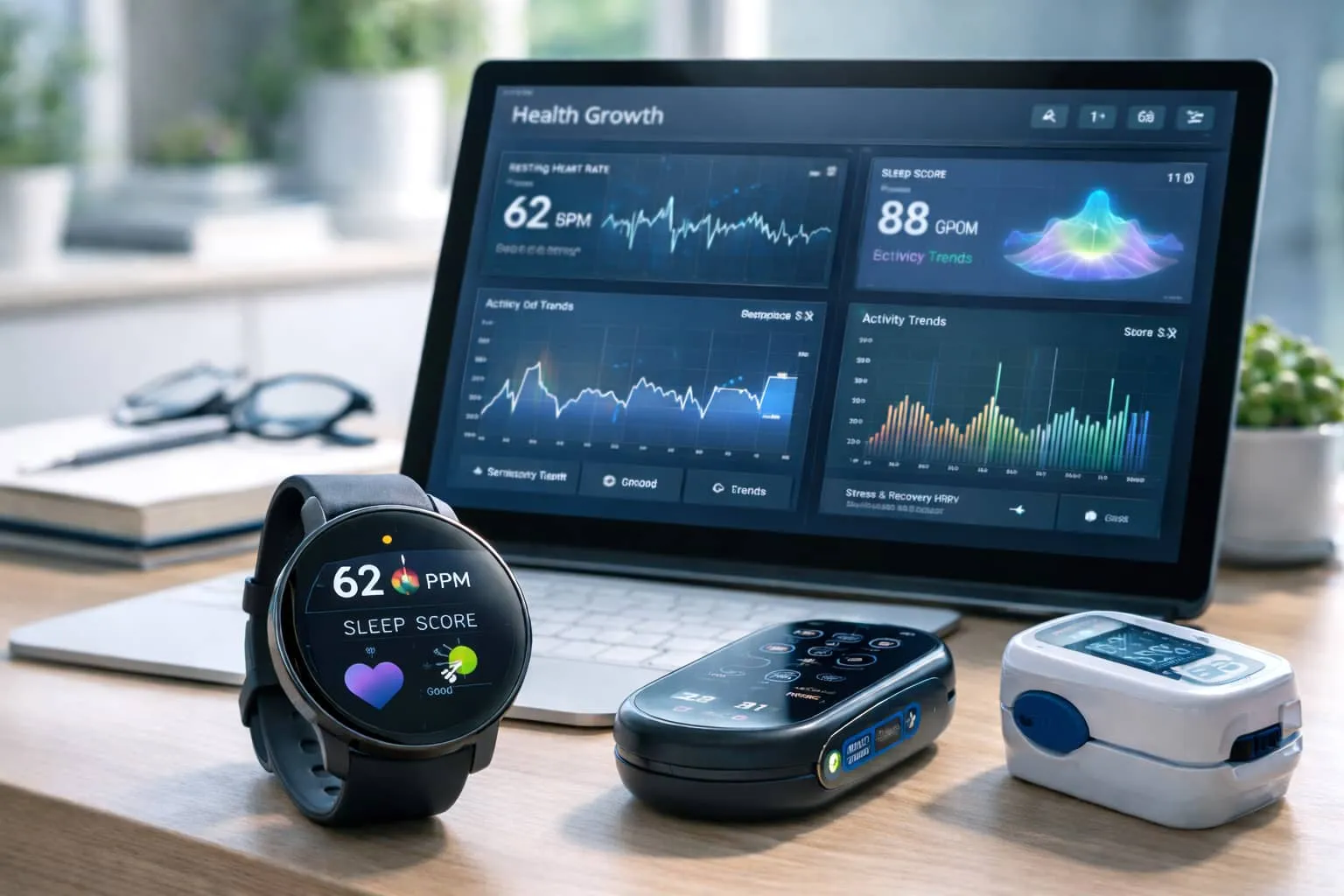
Wearable health devices have quietly become part of everyday life for millions of people. What began as curiosity has become a routine as users check sleep scores in the morning, review resting heart rate after a stressful week, or monitor blood oxygen levels during a long flight.
These devices now track a range of metrics, including physical activity, heart rate, sleep patterns, stress indicators, and blood oxygen saturation, and users are increasingly paying attention to what the data reveal. As digital health ecosystems evolve, many users are beginning to discover how these devices connect with broader platforms such as Fitness Apps and more advanced solutions built on Custom Healthcare Software, opening the door to more integrated and personalised health insights.
But there is a question worth asking: if the data are this rich, why does so little of it inform meaningful health decisions? Most users end up with dashboards full of numbers that feel informative in the moment but do not translate into any real understanding of their health.
The gap is not in the hardware. It is in the software layer that sits above it. Custom healthcare software is increasingly recognised as the component that connects wearable data to genuinely useful health intelligence, and understanding how it does so reveals much about where this field is heading.
The Evolution of Wearable Health Technology
Early fitness trackers counted steps and offered rough calorie estimates. They were useful for prompting greater physical activity, but their clinical relevance was negligible. That has changed substantially. Today’s smartwatches can detect atrial fibrillation, track blood oxygen saturation levels overnight, and estimate physiological stress via heart rate variability analysis.
Continuous glucose monitors provide real-time metabolic data without finger-prick testing. Cardiac monitoring patches can record electrocardiogram data over extended periods outside a clinical setting. Smart clothing embedded with biometric sensors, although still in early adoption, is beginning to find specialised applications in both medicine and elite sport.
The result of this progression is that the volume and complexity of health data generated per person has grown considerably. A single user wearing a modern health wearable for one week generates more biometric data points than a traditional clinical assessment can capture over years of periodic appointments. The hardware has outpaced the tools available to interpret what it produces.
Limitations of Traditional Fitness Apps
Consumer fitness platforms have made health data more visible, but visibility is not the same as understanding. Most mainstream fitness applications operate at a surface level, presenting step counts, sleep stage breakdowns, and resting heart rate trends without providing the context that would make those numbers actually useful to someone trying to manage their health.
Several structural limitations define this gap. These platforms rarely integrate with healthcare systems, so the data they collect are isolated from a user’s broader medical history. Their recommendations tend to be generic by design, built to apply across large populations rather than individual physiological profiles.
Data fragmentation remains a persistent problem: a user tracking sleep with one app, activity with another, and nutrition with a third has no consolidated view of how these variables interact.
Perhaps more fundamentally, standard fitness apps were not built for clinical application. They lack the regulatory framework, validated analytical methods, and data security architecture required for healthcare-grade software. This is not a flaw so much as a design reality.
These platforms were designed to enhance consumer engagement. The problem is that people increasingly expect them to do something that was never part of their original purpose.
What Makes Custom Healthcare Software Different
Custom healthcare software approaches wearable data from a different starting point. Rather than presenting individual metrics in isolation, these platforms are designed to integrate multiple health data streams, apply clinically grounded analytical models, and deliver insights that reflect an individual’s actual health profile rather than population averages.
At the technical level, this involves direct integration with wearable device APIs, enabling continuous data ingestion from multiple devices at once. The aggregated data is then processed using AI-driven analytics to identify patterns that no single metric would reveal on its own. A platform that analyses heart rate variability alongside sleep architecture and daily activity levels can reveal correlations that become apparent only when the data are read together.
Integration with electronic health records is another significant differentiator. When wearable data can be read alongside a patient’s medication history, existing diagnoses, and previous clinical assessments, the analytical value increases substantially.
Personalised health dashboards can then present this synthesised information in formats suited to different users, whether that is a patient managing a chronic condition, a clinician monitoring a patient remotely, or an occupational health team running a corporate wellness program.
Security and compliance architecture distinguishes these platforms from consumer alternatives. Healthcare-grade custom software must comply with standards such as HIPAA in the United States and GDPR in Europe, which require encryption, access controls, and audit capabilities that consumer applications typically do not implement.
Turning Wearable Data into Real Health Insights
The practical value of custom healthcare software becomes clearest when examining specific examples of how it translates wearable data into actionable information.
Cardiovascular health is one of the most developed application areas. Continuous heart rate and rhythm monitoring can detect anomalies early, including irregular rhythms that may indicate emerging atrial fibrillation or sustained resting heart rate elevation that warrants clinical evaluation. These are signals that periodic check-ups are unlikely to detect, as they occur between appointments.
Sleep quality analysis is another area in which deeper software capabilities change what is possible. Consumer platforms can identify broad sleep stages based on movement and heart rate. Still, custom platforms can incorporate additional variables, such as blood oxygen saturation, ambient conditions, and stress biomarkers, to provide a more nuanced picture of sleep quality and its relationship to daytime health outcomes.
Stress and recovery monitoring has become particularly relevant in both athletic and workplace contexts. Heart rate variability, tracked continuously and analysed against activity and sleep data, provides a measurable indicator of physiological stress load and recovery status. Custom platforms can use this data to support personalised training decisions for athletes, or to flag sustained stress patterns in occupational health programs.
For people managing chronic conditions such as diabetes, hypertension, or heart failure, continuous monitoring integrated with custom software creates the possibility of genuinely proactive care. Rather than responding to symptoms after they appear, both patients and clinicians gain access to trend data that can signal deterioration before it reaches a clinical threshold.
Applications Across Different Health Contexts
The range of contexts in which wearable and healthcare software integration delivers real value is broad, and different user groups benefit in distinct ways.
In preventive health, the primary value is early identification. Organisations running employee wellness programs or health insurers incentivising preventive behaviour can use integrated platforms to identify individuals exhibiting early physiological warning signs, enabling intervention before an acute health event occurs.
Athletic performance is a high-value application for professional sports organisations and serious amateur athletes. Custom platforms that synthesise training load, sleep quality, and recovery biomarkers into readiness scores give coaches and athletes a more informed basis for decisions about training intensity and rest periods.
Post-surgery recovery monitoring is a growing application that addresses a real gap in care. Once a patient is discharged from a clinical setting, follow-up is often limited to scheduled appointments. Continuous wearable monitoring during recovery enables care teams to track physiological trends remotely and respond early if abnormalities are detected.
Corporate wellness programs represent a commercially significant market. Employers who integrate custom health software with employee wearable data can build wellness initiatives grounded in objective measurement, track program effectiveness over time, and demonstrate return on investment in ways that survey-based self-reporting cannot support.
Challenges and Ethical Considerations
A fair assessment of this field has to engage honestly with its limitations and the ethical questions it raises.
Data privacy carries particular weight in healthcare contexts. Continuous biometric monitoring, combined with sophisticated analytics, produces detailed health profiles that are highly sensitive. The consequences of a breach or misuse in this context go well beyond what a typical consumer data incident would involve. Strong technical security measures are necessary but not sufficient. Clear data governance policies and transparent user consent frameworks are equally important.
Sensor accuracy is a real and underappreciated limitation. Consumer-grade wearable sensors vary considerably in their clinical reliability, and insights drawn from imprecise input data are only as sound as the measurements themselves. Responsible development in this space requires rigorous validation of sensor accuracy for specific use cases rather than assuming that consumer-grade readings are equivalent to medical-grade measurements.
Regulatory compliance introduces significant complexity to custom healthcare software development, particularly as platforms move toward clinical decision support or diagnostic functions. The regulatory classification of health software varies by jurisdiction and intended use, and navigating those frameworks requires specialised legal and regulatory knowledge that many digital health teams build up over time.
User data ownership is a question the industry has not fully worked through. When wearable data is aggregated and analysed by a third-party platform, the boundaries of user control over that data, including whether it may be used for research or product development, need to be clearly and accessibly communicated rather than buried in terms of service.
Future Trends in Wearable-Driven Healthcare
Several developments on the horizon are likely to define the next phase of this space.
AI-powered health prediction models are advancing quickly. As datasets drawn from continuous wearable monitoring grow larger and more diverse, predictive models will become better able to identify individual health trajectories with greater accuracy. Early warning systems for cardiovascular events, metabolic deterioration, and mental health episodes are all active areas of research and development.
Continuous metabolic monitoring is moving toward broader accessibility. Non-invasive technologies for tracking glucose, ketones, and other metabolic markers are under development, and their integration with custom health platforms would considerably expand the capabilities of continuous monitoring outside clinical settings.
The convergence with telehealth platforms is a logical and increasingly likely development. Wearable data aggregated by a custom platform and shared directly with a clinician during a virtual consultation would shift the nature of a telehealth interaction from a convenience-based check-in to a genuinely data-informed clinical exchange.
Personalised digital health coaching, where AI systems synthesise ongoing biometric data to deliver real-time guidance calibrated to individual physiology, represents a longer-term trajectory for the field. The distance between current capability—which often requires a warmup cache request to function accurately—and that vision is real, but the direction of development is consistent and the investment behind it is substantial.
Conclusion
Wearable health technology has created something genuinely new: an infrastructure for continuous biometric monitoring at a scale that was simply not possible before. The data being generated is substantial in volume and significant in potential clinical value. But data without interpretation does not improve health outcomes, and this is exactly where the software layer matters.
Custom healthcare software transforms what wearables produce into what health management requires: context, continuity, and insights relevant to the individual wearing the device. The challenges, including privacy, sensor accuracy, and regulatory complexity, are real and warrant serious attention from anyone developing in this space. But the overall direction is clear.
The meaningful value in wearable health technology does not sit in the device on someone’s wrist. It sits in the analytical capability built to make sense of what that device collects.