As BYD continues to roll out manufacturing bases across Hungary, Brazil and Thailand, another location has been firmly added to the Chinese new energy vehicle (NEV) giant’s global map: Vietnam. This time, however, the focus is not vehicle assembly but the very core of electric mobility—the power battery. The move signals a deeper layer of BYD’s international strategy, shifting from exporting products to embedding itself within regional supply chains.
Image source: Vietnam government’s website
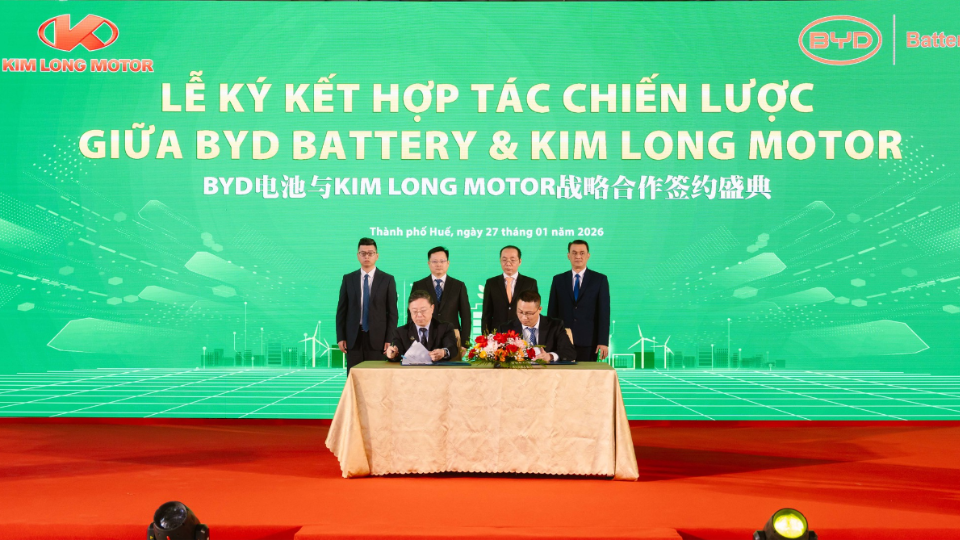
On January 27, BYD signed a cooperation agreement worth USD 130 million in Vietnam with local commercial vehicle manufacturer Kim Long Motor. The partnership calls for the joint construction of a power battery plant in central Vietnam, primarily serving commercial vehicles. On the same day, the duo broke ground on the facility.
Rather than a straightforward overseas expansion, the project reflects a calculated step by BYD to reinforce its position within Southeast Asia’s—and increasingly the world’s—EV supply chain.
1. Phased localization and a clear capacity roadmap
The project is structured in two distinct phases. In the first stage, a 4.4-hectare facility will be built with an annual capacity of 3 GWh, dedicated to supplying batteries for commercial vehicles such as buses and trucks. A second phase will expand the site by an additional 6 hectares, bringing the total footprint to 10 hectares and introducing battery lines for passenger vehicles. Once completed, total capacity is expected to double to 6 GWh.
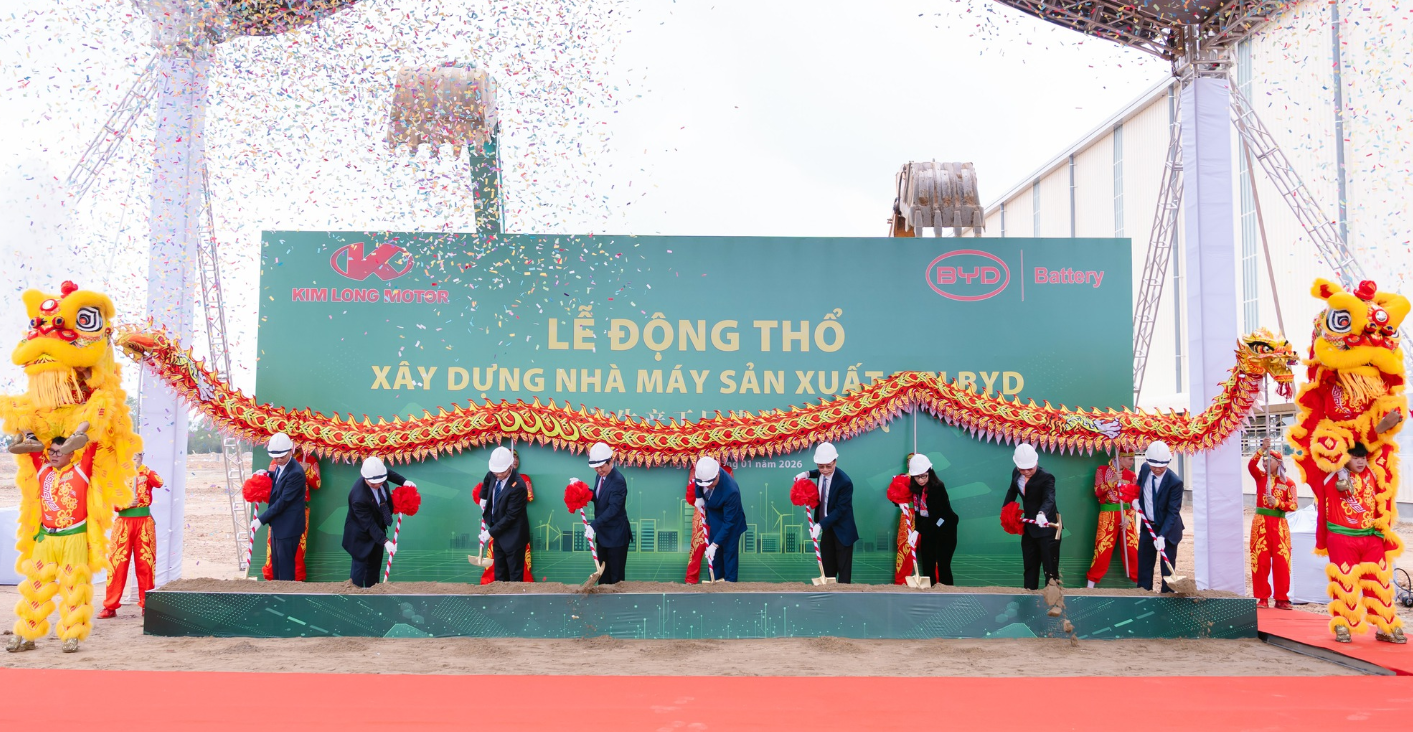
Image source: Vietnam government’s website
While equity and investment details have not been formally disclosed, market sources have suggested that Kim Long Motor may take the lead in capital contributions, with BYD providing its core battery technology and manufacturing expertise. This blend of local market access and Chinese technological know-how has increasingly become a preferred model for Chinese companies entering emerging markets.
BYD’s choice of Vietnam comes against the backdrop of a rapidly expanding Southeast Asian EV market, with Vietnam emerging as one of its most dynamic growth engines.
2. Market momentum and policy tailwinds: Why Vietnam matters
The numbers tell a compelling story. Vietnam’s electric vehicle (EV) sales have surged from just 4,040 units in 2022 to nearly 79,800 units in 2024. Momentum has carried into 2025, with combined sales of electric and hybrid vehicles reaching around 160,000 units in the first 11 months alone, accounting for 38.5% of total auto sales. Such explosive growth has been underpinned by strong and consistent policy support.
Anchored by its national goal of achieving net-zero emissions by 2050, Vietnam has rolled out a comprehensive incentive framework. Measures include extending exemptions on first-time EV registration fees through 2027, cutting consumption taxes and subsidizing charging infrastructure development. Together, these policies have lowered barriers for consumers and created a fast track for market expansion, turning Vietnam from a high-potential market into a strategic must-have for automotive supply chain players targeting Southeast Asia.
Opportunities, however, come with challenges. Vietnam’s domestic automaker VinFast dominates Vietnam’s battery electric vehicle (BEV) segment, controlling an estimated 99% of the market and presenting a formidable barrier to new entrants. At the same time, the local EV supply chain—particularly in power batteries—remains underdeveloped. This imbalance has opened a critical window for Chinese battery makers to establish an early foothold.
Before BYD’s entry, Gotion High-Tech had already partnered with VinES, an affiliate of Vingroup, to build Vietnam’s first lithium iron phosphate battery plant, while battery module suppliers such as Sunwoda have also moved in. BYD’s arrival now signals that Vietnam has become a focal point for China’s leading battery players, as competition to shape the region’s EV supply chain intensifies.
3. Beyond local market: Vietnam as a springboard in BYD’s global network
For BYD, building capacity in Vietnam is about far more than meeting local demand. The deeper logic lies in leveraging Vietnam’s trade geography and tariff advantages to position the country as a regional supply hub—one that can serve Southeast Asia and, increasingly, Europe.
This strategy is underpinned by Vietnam’s extensive network of high-standard free trade agreements. Under the ASEAN Trade in Goods Agreement (ATIGA), vehicles and most auto components manufactured in Vietnam and meeting rules-of-origin requirements can be exported tariff-free to other ASEAN markets, including Thailand, Indonesia and Malaysia.
Even more compelling is the EU–Vietnam Free Trade Agreement (EVFTA), which grants zero-tariff access for qualifying Vietnam-made vehicles and components entering the European Union—a stark contrast to the duties faced by products shipped directly from China.
As a result, Vietnam has evolved from a destination market into an export-oriented manufacturing base and international launchpad. Recognizing this shift, Chinese automakers such as Chery and Geely have established EV production in Vietnam through joint ventures, while SAIC-GM-Wuling and Great Wall Motor have moved into local assembly operations.
From sales to manufacturing: completing BYD’s Vietnam puzzle
The battery plant agreement marks a pivotal step in BYD’s deepening localization strategy in Vietnam. The company first entered the market in 2024 by opening its initial retail outlets, with plans to expand to around 100 sales points by 2026, firmly establishing its commercial presence.
In parallel, BYD subsidiaries have built an electronics plant in Phu Tho province and outlined plans to invest more than USD 250 million in auto parts manufacturing. With battery production now added to the mix, BYD is beginning to form a vertically integrated footprint in Vietnam, spanning sales, components and the most critical element of all—power batteries.
These moves align closely with BYD’s accelerating global expansion. In 2025, the company’s global sales exceeded 4.6 million vehicles, with overseas sales surging 145% year on year and surpassing the one-million-unit mark for the first time.
To reach its overseas sales target of 1.3 million units in 2026, BYD must continue to strengthen its global production network. From Hungary as a European foothold to Thailand as an ASEAN hub and Brazil as its South American base, each site adds resilience and responsiveness to its supply chain. The Vietnam battery plant is now another reinforced link in that expanding network.
Final thoughts: Globalization as a contest of supply chain redesign
At a micro level, BYD’s Vietnam battery project is a straightforward joint venture. At a macro level, it exemplifies the broader restructuring of the global NEV supply chain. China’s NEV players are moving beyond vehicle exports and CKD assembly toward technology transfer, deep localization and regional supply chain integration built around third-country trade advantages.
Competition is no longer defined solely by products or market share, but by how effectively companies design supply chains and navigate global trade rules. With fast-growing domestic demand, proactive industrial policies and an exceptional web of free trade agreements, Vietnam has emerged as a strategic battleground in this race.
By placing its battery bet in Vietnam, BYD is not merely playing for local market success, but activating a much broader strategic hinterland in its global game. When batteries are produced in Vietnam and shipped tariff-free to Thailand or Europe, globalization takes on a more flexible and sophisticated meaning for Chinese companies. That, perhaps, is the most enduring lesson this partnership offers to the industry.
All Rights Reserved. Do not reproduce, copy and use the editorial content without permission. Contact us: autonews@gasgoo.com