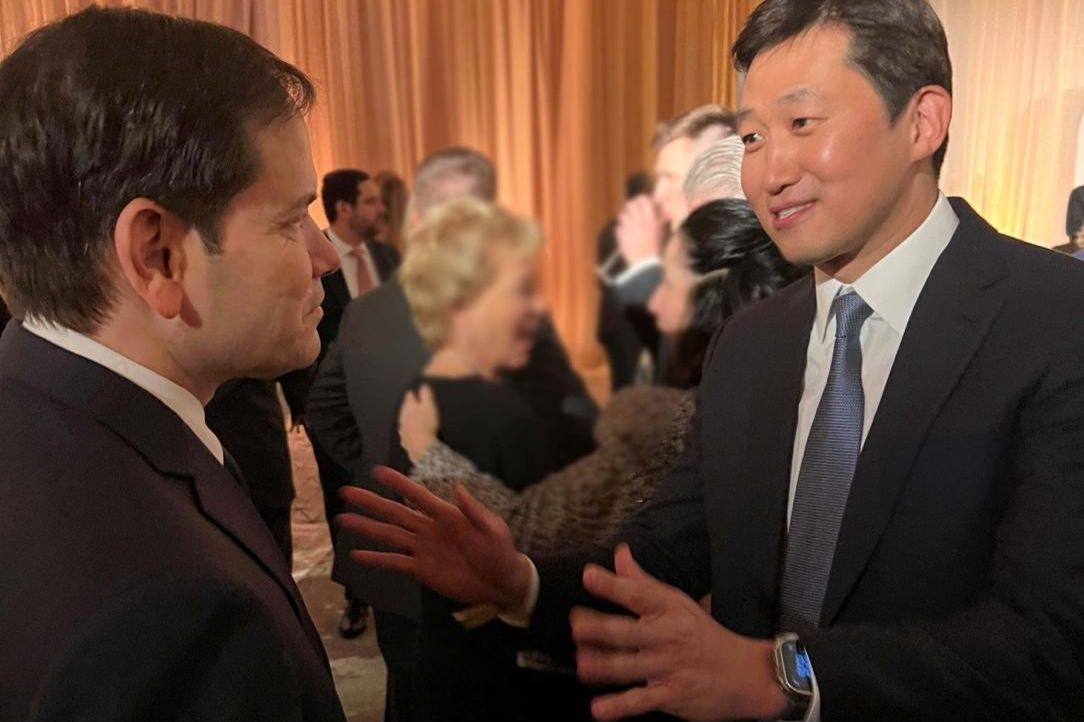
Coupang founder Kim Bom-suk, right, speaks to then-U.S. State Secretary nominee Marco Rubio during a reception hosted by Donald Trump Jr. in Washington, Jan. 18 (local time). Newsis
Coupang’s significant spending on lobbying politicians in the United States has apparently paid off, with Republicans criticizing the Korean government’s ongoing investigation into the Seattle-headquartered e-commerce firm.
They denounced Korea’s probe into Coupang as an attempt to favor China, while remaining silent on the company’s massive data breach of the personal information of 33.7 million users, allegedly by a former employee who is a Chinese national.
Amid growing suspicion that Coupang has been trying to turn the matter into a diplomatic feud, Seoul is now keeping a close watch on the company’s suspected connections with U.S. government officials and lawmakers.
Robert O’Brien, who served as national security adviser during the first Donald Trump administration, said Tuesday (local time) that the National Assembly’s aggressive targeting of Coupang will set the stage for further discriminatory measures by the Korean Fair Trade Commission and broader regulatory barriers toward U.S. firms.
“Trump has worked hard to rebalance the trade relationship with Korea, and it would be very unfortunate if Korea undermines his efforts by targeting U.S. tech firms,” he wrote on social media. “A strong, coordinated U.S. response is essential to safeguard fair treatment of U.S. companies and maintain strategic balance against China’s growing economic influence in the sector.”
U.S. President Donald Trump talks to reporters with Robert O’Brien after naming him the White House national security adviser at Los Angeles International Airport in California, Sept. 18, 2019. Reuters-Yonhap
Republican Rep. Darrell Issa also mentioned Coupang as one of the U.S. tech firms subject to “a campaign of aggression” from the Korean government.
“Specifically, this is being done by new digital trade laws that American companies will tell you simultaneously favor Korean and Chinese businesses and strangle their ability to operate in Korea,” he said in a column published Monday (local time) by the Daily Caller, a U.S. right-wing news website.
Real America’s Voice, a U.S.-based right-wing streaming channel, claimed the same day that President Lee Jae Myung issued a directive to bankrupt Coupang. Lee had urged stronger sanctions against companies involved in data breaches, but he did not issue such a directive.
The channel also shared Issa’s supposition that Korea’s regulation of Coupang and other U.S. tech firms led to the cancellation of last Thursday’s closed-door meeting of the Korea-U.S. Free Trade Agreement Joint Committee, despite the Korean government’s explanation that the event was postponed because both sides needed more time to discuss the details of the agenda.
According to the U.S. Senate’s lobbying disclosures, Coupang has spent at least $10 million in the U.S. since August 2021. The company also donated $1 million to Trump’s second inauguration ceremony in January.
Given the company’s aggressive recruitment of lobbyists in Washington, concerns are mounting that the U.S. may intensify its pressure on Korea to stop the investigation into the company.
In response, Korea’s presidential office ordered the foreign minister and national security officials to attend an unusual ministerial meeting on Christmas Day to discuss countermeasures against Coupang’s data breach.
The Foreign Affairs and Unification Committee will also join the National Assembly’s joint hearing, scheduled for Dec. 30 and 31, to examine whether the Coupang case will affect diplomatic relations with the U.S.