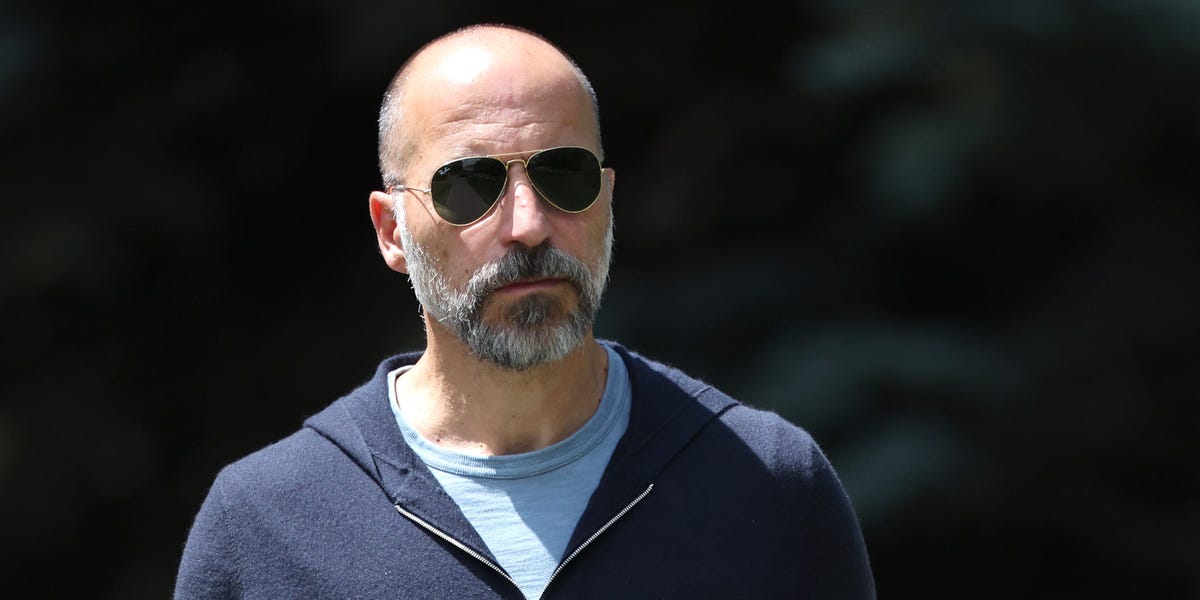
By Dara Khosrowshahi’s telling, the robotaxi future doesn’t belong to one company: Multiple vendors supply the fleet as driverless cars expand the market, and in the middle of it all, Uber stands as the demand gatekeeper.
The ride-hailing giant’s latest deal blitz seems designed to ensure this is the future that materializes.
Uber announced three new robotaxi partnerships in the past few weeks with Zoox, Wayve-Nissan, and Rivian. In less than half a decade, the company has secured at least a dozen deals, including with WeRide, AVride, May Mobility, Momenta, Pony.AI, Wayve, Baidu’s Apollo Go, Motional, and Lucid-Nuro.
Still, less than a half-dozen of Uber’s partners have deployed fully driverless, paid robotaxi operations, and only one, Waymo, operates in the US. Uber has a joint deployment with Waymo in Atlanta, Austin, and Phoenix, but in other cities, Waymo is a competitor.
Uber’s partnership spree is less about seeking the singular, dominant player of autonomous driving. Instead, analysts told Business Insider that Uber is ensuring multiple vendors can participate in the expensive business of robotaxis — fending off the real risk of a Waymo or Tesla scaling on its own — and giving itself a stake in the robotaxi economy by being the aggregator of choice.

“The more diversified the supplier base, the better for the network in the middle, which is Uber,” Mark Mahaney, an Uber analyst for Evercore ISI, told Business Insider.
Uber’s defense and offense
Uber abandoned its in-house self-driving division years ago. Today, the ride-hailing company is targeting partnerships, including companies that, unlike Waymo, have expressed no interest in making their own apps, such as Nuro and Hyundai’s Motional.
Instead, it is going the partnership route to shape a multiplayer market with companies that have expressed no interest in developing their own apps, including Nuro and Hyundai’s Motional.
Those partnerships are not just about hedging, said Lloyd Walmsley, an Uber analyst for Mizuho Financial Group. By joining the investor roster, a giant like Uber puts its stamp of approval on those companies, thus attracting other investors that can help fund a smaller outfit, he said.
“The bets they’re making aren’t that big relative to their market cap,” Walmsley said of Uber. “So it’s in their interest to put a little bit of capital out there that then attracts even more capital from third parties that will build the ecosystem for them.”
Laura Major, the CEO of Motional, framed the stakes more bluntly. She told Business Insider that autonomy — and having multiple players — is “existential” for Uber.
“If there’s one winner, that’s going to be a problem for them,” Major said. “I think it creates a huge risk if that robotaxi partner starts their own ride-hail service.”
Uber’s strategy, through that lens, is defensive. Waymo has shown it can offer commercial robotaxis with its own app and fleet maintenance, and Tesla remains a looming threat as it works on Robotaxi. If one or both companies can control the car, the software, and the customer relationship at scale, Uber’s position weakens.
However, Uber’s bets are also opportunistic. Walmsley said that if Uber can add more autonomous options that bring down the cost of human-driven rides, the company can increase demand, not just cannibalize the volume of trips that exist today.
Mahaney agreed that Uber’s strategy can expand the total addressable market — in this case, the total pool of ride bookings Uber could eventually capture. He added that a larger group of partners could also help Uber secure more favorable deal terms.
One or two players could “probably extract pretty aggressive terms from Uber,” Mahaney said. “If there are five to 10, then actually Uber gets more negotiating leverage.”
Who will stay in the robotaxi race?
The gap between signing a partnership and putting thousands of safe, fully driverless cars on the road remains wide. Most of Uber’s partners have yet to deploy a fully driverless, paid service.
Motional believes cost could be the decisive factor. Alan Hall, Motional’s director of communications, said flashy demos and features will matter less than who can scale the cheapest and safest ride.
Mahaney, the Evercore ISI analyst, similarly said that having a few cars in one city proves far less than having a company that can sustain a large commercial fleet. Until then, Uber is placing bets on a field that still has no clear shape, he said.
“There are a lot of players out there,” Major, the Motional CEO, said. “No one knows quite who’s going to survive this phase.”
An Uber spokesperson did not respond to a request for comment.