
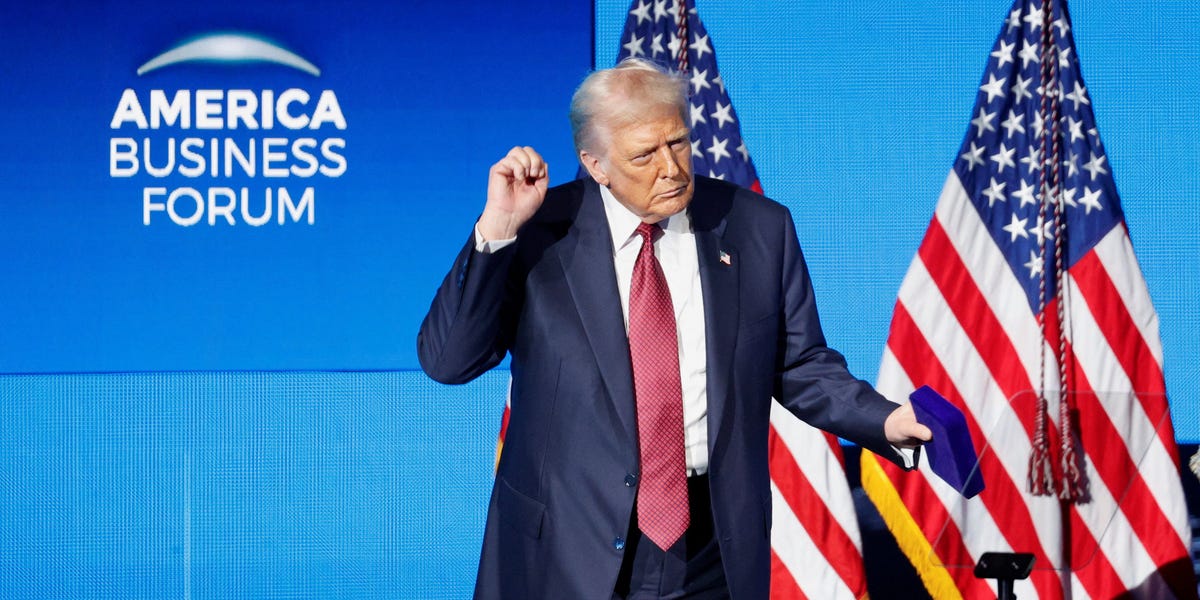
President Donald Trump’s year in office was a mixed bag of blessings and woes for the business world.
Last year began with a lineup of billionaires at Trump’s inauguration, all of whom soon saw their net worth diminish after Trump enacted sweeping tariffs aimed at reshoring manufacturing jobs.
Their fortunes soon rebounded, and Trump has been a booster of the tech industry, which continued to grow in 2025.
Businesses were also often caught in Trump’s crosshairs, including Intel, Amazon, and Walmart.
From the retail sector to the AI industry, here’s how different industries fared in Trump’s first year of his second term.
AI
The AI industry continued to soar during the first year of Trump’s second term.
According to Morningstar, the company’s AI basket of 34 stocks, which includes Amazon, Cisco, and Apple, saw a 50.8% in share value in 2025, while the overall stock market gained 17.3% and the broader tech sector rose 21.4%, based on the Morningstar US Market Index.
Within the first month of his presidency, Trump announced a $500 billion AI infrastructure project called Stargate, to be led by OpenAI, Oracle, and SoftBank, which he said would be “the largest AI infrastructure project in history.”
Trump has also been a booster of the tech industry at large — while receiving donations, gifts, pledges for more American manufacturing, and praise from leaders.
He’s had notable visits with CEOs, including Nvidia CEO Jensen Huang. The US eventually allowed Nvidia to sell H200 chips to China, under the condition that the government gets a cut of the profit.
Trump also rescinded an executive order issued by former President Joe Biden that established a federal framework for AI safety and risk mitigation, and he signed a new order intended to override state-level AI regulations.
And after publicly calling for the resignation of Intel’s CEO, Trump made a deal for the US to take a nearly 10% equity in the company, which has since seen its stock rise.
It’s unclear what Trump’s second year in office in his second term will bring.
Concerns are bubbling under the industry boom. Industry experts fear that an AI bubble burst will bring about a market crash similar to the dot-com crash.
Trump is also warning tech companies that data centers cannot contribute to the affordability crisis by driving up energy bills. Some tech bulls, such as Dan Ives, said that the focus on costs could derail the AI boom.
Retail
Retail businesses, large and small, have been hit hard by Trump’s first year back.
The Trump presidency kicked off with a flurry of tariffs, sometimes on some of the country’s closest trade partners. Businesses in retail have been struggling to keep up with the pace of change, and some have responded by hiking prices.
Business Insider previously reported that the tariffs had disproportionately affected Main Street and entrepreneurs who make physical products. Several small businesses sued Trump over the tariffs enacted using the International Emergency Economic Powers Act.
Even if businesses were able to handle tariffs, they were competing for skittish consumers after sentiment sank to a new low in November, based on the Consumer Index by the University of Chicago. Economists have also found that while the wealthy have continued to spend, others have cut back.
Not everything was down. Trump did backtrack on some of his tariffs, and the retail sector did see some growth compared to 2024, according to the Commerce Department’s Census Bureau.
Manufacturing
Despite Trump’s promise to bring blue-collar jobs back to the US and some high-profile plans, like Apple’s pledge to invest $500 billion domestically and Nvidia’s plans for a US-based supercomputer plant, the manufacturing sector has still not taken off.
According to the Bureau of Labor Statistics, factory employment has dropped by more than 70,000 since April, to 12.69 million as of December, the lowest point since March 2022. The Bureau also estimated that the manufacturing sector lost 8,000 jobs in December alone.
In May 2025, a month after Trump enacted the bulk of his tariffs, Wells Fargo economists predicted that the duties would not be effective in reshoring manufacturing jobs and that the administration would face an “uphill battle.”
Business Insider previously reported that some small and medium-sized businesses have canceled domestic investment plans due to economic uncertainty stemming from the constantly changing tariffs. The loss of manufacturing jobs also reflects a broader trend of a low-hire, low-fire environment, where businesses freeze in the face of an uncertain environment.
Real estate
Trump has shown a recent interest in policy around the sector.
Over the past few months, Trump floated the idea of a 50-year fixed-rate mortgage, arguing it could make monthly payments more affordable for buyers shut out of homeownership.
He also recently said that he wants to ban large institutional investors from buying single-family homes in order to increase the supply of homes. He also announced that he would instruct his “representatives” to buy $200 billion in mortgage bonds, without further clarification.
Home prices rose in 77% of metro markets during the third quarter of 2025, according to the National Association of Realtors’ latest report. Business Insider also previously reported that the median age of a first-time homebuyer hit 40 in 2025, up from 31 a decade earlier.
Economists have thus far commented that neither idea would address the root of the problem, which is a shortage of homes. Trump’s tariffs on raw materials may have also contributed to the cost of constructing homes.