The future of the Haynesville Shale is easy to read, William D. DeMis told a full house of geologists and oil and gas professionals.
“It looks like we’re coming to the end of the field,” said DeMis, a former senior vice president and chief geologist at Goldman Sachs, former exploration manager at Marathon Oil and current Texas-based oil and gas consultancy owner. “I’m going to be showing you how I think the Haynesville is fixing to decline.”
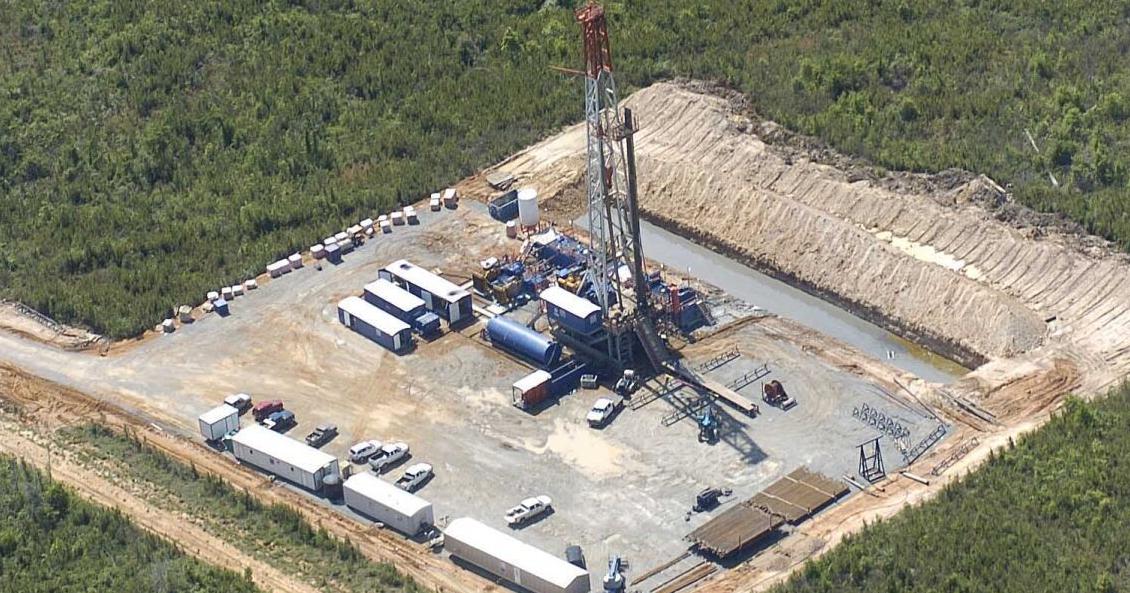
The Haynesville Shale includes roughly 17 parishes and counties in northwest Louisiana and east Texas. It has been called one of the largest shale plays in the U.S. As recently as 2021, the U.S. Energy Information Administration estimated the shale play contained roughly 56.2 trillion cubic feet of “technically recoverable” natural gas.
DeMis pulled public EIA information from the north Texas Barnett and the northern Arkansas Fayetteville shale plays to chart the future of Haynesville.
“These great big shale plays, they get to a plateau, and they have about three years of plateau, three or four years of plateau, and then they just start to decline. And then once they start the decline, they decline quite quickly,” DeMis said. “In five years, the Barnett’s down 44%, and in three years, the Fayetteville is down 40%.”
The general public first began hearing in detail about the Haynesville Shale around 2008 when the current natural gas boom began, but the formation itself is millions of years old, born in the Earth’s Jurassic period.
Geologists had known for years about the wealth of gas contained in tiny pores in rock at 10,000 to 14,000 feet, but new technology that allowed horizontal drilling and hydraulic fracturing created a way to both get to the gas and remove it.
The Haynesville, based on the data DeMis has accumulated, peaked in July 2023 and has been in a plateau for three years. By 2030, DeMis said gas volume will drop between 5 billion and 9 billion cubic feet per day. According to the EIA, the Haynesville Shale produced roughly 14.9 billion cubic feet per day in 2025.
He said some of the drop in production has been caused by producers throttling back volume because of low prices. Low prices may be good for consumers but can put energy producers out of business.
Natural gas prices at the Henry Hub hit $1.61 per 1,000 cubic feet, which DeMis said “was the cheapest molecule of energy since the time of the pharaohs.”
“And I’m not saying this to be poetical or to be flowery. I mean literally, that unit of energy was so low, so cheap, it was cheaper than buying oats and feeding them to your oxen,” he said.
Many Haynesville operators use $2.50 per Mcf, or thousand cubic feet, as a break-even, and $5, they say, will “turn on the tap.”
Historically, when prices have risen, companies have rushed to increase drilling. DeMis believes some of that bullishness is gone even though there continues to be interest in both proven and unproven Haynesville locations.
“I think all those companies are going to be carefully scrutinizing how much cash flow do we need, how much inventory do we have left to come up with the right amount of drilling for their company,” he said.
“I don’t think we’re going to see ‘drill, baby drill,’ and that’s not a bad thing, because if ‘drill, baby drill,’ means you drill yourself into unprofitability and you go Chapter 11 or Chapter 9, that’s not such a great idea.”
Without activity, mineral leases will revert to the landowner, so some drilling is done simply to secure the lease, said DeMis. That is called “held by production.” There are also “drilled, uncompleted” wells that have not yet been fracked, which would bring them into production.
DeMis predicts data centers, LNG exports and unknowns regarding the consequences of the war in Iran will affect natural gas prices, and the new finds in Texas’ Western Haynesville won’t come online fast enough to depress prices. Utilizing the large amounts of gas from west Texas’ Permian Basin will likewise be hampered by lack of pipeline capacity to get it to market.
He said prices will start to “firm up” in 18 months, and in the “intermediate term, we are going to see … strong price rises.” That will be due, he said, to timing and inability to get product to the user.
“Prices may climb up to $7, $8 and that will ultimately spur more discoveries, more drilling, and more product being brought into the market. But I think we’re going to have a mismatch between more demand than we have supply in the later part of this decade,” he said.