
On a recent weekday, construction workers were installing fiber optic lines beneath the plywood subfloors in a 1960s-era building at the corner of St. Charles and Louisiana avenues.
The crew was hustling to complete the renovation of a former medical building that soon will house New Orleans businessman Chris Reade’s new venture, a coworking space named The 1538, which will feature private offices, shared desks and a large common area with comfortable seating, a stocked bar and plenty of light from floor-to-ceiling windows.
Reade is counting on demand for these offices and amenities — and the ample parking beneath the raised one-story structure — to make his $1.8 million purchase of the property and an extensive renovation pay off.
Lately, he’s not the only one in Louisiana making the same bet.
The 20-year-old coworking industry, which experienced major growth in the late 2010s before a pandemic slowdown, is ascendant again — and evidence can be seen across the state.
Last week, The Shop at the CAC announced plans to open a second location in downtown New Orleans. Independent operators have recently opened new facilities in Baton Rouge and Lafayette. And International Workplace Group, a global provider of short-term offices, coworking spaces and meeting rooms, is expanding its operations in the state.

Tech entrepreneur and investor Chris Reade holds a sample of flooring material in the glass-walled breezeway of a building at 1538 Louisiana Avenue on Monday, Feb. 23, 2026. He’s overseeing a renovation that will turn the former medical building into a stylish and comfortable shared workspace.
Two decades of trial and error in the industry have helped owners and operators calibrate their offerings based on what remote workers, freelancers and entrepreneurs are looking for. And now big companies like Amazon and JPMorgan Chase are buying into the coworking concept as well.
Last month, the Wall Street Journal reported that coworking has rebounded from its pandemic downturn, with its U.S. footprint growing from 115.6 million square feet three years ago to 158.3 million square feet. Coworking businesses now occupy 2.2% of U.S. office space, up from 1.7% three years ago.
For Reade, who previously owned a coworking facility in the Bywater called Club Discovery, this new project is a chance to put an empty building back into commerce and, he hopes, bring in more income than if he rented to just one tenant.
As the leader of a mostly remote software team, he’s also looking forward to the company.
A woman walks past a 1960s-style office building at 1538 Louisiana Avenue on Tuesday, Feb. 24 in New Orleans, La. A New Orleans businessman is converted the site into a coworking facility called The 1538 and due to open later this year.
“I wanted an office again,” Reade said. “I thought I could work from home after selling the last building, but I couldn’t. It’ll be nice to have a lot of people around.”
Co-working turns 20
The modern coworking industry traces its roots back to the early 2000s in San Francisco, where a software engineer opened what is considered one of the prototypes of the modern shared office space. Copycats followed, offering small offices or desks that users could rent for a fee that also enabled them to access common areas, kitchens, conference rooms and basic business services.
Regus employees meet at the company’s Place St. Charles location on Tuesday, Feb. 24, 2026. Counterclockwise from left: Daphene Jean Pierre, Robyn Wulff and Atika Booze
Furnished and staffed executive offices that could be leased for short periods had been a thing for years, but they didn’t come with the amenities and programming designed to support the freedom of freelance with the community of a traditional office.
The idea spread across the U.S. and Europe, with the high-profile company WeWork leading the charge. But the pandemic disrupted the office market, and the coworking industry stumbled as customers canceled contracts and operators struggled with long-term leases.
WeWork itself went from poster child to cautionary tale. In 2018, the company bragged that it occupied more Manhattan real estate than anyone else. Five years later, its leaders declared bankruptcy.
The controversial startup never made it to New Orleans, but the city had its own coworking pioneer: Launch Pad, which opened in 2009 in the Warehouse District and for a few years “served as the heartbeat of our city’s first tech generation,” according to New Orleans tech executive Patrick Comer. Launch Pad moved to another location in 2017 and closed in 2020.
In the years since, as employers and employees have embraced remote and hybrid work, coworking spaces are finding what appears to be a more stable niche.
“People thought we could all work from home, and we were silly to think we needed offices,” said Ann Olsen, director of co-working at The Shop. “Then we started to understand all the points of creativity and sharing that you’re missing by working in your kitchen, and a new understanding of the value of coworking has emerged.”
In New Orleans, there are heirs to what Launch Pad started.
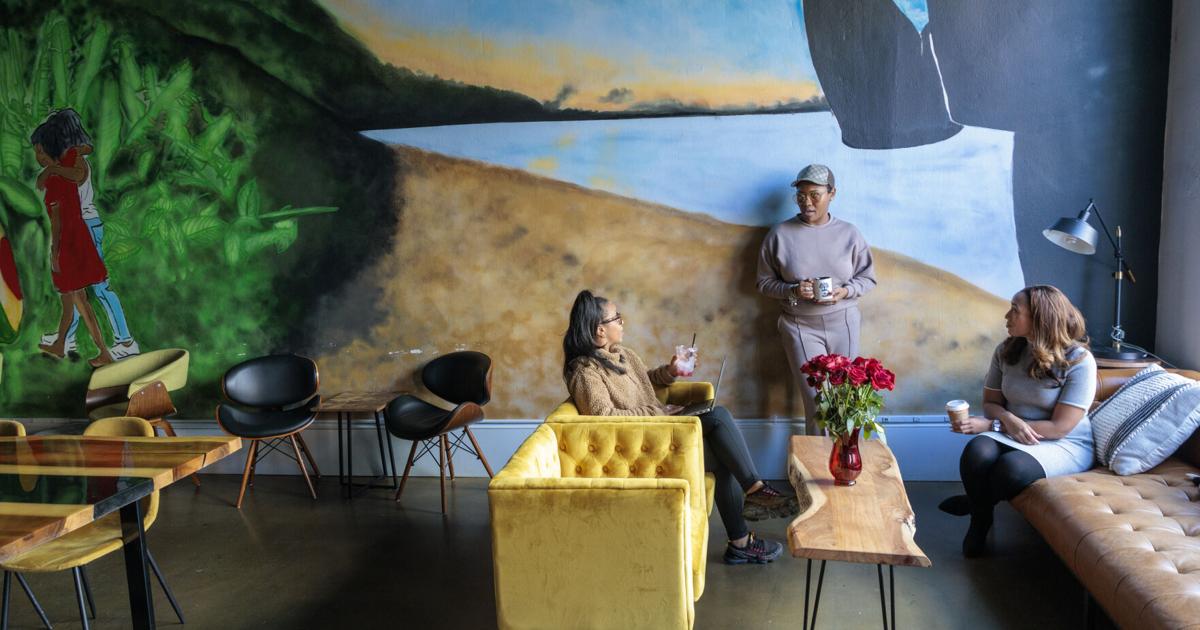
The Shop, which debuted in 2017, has 500 or so members, including the growing software company Copado. Club Discovery, which opened in 2019, was rechristened last year as a coworking space for nonprofits in the Bywater, where another workspace called The Warehouse has amassed more than 200 members. The Green House in Mid-City offers lush environments inside and out, and Maroon on St. Charles offers perks and support for entrepreneurs along with the advantage of being just on the edge of downtown.
The Rigs coworking space at The Batture has about a dozen private offices, some with views of the Mississippi River, and nearly 50 members who share desks and other amenities. The facility was developed by Ben + Burka commercial real estate firm, which purchased former industrial site on the riverfront and is converting it for multiple purposes. (Photo: Sara Essex)
Open since 2024, The Rigs at the Batture has a dozen or so private offices plus shared workspace in two renovated structures that were one part of active oil rigs in the Gulf. Members have views of the Mississippi River and access to ample outdoor space.
Creating communities and generating income
Reade isn’t the only entrepreneur in Louisiana combining coworking facilities with his own office space.
In Baton Rouge, tech entrepreneur Matt Adler opened Studio Cowork last year to make additional income and have a lively place to work.
“I feel most productive when I have other people to talk to,” he said.
He gave his rented space in the city’s downtown a face-lift to make it more inviting and comfortable. Now, it features shared space, one private office, semi-private desks, lounge areas and a creative studio space with photography, video and podcast studio.
“Someone might come in on a weekday and make all the content they need for the next couple of weeks,” he said.
Studio Cowork debuted in downtown Baton Rouge last year.
His business joins Creative Bloc, Spaces, The Brewery and other active coworking concepts in the capital region.
In Lafayette, marketing and branding veteran Jaci Russo opened a coworking hub last year in her downtown building. She sells access by the day, week, month or year to shared desks and private offices as she competes with other Lafayette options, including Trendy Spaces.
“We’ve already paid for the remodel, and now it’s a profit center, even with new places opening constantly,” Russo said.
Jaci Russo, founder of Downtown Workspace in Lafayette, said she wants to serve ‘entrepreneurs, freelancers, and creatives.’ Russo opened the doors to the coworking space last year in the same office where she runs her branding and marketing company and a professional education company.
In New Orleans, attorney Jade Brown-Russell is trying new things this year to grow Maroon, her 4-year-old coworking space near the Pontchartrain Expressway.
Her offerings include a podcast area, several lounges and a conference room. She rents private offices to clients that include a barber, whose customers add to Maroon’s foot traffic. And the space hosts meetings, parties and special events.
This year, Brown-Russell launched Kinfolk Coffee, a coffee shop that’s reserved for Maroon members now but will soon serve the public.
“People are looking for social spaces,” Brown-Russell said. “If they’re going to come and sit at our space for work, we want to make sure they don’t have to leave to find coffee or food.”
Not just ‘beer pong, happy hours’
The independent ventures are joined by options from national and international companies, including Regus, a brand of the International Workplace Group that opened several new locations in Louisiana last year and now has 15 total in the state.
To industry vets, the investment demonstrates that co-working is more than a trend — and it has room to grow.
Barber Dameon “Yoc” Washington, right, with Fire Images Hair Studio, trims Bruce Calway as Oliver Celestin Jr. sits near a window waiting for his turn inside the Maroon workspace on St. Charles Avenue in New Orleans on Monday, February 23, 2026. (Photo by Chris Granger, The Times-Picayune)
“People think it’s just for startups interested in beer pong and crazy happy hours, but that’s not true,” said Olsen. “Companies that have been established for over 100 years are embracing it.”
Mike Siegel, president of Corporate Realty, who focused much of his career on the traditional office market, believes co-working is here to stay.
“It’s a way to quickly get space without a long design and construction process, and without having to deal with a lease negotiation or order furniture,” he said. “Office building owners are now looking at whether they do it themselves or bring in third parties to lease to and let them do it.”