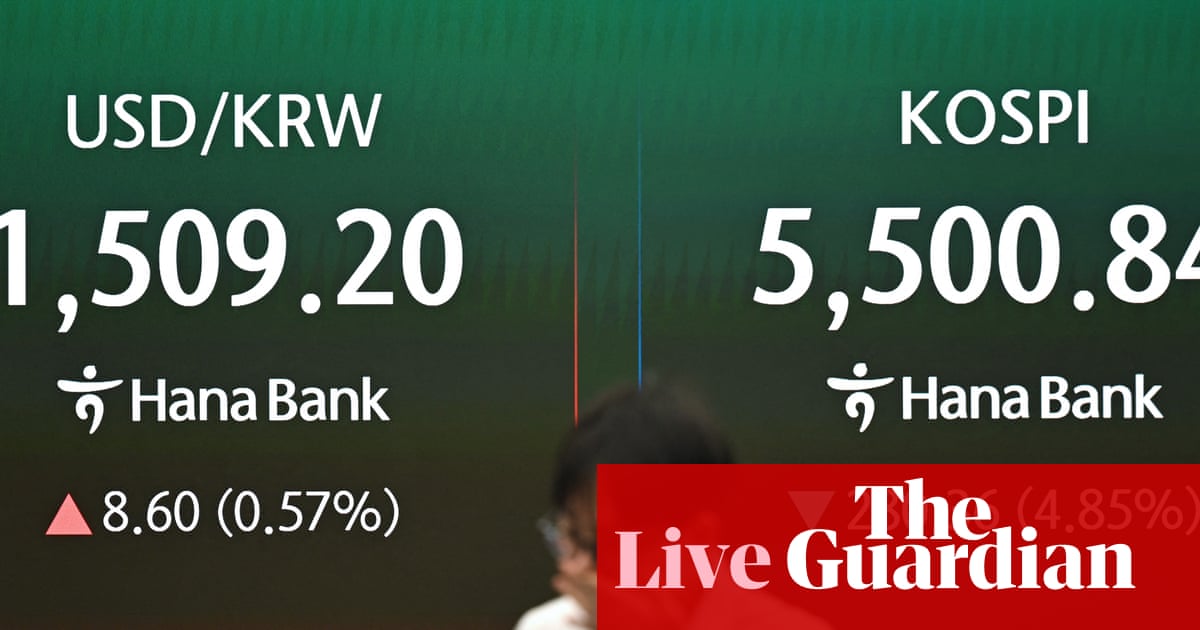
Asia-Pacific markets hit by Iran ultimatum
Donald Trump’s threat to ‘obliterate’ Iran’s power plants unless the strait of Hormuz reopens is hitting global stock markets today.
A wave of selling is sweeping through Asia-Pacific markets at the start of the week. Japan’s Nikkei has dropped by 3.4% in afternoon trading, China’s CSI 300 has lost 2.8%, and South Korea’s KOSPI index has slumped by 6.5%.
Trump’s ultimatum, and Tehran’s threat to “irreversibly destroy” essential infrastructure across the Middle East in response, means the war is entering a new phase of escalation, analysts warn.
Markets are finally starting to wake up to the gravity of the potential for long-term impact on energy markets, reports Neil Wilson, investor strategist at Saxo UK.
This is an escalatory doom loop – or ‘escalation trap’ with currently no realistic off-ramp. Neither side has an incentive to back down as the costs of doing so are increasing day by day. Each side thinks pushing harder will force the other to back down.
As well as fears of escalation in the conflict, investors are also bracing for rises in interest rates this year, with central banks under pressure to fight a rise in inflation.
Key events
The oil is relatively calm this morning, so far anyway.
Brent crude is up 1.2% at $113.34 a barrel, some way below the record highs of nearly $120/barrel seen earlier this month.
Ipek Ozkardeskaya, senior analyst at Swissquote, says:
Oil prices are higher this morning as risks build that regional energy infrastructure could suffer further damage, potentially triggering a larger and more prolonged energy shock.
The IEA’s Fatih Birol warned last week that this conflict could be the “greatest threat to global energy in history”—which can also be read as a reminder of the urgency to accelerate alternative energy efforts.
Iran war energy crisis equal to 70s twin oil shocks and fallout from Ukraine war, says IEA chief
The global energy crisis caused by the war in Iran is equivalent to the combined force of the twin oil shocks of the 1970s and the fallout of Russia’s invasion of Ukraine, the head of the International Energy Agency has warned.
Fatih Birol, the IEA’s executive director, said the growing fallout could be seriously compounded through interuptions to the “vital arteries of the global economy”, including petrochemicals, fertilisers, sulfur and helium.
Speaking at the National Press Club of Australia in Canberra on Monday, Birol said the depth of the problems in energy markets caused by American and Israeli bombings in Iran, and the closure of the strategic strait of Hormuz, had not initally been properly understood by world leaders.
US dollar up
The US dollar is rising today, as investors seek out a safe haven.
With risk appetite curbed by the escalating retaliatory threats in the Middle East conflict, the dollar’s reputation as a safe-haven asset meant it’s in demand.
The dollar index, which measures the greenback against a basket of currencies, is up 0.2%, while the pound has lost half a cent to $1.329.
Gold price dropping
The gold price is sliding fast today too.
Spot gold has dropped by 4.6% today to $4,280 an ounce, hitting a nearly four-month low.
Gold is suffering from rising expectations of higher global interest rates, traders say.
Tim Waterer, chief market analyst at KCM Trade, explained:
“With the Iranian conflict into its fourth week, and oil prices hanging around the $100 level, expectations have pivoted from rate cuts to potential rate hikes, which have tarnished gold’s appeal from a yield point of view.”
Asia-Pacific markets hit by Iran ultimatum
Donald Trump’s threat to ‘obliterate’ Iran’s power plants unless the strait of Hormuz reopens is hitting global stock markets today.
A wave of selling is sweeping through Asia-Pacific markets at the start of the week. Japan’s Nikkei has dropped by 3.4% in afternoon trading, China’s CSI 300 has lost 2.8%, and South Korea’s KOSPI index has slumped by 6.5%.
Trump’s ultimatum, and Tehran’s threat to “irreversibly destroy” essential infrastructure across the Middle East in response, means the war is entering a new phase of escalation, analysts warn.
Markets are finally starting to wake up to the gravity of the potential for long-term impact on energy markets, reports Neil Wilson, investor strategist at Saxo UK.
This is an escalatory doom loop – or ‘escalation trap’ with currently no realistic off-ramp. Neither side has an incentive to back down as the costs of doing so are increasing day by day. Each side thinks pushing harder will force the other to back down.
As well as fears of escalation in the conflict, investors are also bracing for rises in interest rates this year, with central banks under pressure to fight a rise in inflation.
Introduction: Iran war to hit growth and push up prices
Good morning, and welcome to our rolling coverage of business, the financial markets and the world economy.
Growth across the UK economy is expected to almost halve this year, as the Iran war drives up energy prices.
New forecasts from KPMG this morning show that UK GDP is only expected to increase by 0.7% in 2026, down from 1.5% in 2025. Back in December, KPMG had forecast growth would slow by less, to 1% this year.
The energy price shock rippling through the UK economy will push up inflation, weigh on spending and delay interest rate cuts, they predict.
KPMG also forecast a slowdown in investment, and. a rise in the unemployment rate – to 5.3% this year and next, up from 4.8% in 2025.
Yael Selfin, chief economist at KPMG UK, said:
“The outlook for growth in 2026 has taken a hit from the impact of higher energy prices, a cooling labour market and weak household spending.
“The weaker growth outlook coupled with growing cost pressures will likely see firms scale back any investment plans over the coming year. Consumers could also cut back on discretionary spending to offset the squeeze from higher prices.
“With inflation likely to re-accelerate from this summer, the Bank of England will be reluctant to move quickly on rates, meaning households and businesses will face higher borrowing costs for longer, even as the economy slows.”
With fears of a new cost of living crisis growing, Andrew Bailey, the Bank of England governor, is due to meet Keir Starmer and senior ministers later today.
The TUC are calling for an emergency taskforce that would bring employers, unions and the government together to help protect the UK from the economic fallout of the US-Iranian conflict.