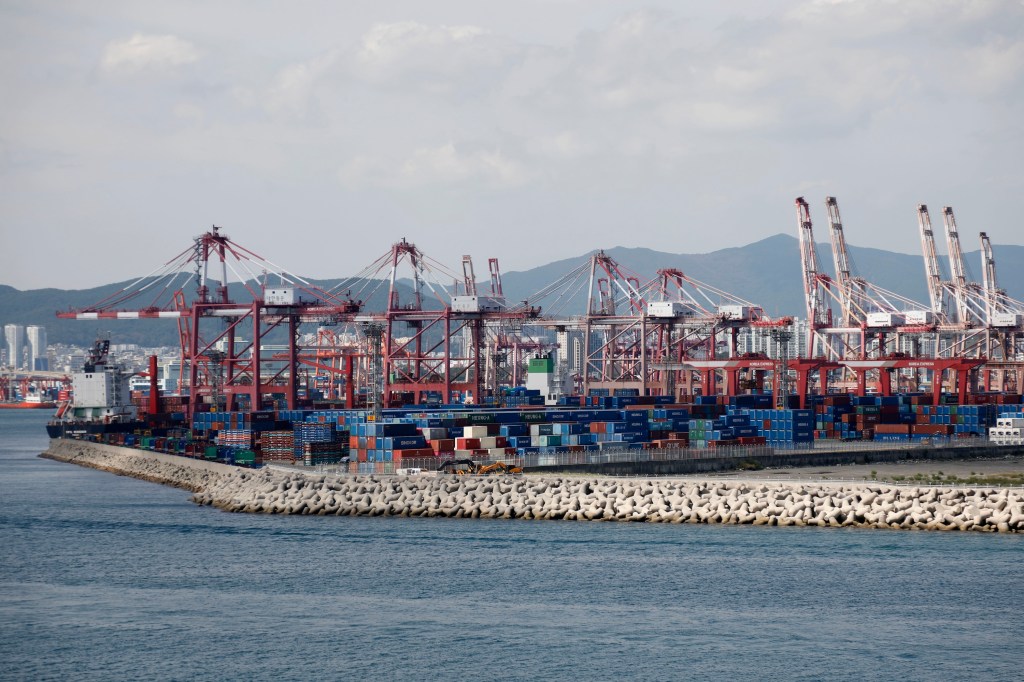
South Korea is investing 4.5 trillion Korean won ($3.1 billion) to expand its global ports and logistics network as the country aims to further bolster its export economy.
The country’s ocean and fisheries ministry made the announcement Dec. 16, referring to the investment as a supply chain “securing strategy” amid global trade instability due to tariffs, the Russia-Ukraine War and the Red Sea crisis.
Despite South Korea‘s high dependence on trade, the ministry described its overseas investment in the logistics sector as “lacking” in a statement.
Through the next decade, the government will prioritize investment in storage and handling facilities at major ports, including logistics warehouses and container yards. The expansion efforts would take place in 11 markets including the U.S., Canada, Mexico, Vietnam, Indonesia, Malaysia, India, Thailand, Germany, Poland and Hungary.
While South Korean companies currently operate nine warehouses and container yards across global ports, the country wants to expand that number to 40 by 2030, and then to 60 by 2035. Among the overseas logistics centers operated by Korea’s 15 major logistics companies, only 8.8 percent are owned, and most are leased, the ministry said.
Major ports such as Los Angeles, Long Beach and New York/New Jersey in the U.S.; Ho Chi Minh City and Hai Phong in Vietnam; Jakarta in Indonesia; and Port Klang in Malaysia, have been selected as strategic investment targets.
The markets were chosen based on the volume of import and export trade with South Korea and overseas direct investment over the past 10 years.
According to a notice released by the ministry, the country aims to improve loading and unloading at facilities and better support inland transportation networks while expanding its port presence.
The government-backed Korea Ocean Business Corporation (KOBC), which provides funding to Korean shipping companies, will help push the investment forward, in tandem with several port authorities and other organizations.
Additionally, the country wants to secure investment in 10 overseas port terminals by 2030, before increasing the total to 15 five years later.
South Korean companies currently have a stake in seven overseas terminals. Leading ocean carrier Hyundai Merchant Marine (HMM) fully or partly owns six of them, including hubs at U.S. ports in Long Beach and Tacoma. HMM also has stakes in terminals in Singapore and the Netherlands’ Port of Rotterdam; as well as in Algeciras, Spain and Kaohsiung, Taiwan.
The ministry says the container terminal stakes are “directly linked to the competitiveness” of the country’s shipping industry. Prior to the bankruptcy of South Korean ocean carrier Hanjin Shipping in 2017, the country’s business had owned shares in 12 overseas terminals.
To develop the container terminals and identify investment opportunities, the Korean government will team up with the KOBC, as well as national shipping companies like HMM and other operators to form a container terminal securing council.
The public-private partnership plans to establish a roughly $700 million global container terminal investment fund to help the country secure terminal operating rights in the future.
Funds available through KOBC’s existing global supply chain investment fund will double from $700 million to about $1.4 billion to help small- and medium-sized logistics companies expand overseas.
KOBC will also oversee funding to modernize South Korea’s domestic terminals, operating a $700 million fund to help construct eco-friendly fuel storage facilities in ports, as well as a $350 million fund to support the deployment of automated cargo-handling equipment.
And while South Korea says it currently hosts two of the top 50 major logistics companies worldwide, the ministry wants to increase that number to three by 2030, and then again to five in 2035.
“In an uncertain logistics environment, securing overseas logistics bases is a key task for stabilizing the supply chain,” said Kim Seong-beom, the South Korean government’s vice minister of oceans and fisheries, in a statement. “We will strengthen our logistics competitiveness and firmly support the export-import economy.”
South Korea’s total exports reached a record high in 2025, surpassing $700 billion for the year on Monday, the country’s trade ministry revealed. The numbers have already surpassed last year’s all-time high of $683.6 billion. Data for the full month of December will be reported on Thursday.
The planned logistics investment follows a more expansive $150 billion investment in U.S. shipbuilding as part of the countries’ new trade deal agreed upon in November.
South Korea remains the second-largest shipbuilder worldwide, according to data from maritime consultancy Clarksons. While China-made ships accounted for 34.8 percent of the global maritime fleet as of June, South Korean vessels comprised 30.9 percent.
Under its deal with the U.S., South Korean shipbuilding giants including Hanwha Group, HD Hyundai and Samsung Heavy Industries will support the construction of U.S. Navy vessels via direct and indirect partnerships.