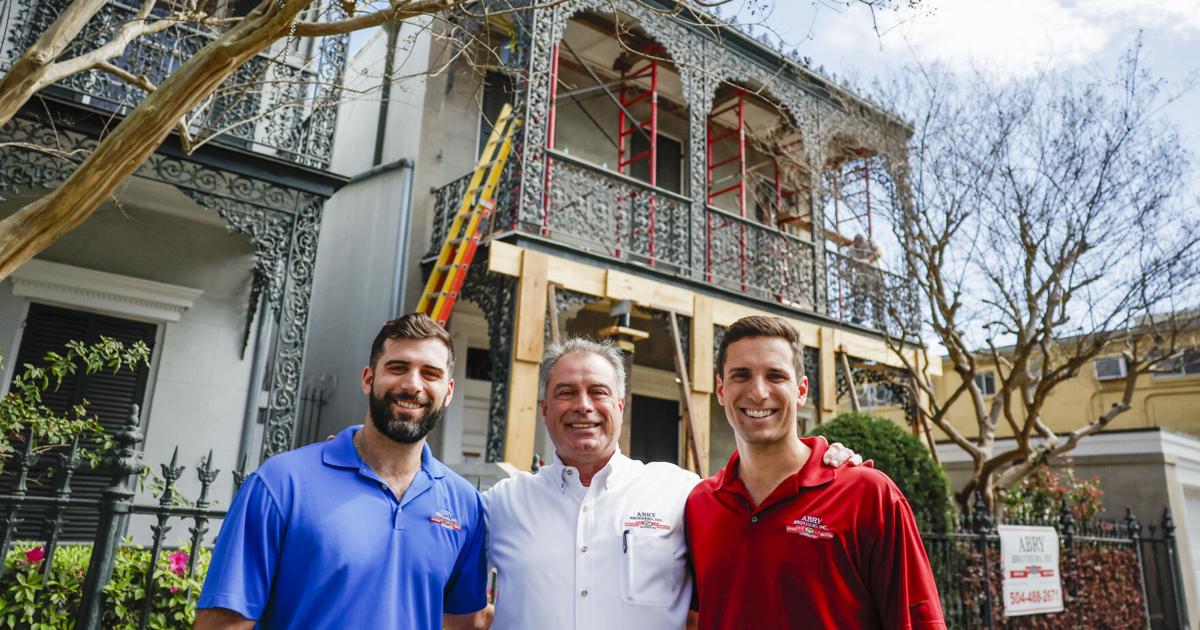
For more than 180 years, one family has been lifting, leveling and relocating buildings around the New Orleans area.
Abry Brothers completes about 150 projects every year, almost entirely in the Greater New Orleans area. They range from $1,500 repairs completed in a single day to six-figure commercial shoring jobs that can take months or more.
In a place where the ground keeps sinking and the water keeps rising, there’s a steady demand for companies with expertise at raising houses, repairing foundations and shoring up collapsing structures, which has helped keep Abry Brothers in business for generations.
“It’s kind of like the undertaker and the corner bar,” said President and CEO Greg Abry, whose great-great-great-great-grandfather founded the company he now runs with his sons Patrick and Thomas. “There’s always a need for us.”
At any given time, Abry Brothers has 25 to 30 workers spread across six or seven active work sites, with another eight employees in its offices.
In addition to those sites, it’ll have up to 20 other projects in progress — generally awaiting other contractors to finish work or secure permits.
Following its 2021 purchase by developer Curtis Doucette, the historic Dew Drop Inn was renovated into a hotel, music venue, restaurant and bar from July 2022 to late 2023 ahead of a formal reopening in March 2024.
Having worked on such notable structures as Warren Easton Charter High School on Canal Street, Central Grocery on Decatur Street and the Dew Drop Inn on Lasalle Street, Abry Brothers is no stranger to historic preservation, even when its worksites don’t have landmark protections.
“The vast majority of what we work on, I would consider historic,” said Patrick Abry. “Because they’ve been here long enough for the foundation to fail.”
Changing gears
Abry Brothers dates back to 1832, when John Abry brought along his house-moving expertise when he immigrated to New Orleans from Frankfurt, Germany.
In the nearly two centuries since, the Bayou St. John-based business has evolved alongside the city whose foundations it’s helped form.

CEO Greg Abry points to a photograph on the wall of the office of Abry Brothers Inc. depicting mules used to move a home from Long Vue Gardens to Metairie Road in New Orleans, Wednesday, March 4, 2026. (Photo by Sophia Germer, The Times-Picayune)
In New Orleans’ early days, the materials it took to build houses were expensive, but labor was cheap, so physically moving houses was easier and more common than one might think, Greg Abry said.
That situation reversed in the post-World War II years, when materials were cheap and labor got a lot more expensive.
And as relocating houses became more challenging, hindered by modern innovations like fiber optic wires and protections for oak trees, Abry Brothers pivoted toward repairing foundations, leveling houses and shoring up collapsing structures.
Today, about 80% of its job sites are private homes, though commercial and residential projects comprise roughly equal parts of Abry Brothers’ more than $5 million in annual revenue.
Pedestrians walk past a home getting shoring work done on Esplanade Avenue in New Orleans, Wednesday, March 4, 2026. (Photo by Sophia Germer, The Times-Picayune)
Lego bricks
Over the decades, the company’s methods have evolved alongside changing building techniques.
In older areas of the city developed before the flood protection system, like the French Quarter and Garden District, houses were originally raised off the ground. Shoring in such cases involves leveling the structure on top of the vertical supports, called piers, and replacing rotted horizontal supports, which are called sills.
Homes in neighborhoods built out in the mid-20th century, such as Metairie and Lakeview, were built on concrete slabs, which couldn’t be lifted using the same jacks.
“When you try to lift the slab house, all your jack and stuff goes in the ground and the house doesn’t come up,” Greg Abry said. “You’ve got to develop something that’s big enough that can pick up the load to actually cause the the house to lift and level. And that’s what my father did.”
Abry Brothers Inc works on the shoring of a home on Esplanade Avenue in New Orleans, Wednesday, March 4, 2026. (Photo by Sophia Germer, The Times-Picayune)
Instead of using a traditional pile driver to hammer beams into the ground, Abry Brothers uses hydraulic jacks, relying on the weight of the building to push down the piling.
The company uses precast concrete pile sections, which are stacked one on top of the other and pushed into the ground until they reach a layer of soil stable enough to support — sometimes as far as 80 feet underground.
“It’s like Lego bricks,” Thomas Abry said. “You put a Lego brick on the dirt, you put a jack on top, you push it down until the top is still poking up, and you put another Lego brick on, you push that down.”
Disruptions and pressures
While the New Orleans terrain provides an endless supply of potential customers for Abry Brothers’ services, market pressures are making it increasingly difficult to do business.
Homeowners insurance excludes foundation repairs and leveling — unless they result from a covered event like a car crash or fallen tree — meaning that most Abry Brothers tabs are not picked up by insurers. At the same time, the company’s own insurance has skyrocketed, rising by at least 300% over the past five years.
“That’s our biggest hurdle, crazily enough,” Thomas Abry said.
Disruptions to federal flood mitigation grants associated with President Donald Trump’s efforts to shift disaster response away from the Federal Emergency Management Agency to state governments — and multiple government shutdowns — have led to more complications.
Abry Brothers Inc sign photographed on Orleans Avenue in New Orleans, Wednesday, March 4, 2026. (Photo by Sophia Germer, The Times-Picayune)
As of early March, Abry Brothers had at least 20 contracts worth about $2.5 million tied up due to uncertainty involving FEMA grants. That has led the Abrys to postpone or hesitate taking on new projects, cutting into the pipeline for the grant-supported work that usually provides up to 25% of its company’s business.
Changes to the way flood insurance rates are calculated — the Risk Rating 2.0 system — have also thrown a wrench into the company’s business.
Under the old flood map system, taking part in a grant program to raise up a New Orleans house could make financial sense for homeowners because they could reasonably expect to recoup that investment through savings on flood insurance premiums.
“But when I’m working with these programs and elevating people’s houses, sometimes the (flood) insurance that they get is more expensive after the home is elevated than before it’s elevated,” Thomas Abry said. “How does this even make sense? There’s no rhyme or reason.”
Looking to the future
In recent years, private equity firms have approached the Abry Brothers on a regular basis about selling the company. The Abrys say it would take an astronomical bid to convince them to part ways with their company after nearly 200 years.
“The way we run this business today, somebody would come in and say, ‘Man, y’all are crazy. Y’all get out of here, I’m going to set this thing up to maximize what we do and efficiency,'” Greg Abry said. “That’s not that important to us.”
Patrick, Greg and Thomas Abry pose with shoring equipment at Abry Brothers Inc in New Orleans, Wednesday, March 4, 2026. (Photo by Sophia Germer, The Times-Picayune)
Instead, he intends to pass the business to his sons as the family has done for generations.
Long-term, the biggest threat to the company’s survival, Abry said, is not drought, storms, or subsidence. Rather, it’s a declining population and economic stagnation.
“If New Orleans does well, we do well, because people fix their houses up,” he said. “But if the city of New Orleans continues to lose population, it creates a vacuum.”