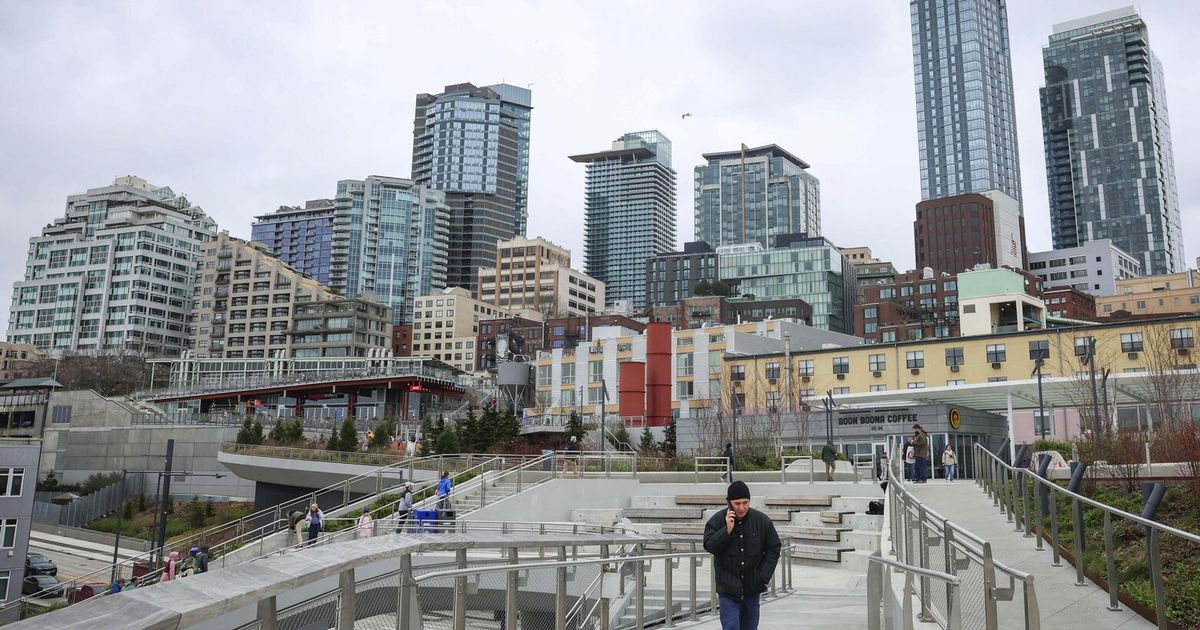
Six years after COVID-19 shuttered downtown, Seattle’s most economically important neighborhood is at a complicated tipping point.
Recovery remains uneven. Momentum from strong residential growth and tourist traffic, and excitement over this summer’s World Cup events, is undercut by record office vacancies and fears that city taxes are pushing jobs to Bellevue.
Yet, oddly, the politics of downtown recovery seem less fractured than in recent years, judging by the pragmatic, even conciliatory tone at the Downtown Seattle Association’s annual State of Downtown meeting Wednesday.
In one particularly striking moment, Seattle Mayor Katie Wilson, a socialist who promised to raise “progressive revenue,” drew sustained applause from a roomful of business executives by acknowledging that Seattle’s tax code puts the city at a competitive disadvantage.
“It is not ideal for our tax environment for businesses to be wildly out of step with neighboring jurisdictions,” Wilson said.
“I will be keeping that in mind as we look at options,” she continued, adding that “I anticipate that we will be doing some significant reprioritization, otherwise known as cuts.”
Wilson’s remarks, which appear to break with some of the city’s previous progressive leadership, come amid a business backlash over rising taxes.
As Wilson spoke in the Seattle Convention Center downtown, state lawmakers in Olympia were just hours from final approval of a new 9.9% tax on high earners.
That comes on top of increases in 2025 in city taxes on sales, property and larger businesses enacted last year under then-Mayor Bruce Harrell.
The result has been a chorus of business leaders threatening to leave the city, and now the state, because of taxes.
The day before Wilson spoke, one of Washington’s richest residents — Starbucks founder and former Seattle Sonics owner Howard Schultz — announced his departure to Miami.
“It is our hope that Washington will remain a place for business and entrepreneurship to thrive, creating essential opportunity for those in Seattle and the surrounding areas,” Schultz wrote in a LinkedIn post, in a comment taken by some as a complaint about the new income tax.
Wilson didn’t elaborate Wednesday on what she meant by “significant reprioritization,” and her office hadn’t responded Thursday to a request for specifics.
But last month, Wilson directed all city departments to develop plans for cutting their budget by 5% to 10% as the new mayor gears up for what is widely expected to be a very difficult budgeting process later this year.
She has made other overtures to the business community, including having Jon Scholes, Downtown Seattle Association CEO, serve on her transition team.
For some observers, this all may seem like a significant shift for a young politician whose first high-profile public act after winning the election — joining a union protest against Starbucks and urging Seattleites not to patronize the company — may not have endeared her to Seattle business leaders.
But Wilson isn’t the only progressive signaling a more pro-business stance.
At Wednesday’s gathering, King County Executive Girmay Zahilay echoed Wilson’s pragmatic tone and themes.
Like Wilson, Zahilay explicitly acknowledged the impact homelessness and crime have had on businesses, especially in downtown.
Zahilay touted plans to boost accountability and transparency in county government, and to reevaluate the county’s spending and programs. “That means, for the first time, we’re not just going to roll over 90 or 95% of our budget from one biennium to the next,” Zahilay said.
“Instead, we’re going to build our budget from the ground up, identifying the programs and the strategies that are most effective.”
Some in the business community think progressives like Wilson and Zahilay are trying to strike a delicate balance between a largely progressive electorate and a business community impatient with progressive policies.
“I think what you have … are two very smart progressive leaders that recognize that the last time that the progressive left was in charge of local governance … the outcomes and results weren’t all that great,” the Downtown Seattle Association’s Scholes said in an interview Thursday.
Downtown business leaders are quick to insist they’re not pushing for a wholesale sweep of Seattle’s deep progressive traditions.
In explaining why downtowns like Seattle’s survived the pandemic, Scholes pointed to the enduring human need not only for places to work, play and celebrate, but also places “to come to protest, to come to mourn.”
But breaking with some progressive traditions was very much the theme at the State of Downtown, which has become one of the business community’s biggest events.
The keynote speaker was Derek Thompson, co-author with Ezra Klein of the bestselling book “Abundance,” which sees blue-state problems like too-costly housing partly as the result of progressive policies that slow the building of homes and public infrastructure.
In particular, progressive Democrats need to step away from their decades-old tendency “to associate success with how much spending they authorized, rather than how much they actually built with that spending,” Thompson said.
Thompson commended Seattle for what he called its nation-leading efforts to add housing units in dense areas. But he warned that the city can’t “live on its laurels,” and must keep looking for new ways to increase density.
He also cautioned progressives everywhere from letting their opposition to policies of the Trump administration turn into a reflexive defense of all past progressive policies.
Thompson insists he and other abundance advocates “have no illusions about the dangers, the downsides, of Donald Trump and his Republican Party.”
But at the same time, he warned, “the Democratic Party, in response, cannot allow the forces of negative polarization to turn them into the party that simply reflexively defends the status quo at every turn … refusing to reform institutions that have lost the public’s trust.”
For many in the downtown business community, a priority for reform is the city’s tax structure.
One problem, says Scholes and others, is that Seattle’s rising reliance on property taxes has shifted costs to small businesses and individuals as office vacancies downtown have reduced valuations and tax revenues collected in the downtown core.
Scholes thinks the city’s higher taxes also make vacancy worse, dissuading employers from opening or keeping offices downtown.
Although other factors, such as remote work and shifts in the tech sector, have played a part, Scholes notes that those factors haven’t stopped Bellevue filling offices.
A Downtown Seattle Association analysis of cellphone data from Placer.ai found an increase in the number of workers in downtown Bellevue since 2023, but a slight decrease in downtown Seattle.
“I’m not hanging all of our challenges around employment growth on the tax structure,” Scholes said Thursday.
But “we have a pretty good control group across the lake to look at that’s dealing with those same set of variables around hybrid work and tech companies shifting investment and some tech layoffs,” he added, referring to Bellevue. “But they’re going one direction. We’re going the other.”