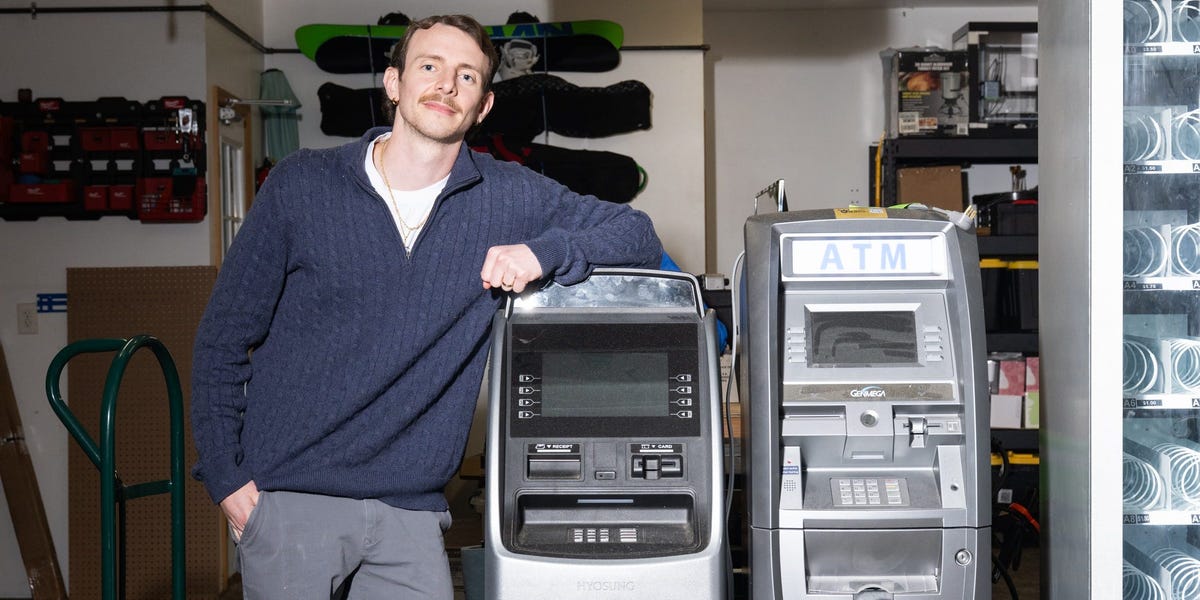
When William Butterton discovered ATM placement on Instagram and TikTok, the side hustle seemed relatively low stakes.
“The more I looked into it, the more I was like, ‘OK, there’s really no risk in trying this, outside that original financial obligation of $2,500 to buy the ATM,'” the full-time electrical engineer told Business Insider.
Butterton, who started looking into side hustles after his first kid was born, is skeptical of the term “passive income.” But placing and reloading ATMs has turned out to be the closest thing to passive he’s found.
“You’re only there for 10 minutes to load it up, and then you’re on your way,” he said. “It’s essentially your employer that you don’t have to pay.”
He and his business partner started Viking Vendors in Silverdale, Washington, in 2022. As of March 2026, they have five ATMs placed and three vending machines. Vending machines are less passive, he said, as transporting and loading food and drinks is more cumbersome. They split about $1,500 in monthly profit, according to terminal activity summaries viewed by BI.
The income is nothing flashy, he said, but it helps cover expenses like a car payment and day care while leaving him time with his family and to pursue other side projects.
Here’s how Butterton says the ATM business works, what it costs to get started, and the biggest challenges to look out for.
Expect about $5,000 in startup costs
When Butterton got started in 2022, machines cost around $3,000 each, after tax. Beyond the purchase price, he needed about $1,000 in cash to stock the machine and another $1,000 in reserves, for a total upfront cost of about $5,000 per machine.
He and his business partner each put up about $5,000, giving them enough to order two machines.
That said, there may be ways to get into the business for much less. Butterton said they expanded to their third and fourth machines by buying two inactive ATMs from nail salons for $1,000 apiece: “It was like a two-for-one.”
The salons had owned the machines themselves, but could no longer operate them after their bank stopped allowing that type of account. Butterton said one of the hardest parts of the business is finding a bank account that will work with an ATM company, since many large banks are wary of ATM operators because of the industry’s ties to fraud and money laundering. He eventually found a small local bank willing to work with them.
How ATMs make money
With ATMs, the main source of profit is the surcharge fee customers pay to withdraw cash.
When a customer agrees to pay the out-of-network fee to withdraw cash, “100% of that goes into our business bank account,” Butterton said. “That’s your profit, and it’s purely location-based: How many transactions per day is that machine receiving, and what is the surcharge fee that you set?”
He hasn’t had to profit-share with the businesses where he places ATMs because the arrangement already benefits the owner. For one, customers who withdraw cash often spend it immediately inside the establishment. The machine can also help businesses reduce credit card processing fees. In many cases, the host business only has to provide power; Butterton handles the cash loading, maintenance, and servicing.
Setting the fee takes some trial and error and depends on the location, he said. The goal is to find the highest possible price while still maximizing the number of transactions. If a machine gets the same 100 transactions at $3 as it did at $2, for example, then $2 was probably too low.
Butterton said he started at $2.50, but learned that around $3 is standard in his market.
His goal was to earn a roughly 10% monthly return on each machine. On a $3,000 ATM, that would mean bringing in about $300 a month in surcharge fees, or about 100 transactions at a $3 fee.
“If you have good locations, that’s a very achievable number,” he said.
Where to place an ATM
According to Butterton, location is the most important factor in whether an ATM will turn a profit.
First and foremost, he targets cash-only businesses. Next, he’ll look for businesses where customers are more likely to use cash, including barbershops, convenience stores, and nail salons. Businesses where tips are common can also be attractive because customers may need cash on the spot.
In Washington state, where he’s located, cannabis dispensaries are some of the most profitable ATM locations, but they’re also among the hardest to break into. If you land one, expect to share profits, he added: “If you want a high-profile location like a dispensary, you are going to have to offer more than the other people that are already profit-sharing. There’s like a 0% chance you’ll get into a location like that without splitting the money.”
Regardless of where you place your machine, you’ll want to draft a contract with the business. It matters for day-to-day operations and for the long-term value of the business. He said that if he ever wanted to sell his ATM route, having contracts in place would make his business more attractive to a buyer.
He found a contract template online, revised it, and had a lawyer review it. His standard contract states that Viking Vendors will serve as the business’s ATM provider for two years, but either party can cancel with 30 days’ notice. It also spells out who is responsible for what.
The overlooked challenges: theft and insurance
Once the machines are up and running, the work is passive — he spends about an hour a week on the business — and operating costs are low.
However, theft and vandalism can eat into profit margins. Butterton said he struggled to find affordable insurance early on. The coverage he initially found cost about $2,500 a year, which was hard to justify when he had only two machines. He said he has since found cheaper insurance, and because the cost is about the same whether he covers two machines or 10, it becomes easier to absorb as the business scales.
In four years of business, he’s had one ATM stolen. It was eventually found empty on the side of the highway, and, while it wasn’t functional, he was able to sell some of the parts.
“When that happens, it’s a setback, and it might knock you off the track that you were on for a little bit, but if everything is set up correctly, you recover,” he said. “That’s part of the business. You have to assume that that’s going to happen at some point.”