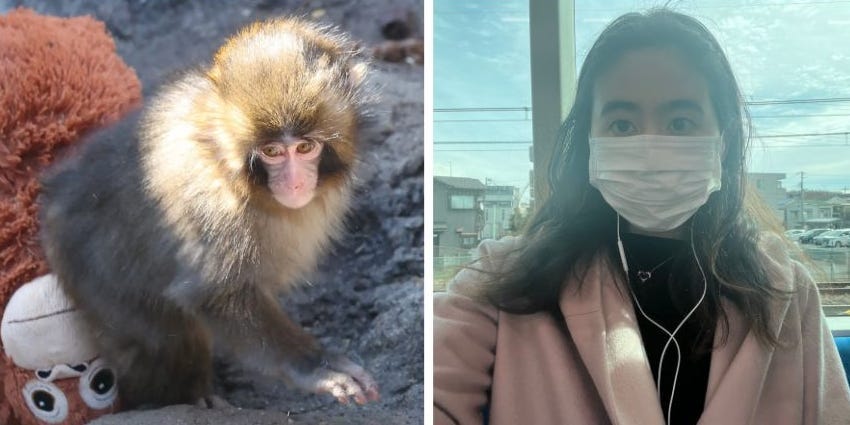
Since moving to Tokyo last year, my friends back in New York have made a habit of sending me viral posts about Japan. That’s how I first learned about Punch, the baby monkey abandoned by his mother and now cared for by zookeepers at Ichikawa City Zoo, east of Tokyo.
Videos of Punch — a 7-month-old Japanese macaque — clinging to an Ikea orangutan have racked up millions of views on TikTok. The hashtag #HangInTherePunch has gone viral.
Javier Quiñones, commercial manager at Ingka Group, which operates Ikea stores worldwide, told Business Insider that Ikea has seen sales of the Djungelskog orangutan toy increase.
“The toy has long been one of our most sought-after across markets, and the story from Japan is now giving it a little extra love,” he said.
Provided by Reeno Hashimoto
On a recent Friday afternoon, I visited the zoo
I expected other fans to be making the trek, but I didn’t spot a single rider headed for the zoo. The trains were packed at first — commuters with suitcases bound for Narita Airport, salarymen, uniformed schoolkids — but by the time we reached sleepy Ichikawa Station, most had cleared out.
Getting there took just under 2 hours: three trains and a 30-minute walk. The zoo-bound bus doesn’t run on weekdays.
Near the entrance, I began spotting both foreign and Japanese visitors climbing out of taxis, clutching monkey stuffed animals. It was obvious who they were there to see.
Provided by Reeno Hashimoto
Heading into the zoo
I paid the 440-yen, or $2.80, admission fee and made my way to Monkey Mountain, passing a mosaic mural of animals along the path.
There were rows of people lined up around a blue iron fence, phones raised, waiting to capture Punch in action. Spectators oohed as other monkeys climbed the rocky structure to play with a silver chain affixed to the top.
The air smelled of manure. The enclosure itself was stark — rocky, with little vegetation, more concrete jungle than mountainside.
Provided by Reeno Hashimoto
Some of the monkeys appeared thin, even balding
Punch, by contrast, looked healthy, his fur darker and thicker than the others’. Visitors laughed when he leapt from a rock to the monkey bars.
He isn’t the only baby in the exhibit, but he appears to be the smallest. Mostly, he keeps to himself, occasionally playing with a slightly larger one.
A woman from Canada, wearing a Yankees hat and visiting with her family, told me she’d seen Punch playing with his Ikea toy earlier and interacting with the others.
“We didn’t see any monkey fights,” she said. “We don’t love zoos and were a little concerned about supporting one if it doesn’t have the best enclosures. They could use some improvements, but it was better than I thought.”
Provided by Reeno Hashimoto
After about 10 minutes, the troop grew restless.
“Lunchtime,” someone nearby said in Japanese.
The monkeys scrambled upward. Punch returned to the monkey bars. A slightly larger monkey barreled into him, knocking him off balance, but he quickly recovered.
A group of heavily made-up girls in Japanese high school uniforms arrived, giggling. “Yabai,” they whispered. “Kawaii.”
Provided by Reeno Hashimoto
Notably, Punch wasn’t clutching his orangutan.
The toy sat abandoned on the other side of the enclosure.
At 2:50 p.m., the monkeys began clamoring for food, climbing the door and hanging from the rails. Then a young man in a blue uniform entered.
Punch immediately climbed onto the zookeeper’s leg as he circled the enclosure, scattering orange and yellow pellets. Within minutes, the food was gone.
The zookeeper returned with what looked like grass. This time, Punch perched on his shoulder as they made another lap before disappearing into a back room together.
Provided by Reeno Hashimoto
Around me, spectators wondered whether Punch would reappear before closing. Most were young adults — students and couples, some in coordinated outfits — clearly here for a photo.
I asked a zookeeper if he had time to answer a few questions, but he said the staff was overwhelmed by Punch’s popularity and too busy to respond, even to email inquiries.
Then an announcement crackled over the loudspeaker: Monkey Mountain was getting crowded. Visitors were asked to limit their stay to 10 minutes.
Punch’s fame was being rationed in 10-minute increments.