Unlock the Editor’s Digest for free
Roula Khalaf, Editor of the FT, selects her favourite stories in this weekly newsletter.
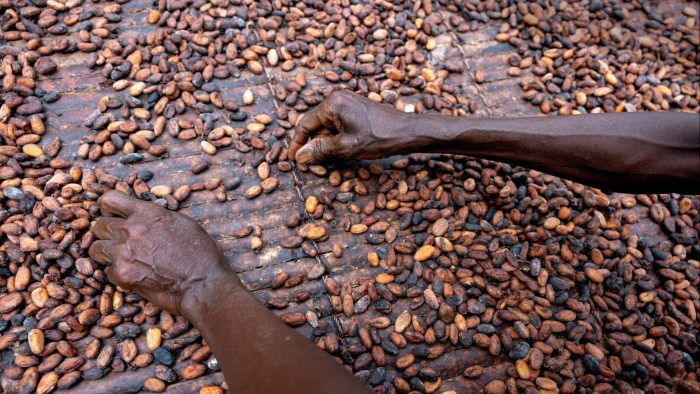
In the quest for ethical and sustainable production, one chocolate company has taken an unconventional route: sharing its playbook. Tony’s Chocolonely, the Dutch company founded specifically to eradicate slavery and child labour from the cocoa industry, has pioneered an “Open Chain” model that details its sourcing approach for competitors to follow.
While most corporate sustainability efforts centre on polished narratives and consumer-facing credentials, sharing supply chain practices is less common. Materials and procurement strategies are of little interest to consumers, and frequently viewed as proprietary assets essential for brand and product differentiation.
Tony’s avowed mission is not focused on selling more chocolate bars, but to end exploitation in the cocoa industry. It was launched in 2005 by Teun (“Tony”) van de Keuken, a journalist who had investigated such abuses. Its key measures of success including child labour rates, living income benchmarks and co-operative capacity, differ from the sales- or margin-first focus of traditional businesses.
FT European Business Schools Ranking
Read the report and ranking
Protecting intellectual property takes a back seat to scaling impact, in line with an approach taken by other sustainable brands. For instance, footwear company Allbirds open-sourced its carbon footprinting tool and SweetFoam, its proprietary green foam made from sugarcane, allowing competitors to adopt low-emissions materials. Outdoor clothing company Patagonia has committed to organic cotton sourcing, and established the Regenerative Organic Certified industry standard.
But such an approach is still rare and raises many core business strategy questions. Can a company scale impact faster by giving away part of its “secret sauce”? How do companies balance the pressure to grow, differentiate and deliver returns while pushing for industry-wide change? Is it realistic to believe larger companies will adopt the practices of their rivals?
Tony’s Open Chain treats ethical sourcing not as a competitive edge, but as a pre-competitive foundation for responsible business. Its framework is built around five core sourcing principles: traceable cocoa beans (mapped using GPS); a higher price (including Fairtrade and living income premiums); strong farmer co-operatives (supporting training, governance and bulk purchasing); long-term relationships (minimum five-year sourcing commitments); and improved quality and productivity (to boost yields and incomes).
Its Open Chain platform includes contract templates, its BeanTracker tool and data-sharing protocols that allow all supply‑chain actors — from farmer co‑ops to processors — to input and access real-time data on bean volumes, locations and payments.
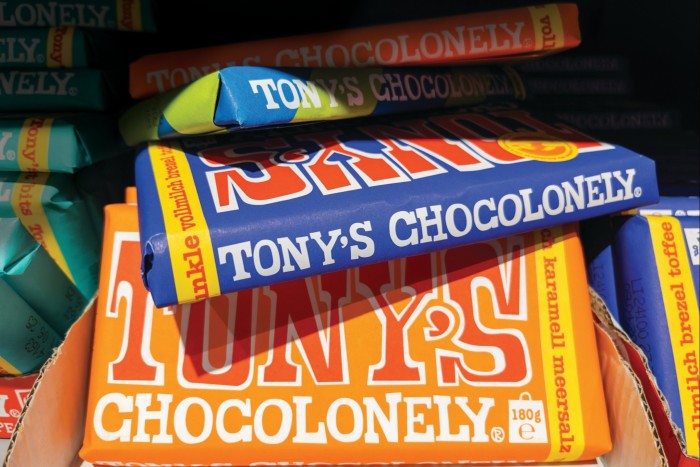
The approach discloses prices paid above the average and tracks progress towards living incomes for farmers. Designed to be scaled, the system allows other companies to adopt it rather than build their own.
This model has already attracted a growing coalition of food sector “Mission Allies” including Ben & Jerry’s, Aldi, Pleese, Jokolade and Holie Foods. In the 2023/24 season alone, 20 companies sourced more than 17,000 tonnes of cocoa via the platform, a nearly 20 per cent year-over-year increase. As of 2023, the company estimated Open Chain supplied 0.5 per cent of the West African cocoa market.
Among Tony’s longest standing co-operative partners, the child labour rate is 3.9 per cent, compared with an industry average of nearly 50 per cent. Tony’s pays Ghanaian farmers an extra $330 per tonne on top of the Fairtrade premium — closing the gap towards a living income. “We’re not paying them crazy money . . . It’s just a living income to get them out of poverty and stop using their kids on farms,” Ben Greensmith, Tony’s manager for the UK, Ireland and the Nordics, told the FT in 2022.
Chief executive Douglas Lamont said last year that the model has to be shaken up. He stressed that his company’s pricing approach is designed to bypass the “people making a lot of money in the middle” and ensure more value reaches farmers.
Yet the company is candid about its limitations. Former chief executive Henk Jan Beltman said in 2018 that with thousands of farmers across remote areas, he cannot guarantee that every chocolate bar his company sells is 100 per cent child-labour free. The goal is to reduce harm structurally, not pretend perfection.
In spite of the progress, broader challenges remain: the global cocoa market is under mounting strain. Rising input costs, crop diseases and climate volatility have decimated yields across Ghana and Ivory Coast.
Lamont has emphasised repeatedly that the ambition is to scale without compromising impact — but whether that is financially sustainable remains unanswered. In 2023, Tony’s revenues grew 23 per cent to €150mn, but it posted a €2.7mn loss — largely due to higher premiums paid to cocoa farmers and continued investment in global expansion.
The question is not whether Tony’s model is perfect, but whether it can shift how businesses think about their role. Across sectors plagued by extractive practices — from seafood and cotton to lithium and coffee — the idea of companies co-investing in open, pre-competitive infrastructure could be a blueprint for collective accountability.
What if — instead of guarding supply chains like trade secrets — companies shared the scaffolding that makes ethical sourcing viable at scale? Success would likely require a cultural shift: viewing transparency and collaboration not as risks, but as levers for system change.
Can companies scale their impact faster by open sourcing and giving part of their advantage away? Maybe the better question is: in a world of climate instability, price shocks and inequality, can they afford not to?
Christopher Marquis is Sinyi professor of management at Cambridge Judge Business School. Educators who would like the teaching guide can email c.marquis@jbs.cam.ac.uk
Test yourself: questions to consider
-
What are the advantages and limitations of open-source models such as Tony’s Open Chain compared with conventional corporate sustainability schemes?
-
How can transparency and traceability contribute to accountability in global supply chains and what are their potential downsides?
-
What incentives exist for larger companies to join a system such as Tony’s Open Chain and what might deter them?
-
Is it realistic to expect major food companies to adopt an “open-source” approach to sourcing? Why or why not?
-
Can pre-competitive collaboration models such as Tony’s be replicated in other industries facing similar supply chain challenges (eg seafood, coffee, cotton and palm oil)?
Further FT reading: