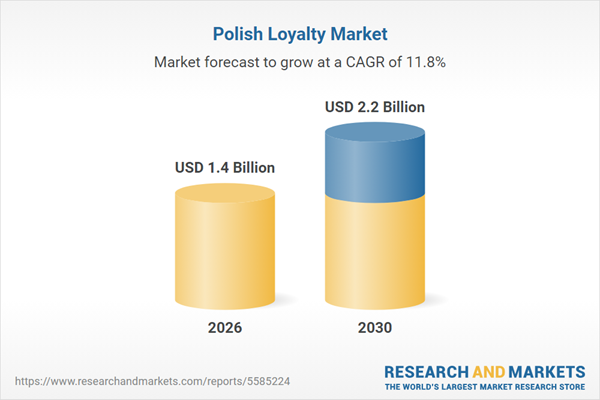
The Polish loyalty market is thriving, projected to grow annually at 14%. Key opportunities lie in AI and blockchain integration, diverse program models like points and cashback, and sector-specific strategies in retail, finance, and travel. Channels like in-store and mobile are vital for reaching B2B and B2C consumers.
Polish Loyalty Market

Dublin, Feb. 06, 2026 (GLOBE NEWSWIRE) — The “Poland Loyalty Market Size & Forecast by Spend Value Across 100+ KPIs by Program Type, Channel Mix, Sector, Embedded Loyalty Penetration, and Platform Spend Segmentation – Databook Q1 2026 Update” report has been added to ResearchAndMarkets.com’s offering.
The loyalty market in Poland is expected to grow by 14.0% annually, reaching US$1.40 billion by 2026.The loyalty market in the country has experienced robust growth during 2021-2025, achieving a CAGR of 16.0%. This upward trajectory is expected to continue, with the market forecast to grow at a CAGR of 11.8% from 2026 to 2030. By the end of 2030, the loyalty market is projected to expand from its 2025 value of US$1.23 billion to approximately US$2.20 billion.
This report provides a detailed data-centric analysis of the loyalty industry in Poland, offering comprehensive coverage of both overall and alternative lending markets. It covers more than 100+ KPIs, including spend value on loyalty schemes, loyalty breakage rate, and penetration rate.
The report provides in-depth segmentation across the loyalty ecosystem, capturing loyalty spend value and breaking it down by core market dimensions. It classifies loyalty activity by program models (such as points, cashback, tiered, subscription, coalition, and gamified formats), membership structures, and execution channels (in-store, online, and mobile app), alongside embedded loyalty use cases integrated into payments, commerce, and platform ecosystems.
The analysis further segments the market by industry verticals and assesses technology enablement, including AI-driven personalisation and emerging blockchain-led program mechanics. In addition, the dataset captures consumer demographics, enrolment pathways, and key program economics such as value accumulation, redemption, and breakage. Collectively, these datasets provide a comprehensive and quantifiable view of market size, structure, engagement behaviour, and value realisation dynamics within the loyalty market.
Reasons to Buy
-
Comprehensive Market Intelligence: Gain a comprehensive view of the loyalty market by quantifying total loyalty spend value and its composition across loyalty schemes and loyalty platforms, supported by retail context indicators to benchmark market scale, structure, and growth dynamics.
-
Granular Loyalty Spend Coverage: Analyze loyalty spend value across loyalty schemes and loyalty platforms, supported by structured segmentation across program types (e.g., point-based, tiered, cashback, subscription, community, gaming, mission-driven, paid, and referral-led formats).
-
Channel and Sector-Level Execution Insights: Evaluate how loyalty spend is distributed across in-store, online, and mobile channels, and across key verticals including Retail, Financial Services, Healthcare & Wellness, Restaurants & Food Delivery, Travel & Hospitality, Telecoms, and Media & Entertainment, with dedicated sector channel views.
-
Program Structure and Participation Mix: Understand how loyalty schemes differ by business model (seller-driven vs. payment-instrument-driven), accessibility (card-based vs. digital), consumer type (B2B vs. B2C), and membership type (free, premium, and free+premium), enabling more precise program design and competitive benchmarking.
-
Embedded Loyalty and Emerging Mechanisms Tracking: Assess the evolution of embedded vs. non-embedded loyalty and track spend splits linked to program enablement, including AI-driven and blockchain-driven loyalty program spend where captured in the dataset.
-
Platform Spend and Vendor/Deployment Benchmarking: Benchmark loyalty platform economics by software use case (analytics/AI-driven vs. management platforms), solution partner model (in-house vs. third-party), deployment (cloud vs. on-premise), and offering mix (software vs. services; custom-built vs. off-the-shelf).
-
Consumer Demographics and Program KPI Lens: Access loyalty spend share by age, income, and gender, alongside decision-critical program KPIs such as loyalty penetration (% of retail sales under loyalty), primary motivation split, breakage rate, enrollment channel mix, and embedded loyalty penetration by channel.
-
Decision-Ready Databook Format with 100+ KPIs: Leverage a structured dataset with historical and forecast coverage through 2030, designed for direct integration into market models, strategic planning, and executive presentations by retailers, platforms, payment providers, technology vendors, and investors.