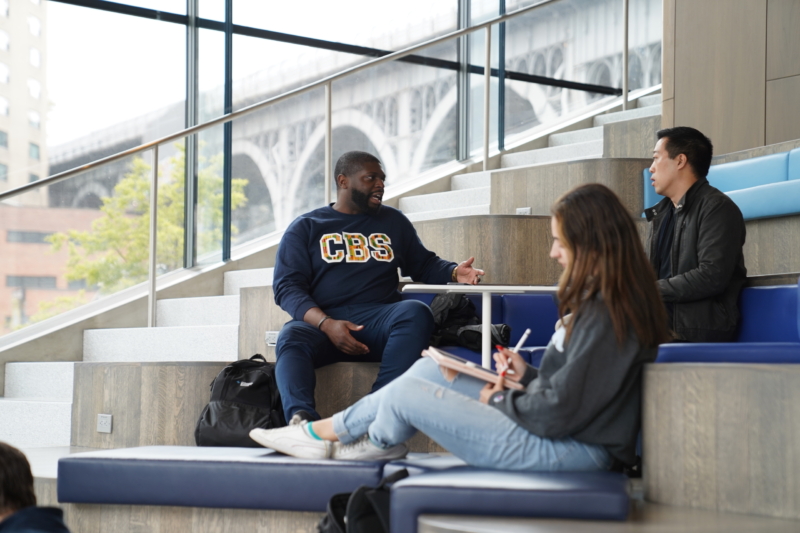
Columbia MBA Students
Columbia Business School didn’t just see the future coming — it decided to build it.
While most business schools are still debating the role of artificial intelligence in business education, Columbia has sprinted ahead with one of the world’s most ambitious, multi-layered AI strategies. The centerpiece is CAiSEY, a voice-powered learning platform that has already changed how thousands of students prepare for class. It’s part of a sweeping effort to rethink curriculum, pedagogy, and even school operations around breakthrough technology.
“We may debate whether AI is transformative in the next six or twelve months,” says Dean Costis Maglaras, “but over the span of a decade, it’s going to change the world — and it will be a positive change. Our students are 27 or 28 years old. They’re thinking about the next 20 or 30 years of their careers. Academia has to help them navigate that journey.”
MBA PROGRAM OF THE YEAR: COLUMBIA BUSINESS SCHOOL
 For this forward-leaning stance — and for the remarkable depth of innovation running through curriculum, faculty hiring, interdisciplinary partnerships, and student outcomes — Columbia Business School is Poets&Quants’ MBA Program of the Year. Many business schools are experimenting with AI. Columbia is reorganizing itself around it. A few schools offer climate electives.
Columbia has built an entire climate curriculum, created a School of Climate, and launched an MS in Climate Finance. Business School deans now talk about interdisciplinary integration. Columbia is actually doing it — across engineering, medicine, climate science, data science, and the university at large. A few schools tweak curriculum annually. Columbia is rebuilding it semester by semester. And while doing all of this, the school continues to deliver one of the most diverse and academically strong MBA classes in the world.
Even in a complicated political moment for international students, Columbia saw a remarkably steady admissions cycle.
Applications for the latest cohorts remained near record highs, dipping by a mere 10 apps to 7,477 this past year. CBS will enroll 982 students across its August 2025 and January 2026 intakes, up from 972, making it the largest of any M7 school, including Harvard. Women reached 46%, a school record. U.S. minorities climbed to 48%, another record. International enrollment slipped from 46% to 41%, reflecting national trends.
On academics, the numbers remain elite: Average GMATs hit 734, a CBS record, with average undergraduate GPAs of 3.6, maintaining last year’s record. The GRE average is an impressive 326. And GMAT Focus scores ranged from a perfect 805 down to the 600s.
AN ‘ENORMOUS APPETITE’ FOR ARTIFICIAL INTELLIGENCE

Columbia Business School Dean Costis Maglaras
Maglaras says the school is “anticipatory” about international recruiting given emerging regulations. “We’ll have to see how these policies evolve,” he cautions, “but we continue to invest in global employer relationships. Our students benefit from having a global view, and diverse voices enrich the experience.”
What’s behind the demand? Partly it’s the school’s new, modern campus in Manhattanville which opened in 2021 and more than doubled the size of the school. It’s also the school’s location in New York City, arguably the world center of the commercial universe. But mostly it’s how Columbia’s flagship program, it’s full-time MBA, has stayed increasingly relevant to the times.
When generative AI exploded into mainstream consciousness in late 2022, CBS faculty member Dan Wang didn’t try to fence it out. He built a better way in.
‘YOU LEARN BY DOING’
The result — CAiSEY, a Classroom Artificial Intelligence Studio for Engaging You — allows students to have adaptive, voice-to-voice conversations with an AI partner before class. What began as a prototype in one course now reaches more than 3,000 students across eight business schools, and CBS students have embraced it almost instantly.
The technology has been deployed across Columbia’s core strategy cases for 1,000 students, including a case on business strategy at Netflix. MBA candidates use AI to determine whether Netflix should build content in house or outsource it to an external production company. “Students get pushback, and it is a really rich tool for discussion. It has had rave reviews,” says Senior Vice Dean Paul Tetlock.
“Students want more of it,” Maglaras says. “You learn by doing, and we see real opportunities to improve operations, teaching evaluations, syllabi — even creating course-specific tutors. There is enormous appetite internally.”
Tetlock, who oversees much of the curriculum expansion, says the reactions have been “rave reviews.” “Students cover a far wider diversity of topics in these AI conversations,” Tetlock notes. “They come into class better prepared, more ready to debate, and more open to different perspectives. Discussions last longer, they’re richer, and frankly, they’re more civil.”
BUSINESS SCHOOLS MUST BE ACCESSIBLE, ADAPTIVE & INCLUSIVE
Beyond performance improvements, CAiSEY has delivered something deeper: accessibility. Wang discovered that 20% of U.S. adults are dyslexic or dysgraphic, and many CBS MBAs told him CAiSEY was the first educational tool that truly accommodated their learning styles. “They learn better by listening and speaking,” Wang explained. “And this is the first time, after 20 years of schooling, that something has really worked for them.”
Tetlock says this is a preview of where business schools must go: accessible, adaptive, inclusive forms of learning that don’t sort students by how fast they can read or write.
Maglaras and Tetlock think about AI as more than a tool. They’ve created a comprehensive redesign of how a business school teaches and learns.
COLUMBIA’S APPROACH TO ARTIFICIAL INTELLIGENCE
Maglaras breaks it into four layers:
-
Understanding AI as a capability.
“We want our students to know what it is, how it works, and when it doesn’t work. If I were teaching today, these are the courses I’d be teaching,” he says. -
Using AI inside the curriculum.
That includes CAiSEY and a growing suite of AI-enabled tools. “Dan’s innovations started in one isolated course and are now used across the core,” Maglaras says. “Several top schools across the country are using them.” -
Teaching how AI reshapes industries and roles.
From investing and financial services to real estate, marketing, and product management, CBS is rolling out new courses every semester that explore how AI is changing business fundamentals. - Looking 5, 10, 15 years ahead.“This is the hardest one,” Maglaras admits. “But we have to do it. The kids coming for undergraduate education haven’t been born yet. Who knows how their brains will be wired? We need to anticipate what business will require from them.”
© Copyright 2025 Poets & Quants. All rights reserved. This article may not be republished, rewritten or otherwise distributed without written permission. To reprint or license this article or any content from Poets & Quants, please submit your request HERE.