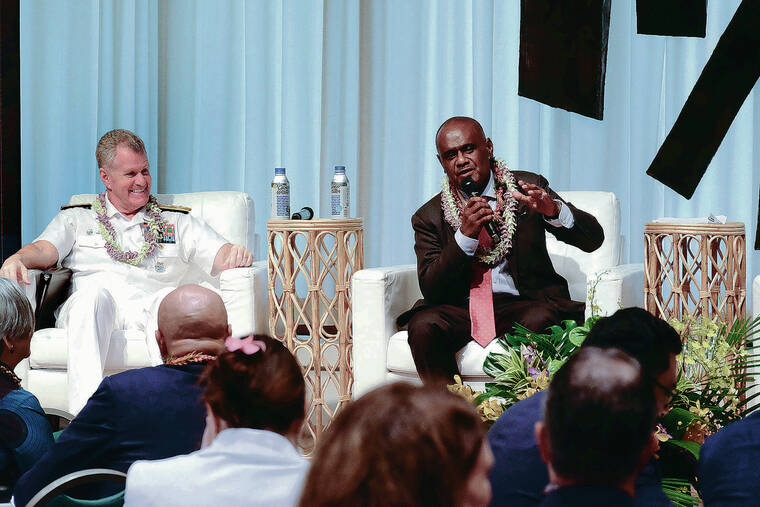
Leaders from Pacific Island nations and territories gathered this week at the East-West Center in Manoa for an inaugural diplomatic and business summit aimed at promoting private sector investments and contracts across island communities in Oceania.
Through Monday and Tuesday the Pacific Agenda summit brought representatives from more than a dozen countries and more than 80 companies, as presidents and prime ministers from across the region rubbed shoulders and held meetings with American corporate executives, investors and experts to discuss everything from infrastructure, energy, tourism, telecommunications and satellite technology.
Among the companies participating were national giants like Salesforce, Boeing, Google, SpaceX and JP Morgan along with local companies like L&L Hawaiian Barbecue, Hawaiian Airlines and Hawaiian Electric.
“Over these past two days, we have listened and shared through the roundtables and dialogues,” said Solomon Islands Prime Minister and Pacific Islands Forum Chair Jeremiah Manele as the summit wrapped up Tuesday evening. “I have noted some candid and frank discussions centered on the topics of this summit. Whilst the past and present may have influenced our perspectives, what we take forward as partners in commercial diplomacy following this summit is critical. Indeed, investment and security are inseparable and critical for prosperity.”
The summit was hosted and co-organized by the East-West Center, U.S. State Department and Oahu-based U.S. Indo-Pacific Command. It’s part of a long effort that is in part aimed at countering China’s growing influence across the Pacific Islands as the U.S. and its allies work to maintain a footing in strategically important island chains.
Many Pacific Island countries have signed onto China’s Belt and Road Initiative, a series of Beijing-funded infrastructure projects aimed at promoting trade with China. Some analysts argue that many of the projects are “dual use” endeavors that also may be supporting Chinese intelligence and military operations in the region.
Don’t miss out on what’s happening!
Stay in touch with breaking news, as it happens, conveniently in your email inbox. It’s FREE!
“We’ve seen other countries coming in the Pacific in quite an aggressive manner,” said U.S. Deputy Secretary of State Christopher Landau. “And in a sense, maybe that’s not a bad thing, and it’s given us a little bit of a kick in the butt to up our game in this region.”
Palauan President Surangel Whipps Jr. told the Honolulu Star-Advertiser that it’s been something he’s brought up frequently with American officials, saying that U.S. government agencies are “helping us build infrastructure, schools, health care facilities, roads. But when it comes to private sector, we don’t see you. You’re absent, but China’s there. So what we want to see is we want to see U.S. investment. We want to see Taiwanese investment. We want to see Japanese investment in our islands. We want to see Australian investment.”
The U.S. military has been investing heavily in Palau on infrastructure to support its operations as it pursues port renovations, building radars and stockpiling weapons and equipment for a potential Pacific conflict.
It also has begun building a new fuel depot in Papua New Guinea to offset effects of the ongoing shutdown of Red Hill and working on airstrips and other facilities across the region.
INDOPACOM Commander Adm. Samuel Paparo told attendees and the summit “we do need you in the private sector to move in and to help us build the vibrant commerce that brings this infrastructure to life. I ask you to work with our partners to develop and connect markets, to lower risk, to enhance transparency and to ensure a level playing field.”
As the summit concluded, the U.S. Trade and Development Agency announced it would fund a “hospital relocation project feasibility study” around Palau’s Belau National Hospital — the only hospital in the small island nation — in hopes of rebuilding and modernizing the aging facility, with local company Architects Hawaii Ltd. taking on the work.
Several other Pacific Island leaders told the Honolulu Star-Advertiser they had reached memorandums of understanding with companies to work on future projects across the region. Manele said top issues for island communities included “whether our child has electricity to study at night and whether farmers can reach markets, whether digital connections allow young people to participate in the global economy.”
Gov. Josh Green, who sits on the EWC’s board of governors, called the summit “an extraordinary success from the East-West Center perspective to gather all of these leaders … a lot of serious business partners that are interested in looking at Hawaii as a potential bridge deep into the Pacific.”
Landau said that he foresees looking to the EWC more to engage with Pacific Island nations, saying “the location here in Hawaii makes it a natural choice.” But he said that it would ultimately take years as deals discussed at the summit actually take shape before anyone can measure the impact of the summit.
“We welcome the realignment of foreign policy, and this is the first step in engaging us,” Tongan Prime Minister Fatafehi Fakafanua told the Star-Advertiser. “I think it’s a smart move to use the private sector to encourage investment into the Pacific. Evidently, there is not that much U.S. investment in the Pacific Islands, and we think this is a great catalyst for us to deepen our relationship.”
During closing remarks, Manele told Landau he would like him to “to help us with the establishment of a Pacific trade investment office in the U.S. similar to those that we have in New Zealand, Australia, China, Japan and in Geneva. It will greatly help our efforts in connecting trade and investment opportunities for us into the future.”
But while Pacific Island leaders welcomed the attention of American officials and companies, many still have deep disagreements with the United States. This month President Donald Trump’s administration rescinded the 2009 Endangerment Finding, which allowed the U.S. Environmental Protection Agency to regulate greenhouse gas emissions that contribute to climate change.
Trump and much of his Cabinet have insisted that climate change is a hoax. The White House has been rolling back environmental regulations while seeking to boost production of fossil fuels, encouraging other countries to import American oil and coal and deriding renewable energy sources.
In a keynote opening the summit, Manele said “climate change remains the greatest security threat impacting our livelihoods, communities and economic prosperity. Rising seas and intensifying disasters erode development gains and strain national budgets. A flooded school or damaged hospital is not only a humanitarian issue, that is strategic one.”
Fakafanua said that during the conference his delegation had conversations with an American company on the prospect of underwater geothermal energy, a renewable source that could help Tonga become less dependent on imported fossil fuels.
“United States administration has prioritized some key areas that they’re focusing on,” Fakafanua said. “But at the same time, it’s a free conversation, and we’re also putting on the table our own priorities.”