Spring break is typically busy at Sharlyn Foo’s budget accommodations in Haleiwa. But last month, instead of welcoming surfers and families, Foo spent her days canceling reservations, refunding payments and responding to repeated calls from travelers asking whether Oahu’s North Shore was even open.
“I’m down to zero; nobody is here,” said Foo, owner of Backpackers Vacation Inn & Plantation Village. “When they hear the word ‘Haleiwa,’ I have no business.”
Foo’s experience reflects the fallout from back‑to‑back Kona-low storms that battered the North Shore in March, triggering floods, highway closures and brown-water advisories. While conditions have largely improved and businesses have reopened, visitor demand has been slow to rebound.
State officials and business leaders say confusion — fueled by viral images of houses and cars swept away by raging floodwaters — has prolonged economic losses as the region heads into the critical summer booking season.
Foo said her property did not flood but the power was out for two days and potable water was unavailable for nearly a week, making it impossible to host guests. Even now, she continues fielding calls from travelers unsure whether roads are open or whether it’s appropriate to visit.
An illuminated “open” sign hangs in her front window, but the rooms behind it remain dark.
Don’t miss out on what’s happening!
Stay in touch with breaking news, as it happens, conveniently in your email inbox. It’s FREE!
“Haleiwa town is open,” Foo said. “We’re recovering on all levels. I can see the ocean is blue again across the street at Three Tables Beach.”
Officials representing the North Shore and Hawaii’s visitor industry say imprecise messaging has devastated businesses, including many that escaped flood damage and others far from the disaster area.
State Rep. Sean Quinlan (D, Waialua–Haleiwa–Punaluu) said weeks of road closures, outages and traffic gridlock effectively cut off the region while images circulating nationally created the impression the entire island shut down.
“At the Waialua Sugar Mill, some days there were more than 1,000 cars coming through, but no customers,” Quinlan said.
He estimates that business in Haleiwa is down about 70% on average. Ocean‑based operators — surf schools, shark tours and boat charters — suffered near‑total losses during extended brown-water advisories. Preliminary estimates place total economic losses from the two Kona lows at over $100 million across the North Shore, Quinlan said.
Cancellations rippled well beyond the flood zone, affecting Waikiki hotels and The Ritz-Carlton O‘ahu, Turtle Bay, he added.
“Most visitors aren’t well-versed in island geography,” Quinlan said. “When they see images on the news, they assume all of Hawaii is closed.”
He warned the downturn could linger, as it did on Maui after the Lahaina wildfire.
“Out of respect and shock, the message became ‘don’t come,’ and that quickly turned into ‘don’t come to Maui,’” Quinlan said. “We’re seeing the same thing now.”
DURING THE storms, North Shore restaurants and food trucks pivoted to relief efforts, feeding residents and distributing supplies. But as the cleanup continues, workers who lost homes or vehicles now face another threat: lost income.
“I don’t want anyone who lost their home to also lose their job,” Quinlan said.
Sherry Menor, president and CEO of the Chamber of Commerce Hawaii, described the downturn as “instantaneous,” particularly for small family‑run businesses reliant on daily visitor traffic. Many lost the spring-break boost entirely and now face a weak summer season if uncertainty persists.
“Some businesses are operating with virtually no revenue while still paying employees, benefits and even feeding the community,” Menor said. “Many are dealing with damaged equipment, spoiled inventory and flooding impacts — often without adequate insurance. They are bleeding.”
She said the disruption rippled through the supply chain, affecting farmers, distributors and transportation companies.
Brett McLoughlin, a sales associate at North Shore Surf Shop, said business collapsed after the storms and have yet to fully recover.
“The first week I sold one tank top all day — $30 — when an average day would be at least $100,” McLoughlin said. “That’s a 70% to 80% drop.”
Sales improved slightly after a 50% discount was offered on used surfboards, but most customers have been locals. Surf instructor Julian Williams, whose ground‑floor studio flooded, hasn’t taught a lesson since before the storms.
“I’ve been digging myself out just to get here to work,” Williams said. “It’s frustrating.”
McLoughlin said many North Shore business owners and workers are balancing flood recovery with lost income.
“We still need to work to pay rent,” he said. “I can’t imagine rebuilding a home without having work yet.”
The Hawaii Chamber of Commerce Foundation launched a relief fund specifically for North Shore businesses — one of the few efforts focused on business recovery rather than household assistance.
Menor urged companies to support the area by placing catering orders, purchasing gift cards or sourcing goods from North Shore vendors. Kamaaina, she said, also can help by dining, shopping and booking services locally.
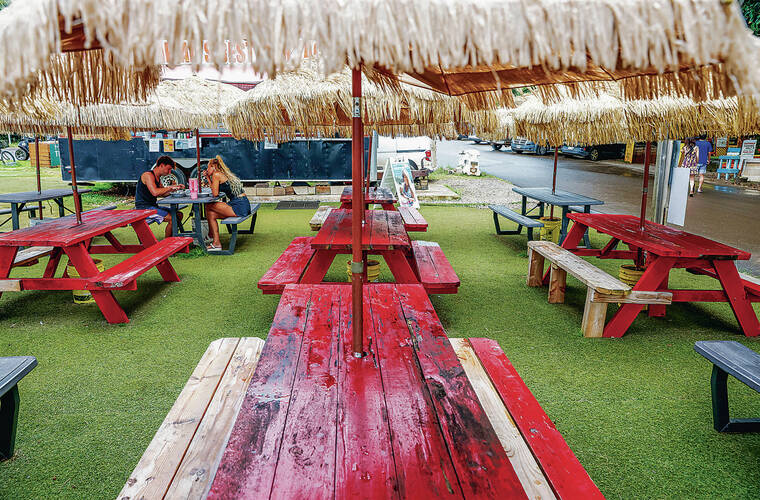
LOGAN GARNER and Camryn Trussell of Waipahu were doing just that Thursday while eating at the food-truck collective along Kamehameha Highway, across from Shark’s Cove in Pupukea. The pair said they love the North Shore and visit several times a month, but this was their first trip back since the floods.
“It’s really slow,” Trussell said. “There were parking spots everywhere; that’s really uncommon.”
Garner said they came specifically to support local businesses and ended up having an especially enjoyable day.
“We’re probably heading to Keiki’s next; the water looks good. It’s blue,” he said.
For visitors on the ground, the reality is often better than their perception. Bonna Savarise, visiting from Las Vegas, said she and her husband briefly reconsidered their trip after seeing storm footage online.
“All the water is dried up, everything is clean and there’s a strong presence of authorities,” Savarise said while shopping in Waialua. “It’s been great. I’d tell other visitors to come.”
State officials say correcting misinformation now is urgent.
The Governor’s Office said a recovery campaign is needed to restore confidence and encourage visitors to keep or rebook trips. Funding would come from HTA’s fiscal year budget reserve for marketing, which is held back annually for situations like this.
“Businesses that rely on visitors have been hit hard by floods and the subsequent drop in revenue. Uncertainty from floods, global conflict, plus rising fuel and airfare costs are causing visitors to reconsider their summer travel plans,” the Governor’s Office said in an email. “We need a campaign to encourage those who canceled their trips last month to rebook, reassure those with trips scheduled to keep their travel plans, and encourage those considering a trip that Hawaii welcomes their support.”
The Governor’s Office cited the state’s $6.4 million Maui recovery campaign, which generated an estimated 79,000 hotel room nights and $15.8 million in economic activity, as evidence that targeted marketing can help stabilize tourism.
James Kunane Tokioka, director of the Department of Business, Economic Development and Tourism, said misinformation has been especially damaging. “Some messages say the North Shore is closed — that is absolutely not true,” he said. “Visitor traffic sustains local businesses and jobs.”
THAT CONCERN resonates with Lamont Brown, owner of The Fixx Haleiwa and Maya’s Tapas and Wine, whose revenues are down about 75%.
“We got through COVID, we’ll get through this,” Brown said. “But this time, people have lost homes and don’t have extra money.”
Brown said his restaurants cooked thousands of meals during outages and he’s trying to keep all 45 employees on the payroll. Many, he added, lost cars and need immediate transportation assistance. He hopes U.S. Small Business Administration loans become available but said some businesses need help sooner.
“A rent‑break program would help,” Brown said. “When a business can’t operate for eight days and margins (for restaurants) are only 4%, the math is brutal.”
Even major North Shore employers were affected. At Kualoa Ranch, President and General Manager John Morgan said the property closed for two full days and two half-days but has fully reopened.
“The worst winds hit March 13 — the strongest since Hurricane Iniki,” Morgan said. “Then on March 20, we got 13 inches of rain. We had damage, but areas like Waialua were hit harder because their watersheds are larger.”
Morgan said uncertainty poses the biggest long‑term risk.
“When people think all of Hawaii is impacted, they make other plans,” he said. “Clear messaging matters.”
The Polynesian Cultural Center in Laie closed for two days due to the second Kona low but felt impacts far longer because of road damage.
“Access was severely limited from March 13 until last week,” said PCC President Alfred Grace, noting the main road near Waimea Bay was reduced to one lane until last Wednesday.
The disruption wiped out spring-break business.
“I can’t recall a worse March outside of COVID closures,” Grace said.
With summer approaching, prompt timing is urgent.
“We need bookings now or we miss the window,” Grace said. “We need to salvage May and June … ; (that’s) critical to us making back some of the loss that we’ve experienced.”