5-minute read

Gov. Mikie Sherrill addresses affordability crisis in NJ: video
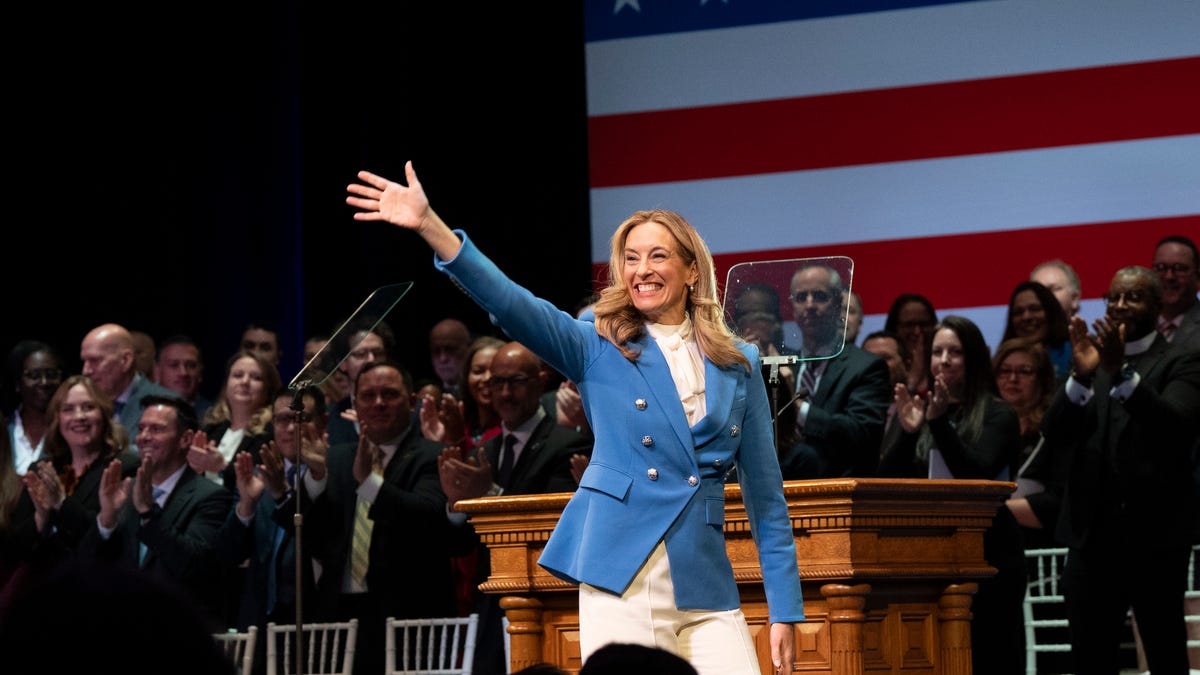
Watch new Gov. Mikie Sherrill on state affordability: “Too many people are working too hard and still falling behind.” Jan. 20, 2026 at NJPAC, Newark
- The state’s GDP grew 3.4% in the third quarter of 2025, trailing the national average, while its unemployment rate was among the highest in the nation.
- Sherrill has pledged to focus on making New Jersey more affordable and has proposed a “Get to Yes” approach to help businesses grow.
- Economists suggest that actions like investing in start-ups, infrastructure, and energy generation could help improve the state’s economy.
Mikie Sherrill has taken office as governor at a time when New Jersey faces significant economic hurdles — the state’s gross domestic product lags behind much of the nation, and its job market is slowing.
The Garden State’s economy grew 3.4% in the third quarter of 2025, better than only five other states and Washington. And New Jersey ended 2025 with a gain of 9,000 jobs — down from 39,200 in 2024 and 64,200 in 2023, government figures show.
Sherrill, who was sworn in Jan. 20, ran a campaign focused on affordability, after New Jerseyans were socked with 40-year-high inflation following the COVID-19 pandemic.
Story continues below photo gallery.
Sherrill vowed in her inaugural address to “spend every minute trying to make New Jersey more affordable and open doors to opportunity across our state.”
What do NJ GDP, unemployment numbers show?
Figures from the U.S. Bureau of Economic Analysis released on Jan. 23 showed that New Jersey’s 3.4% rate of growth in GDP — the total monetary value of all the goods and services it produced — trailed the national GDP growth of 4.4% in the third quarter of 2025.
Meanwhile, state job figures showed a slowing labor market. New Jersey added jobs in the education and health services sector and professional and business services sector, but those gains were largely offset by losses in other sectors.
Among them: Construction lost 10,200 jobs, and trade, transportation and utilities, which includes retail and warehouses, lost 9,800 jobs.
A separate report said New Jersey’s unemployment rate in December was 5.4%, the highest since the COVID-19 pandemic and higher than every state except California, according to the U.S. Bureau of Labor Statistics. By comparison, the nation’s jobless rate in December 2025 was 4.6%.
New Jersey isn’t the only state seeing the job market slowing down. Data last year from payroll processing firm ADP showed a nationwide net decrease of 32,000 jobs.
“Hiring has been choppy of late as employers weather cautious consumers and an uncertain macroeconomic environment,” ADP Chief Economist Nela Richardson said in a December statement. “And while November’s slowdown was broad-based, it was led by a pullback among small businesses.”
But the numbers do not necessarily spell bad news for New Jersey, said Robert Scott, an economist at Monmouth University in West Long Branch.
Unemployment is rising slowly, he said, and New Jersey misses out on the economic value of employees who live in the state but commute across the river to New York City or Philadelphia.
“Businesses are holding their breath a bit,” he said in an email. “They’re waiting to see how the change in the governor might affect policy, what happens with tariffs, and all the other expenses affected by inflation (energy, taxes, building costs, etc.).”
And the problems may not be unique to New Jersey, said Will Irving, a professor at the New Jersey State Policy Lab at Rutgers University.
“I would not be surprised to see other states start to experience rapid increases as employment growth nationally continues to slow and/or decline,” he said in an email.
Peter Chen, an analyst with the progressive think tank New Jersey Policy Perspective, told NorthJersey.com that because New Jersey’s economy is heavily dependent on international trade — given its sprawling port and logistics sector — the state’s economy has suffered from the uncertainty around the White House’s tariffs.
Can Sherrill do anything for New Jersey’s economy?
Sherrill is “laser-focused on expanding economic opportunity and improving affordability through a new ‘Get to Yes’ mentality throughout state government,” spokesperson Maggie Garbarino said in an emailed statement.
“Trenton should be a partner helping businesses grow and succeed, not a barrier to their success,” she continued.
There are some actions Sherrill can take that are specific to New Jersey’s economy, said Scott, the Monmouth University economist:
- More money and resources for start-ups, especially in coordination with New Jersey colleges like Rutgers University, Rowan University, Princeton University, the Stevens Institute of Technology and New Jersey Institute of Technology, which can serve as “incubators for new businesses.”
- More focus on long-term infrastructure projects.
- More focus on energy generation.
- Better communication from the administration “about the challenges and opportunities surrounding NJ’s future.”
“Be as transparent as possible about funding needs, limitations, regulatory restrictions,” Scott said. “There is typically a wall between decisions made at the state level and everyday citizens.”
Some business leaders feel NJ economy is stagnant
In early December, the New Jersey Business & Industry Association put out results of a survey showing that tariffs and high energy costs left an overall sour taste for business owners in 2025, with many not expecting the economic outlook in the state to improve this year.
“The economy in New Jersey is not terrible, but if it’s better elsewhere, it begs the question: what are we doing that’s impeding our business here that other states aren’t doing,” said Chris Emigholz, a chief lobbyist at the New Jersey Business & Industry Association.
Having fewer regulations is critical, the association has said, because the more rules businesses have to follow, the more costs they take on. And the state’s corporate business tax, ranked the highest in the nation by the Tax Foundation, is also a problem for New Jersey’s competitiveness, the association has said.
What could NJ’s economy look like in 2026?
At a banking conference in December, New York Federal Reserve President John Williams said New Jersey managed to escape the worst of 2025’s economic woes — from tariffs to inflation and a labor market upheaval spurred by artificial intelligence.
But, he noted, economic quality of life will be uneven for many residents.
That’s even with the Garden State well-poised to ride out the economy this year, which is in a much better position than was feared a year ago at the start of President Donald Trump’s second term.
Inflation has been a setback in recent years for “millions and millions of households” that have grappled with the costs of infrastructure, housing and health care, Williams told NorthJersey.com in a sit-down interview after the December banking conference.
Even today, “they have seen the prices of the things that they buy — whether it’s food, whether it’s the rent they have to pay — have gone up significantly over the past five or six years,” Williams said.
“That is a very challenging situation, where you’re deciding ‘Where I am going to spend my money?’ given all the different things you need to pay for,” he said. It will take time to even out, Williams said, and may last longer than 2026.
“There’s been a hesitancy by businesses to hire too much, because you may wish you hadn’t, and also a hesitancy to lay off workers, because you may wish you needed those employees,” he said, characterizing the economy as “low-hire, low-fire.”
Daniel Munoz covers business, consumer affairs, labor and the economy for NorthJersey.com and The Record.
Email: munozd@northjersey.com; Twitter:@danielmunoz100, Facebook and Instagram