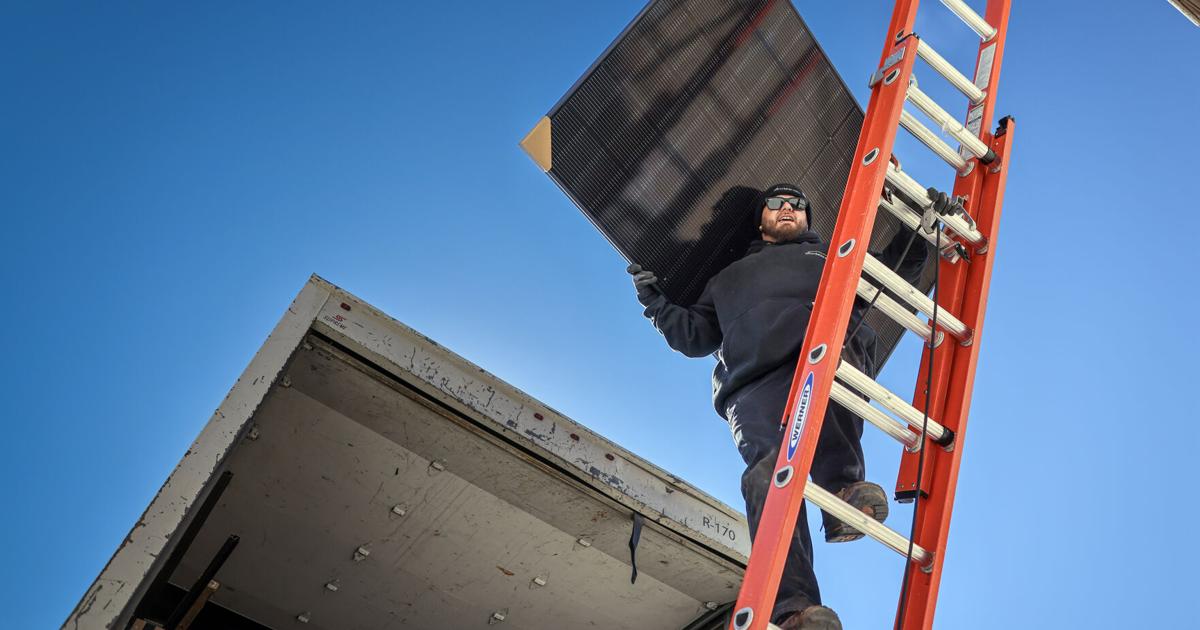
New Mexico solar firms hope tax credit hike will help boost business | Local News
Table of Contents
When Diane Metoyer, the office manager for Albuquerque-based Affordable Solar, asks for a customer’s Social Security number to help them apply for the state’s solar tax credit, they tend to balk.
The hesitancy doesn’t usually last long: All Metoyer has to do is explain the process they would face to apply for the credit themselves. “And then they just give me the social,” she said.
Affordable Solar is one of a handful of solar installation companies that walk clients through the rigorous application process for New Mexico’s tax incentive for home energy systems. The credit, revived by the state Legislature in 2020, offers up to $6,000 or 10% of the cost to install a renewable energy system at a residence or business.
With the Dec. 31 expiration of a larger federal tax credit — which covered 30% of a solar project’s cost — New Mexico solar companies are seeing a decline in business. In the absence of a federal credit, increased focus is on the state counterpart, which some lawmakers are seeking to increase during the current legislative session to make up for the lost federal incentives.
Santos Torres of Affordable Solar prepares solar panels to be installed onto the roof of a home in Albuquerque on Wednesday.
Gabriela Campos/The New Mexican
A fiscal analysis for Senate Bill 55, which would increase the New Mexico income tax credit from 10% of a project’s cost to 30% and the individual reimbursement cap from $6,000 to $15,000, says the more enticing offer could lead to higher demand for the state program.
Solar companies and consultants say the federal credit was simple to apply for, but the state’s version may be more difficult for homeowners to navigate. Funds for the program initially were too low to meet demand, creating further frustrations for applicants.
“It’s supposed to be an incentive,” said Daniel Baker, who owns consulting firm EnviroKarma in Santa Fe. “So why should this form be so hard to use that someone has to hire me to do it for them?”
The state requires proof of ownership of a property where a system was installed; a building code inspection report; an itemized invoice for the installation, including labor, equipment, permitting and materials; the system’s schematic and specs; a bird’s-eye-view site plan; and an electrical diagram.
For the federal tax credit, before its expiration, documentation was only required if an applicant’s income tax return was audited.
Bill could boost demand
The state previously had a solar tax credit that expired in 2016. Lawmakers brought it back four years later.
Homeowners and businesses couldn’t get enough. A cap for the program, initially set at $8 million and later at $12 million, was met in fiscal years 2020, 2021 and 2022, leaving many applicants behind.
The Legislature decided to approve some supplemental funding, said Rebecca “Puck” Stair, director of the Energy Conservation and Management Division, which administers the tax credit. That led to a spike in the number of approved projects in fiscal year 2023, Stair said, which she thinks might create an artificial appearance of a decline in interest in following years.
The cap was also raised to $30 million in total credit value starting in fiscal year 2024. Distributions were about $8 million that year, far under the cap. In fiscal year 2025, about $6 million in credits have been claimed so far.
But Stair said that’s not necessarily an indication interest has declined; the department typically sees an influx of applications in the months before the tax deadline.
“I don’t want to speak for the legislators, but I suspect their intent was to set the cap high enough that we would never hit it again,” she said. “Because it was frustrating for a lot of folks involved.”
Not every New Mexican who installs solar on their home or business applies for the credit. The vast majority of the projects certified by the Energy, Minerals and Natural Resources Department connect with Public Service Company of New Mexico’s power grid. Each year of the program, the number of people connecting their residential solar into PNM’s network has exceeded by a few thousand the number of projects receiving state credits.
According to the fiscal analysis for SB 55, demand from New Mexicans for the federal tax credit exceeded that for the state credit. Increasing the credit value could bring claims closer to that $30 million cap, the analysis stated.
“While the existing state credit resulted in only about $9 million claimed in FY25 with roughly 3,500 claims on average over the last three years, the substantially larger level of prior federal participation — about 12,500 federal claims totaling nearly $60 million in tax year 2023— suggests a much larger pool of households and businesses have recently demonstrated demand for a solar incentive at or near a 30 percent credit rate,” the report states.
Stair said the state’s solar tax credit was cut when a federal incentive was put in place. SB 55, if adopted, would actually restore the tax credit to its previous levels, she added.
Stansfield said incentives remain an important part of the residential solar business. After the larger, federal tax credit expired at the end of the year, the Albuquerque-based solar company let go of about half its staff, predicting a decline in business of about 60%.
January is already the slow season for a solar company, Stansfield said — not many people are thinking about solar in the short, cloudy winter days. Although the business is still likely overstaffed due to projected declines, he added, it is closely watching the outcome of SB 55.
“We are putting a lot of eggs in that basket. We have maybe kept staff … in hope that that comes through,” he said. “If that doesn’t come through, then we’re going to be facing more challenges.”
System tough for some
Some solar energy professionals say helping clients apply for the New Mexico incentives — especially with the loss of the federal tax credit — has become important part of their business.
Affordable Solar already has a lot of the client information the Energy, Minerals and Natural Resources Department requests for certification of eligible projects, general manager Wayne Stansfield said.
“We felt that in lieu of sending the information and … leaving them to fend for themselves, we could kind of shepherd that process through and probably just make it more efficient for both parties,” he added.
While some of the requested details may be foreign to a homeowner, he said, the process is relatively speedy when a company has all the documents in hand.
Dionne Shirley, permit and inspections coordinator and “jack of all trades” for Positive Energy Solar, which serves customers in Santa Fe and Albuquerque, said the company has adjusted its pricing to include the tax credit application.
When the credit was brought back in 2020, Shirley said, her colleague noted the employee-owned company would be “inundated with calls by customers for help” and suggested they get ahead of the curve.
At first it took at least an hour to apply, she said, but she’s been able to automate some of the process and cut that time in half. Without automation, she added, the process would be “so overwhelming.”
Metoyer said the process was “kind of nerve-wracking” when she first started about a year ago, due to the amount of information required from the state agency. But over time, she’s developed her own system, and the online technology has improved.
Stansfield, meanwhile, recalled when applications were only done on paper.
The online system had some kinks when it was first rolled out, he said, adding it’s a vast improvement over the previous system.
Though, he acknowledged, “Change is never easy.”
Baker, of EnviroKarma, is more critical.
It’s always been difficult to get the 10% tax credit from the state, he said, and he doesn’t believe the online application has made the process easier.
“It’s been on the books and legislated and funded,” Baker said. “But the hoops that a homeowner has to go to get that 10%, it’s incredible.”
Baker said one of his clients had two eligible solar systems on one property, but when he tried to apply for tax credits for the second system,the online form wouldn’t take the address because it was tied to an existing an application.
Michael Standridge carries a solar panel to his crew during a installation at a home in Albuquerque on Wednesday.
Gabriela Campos/The New Mexican
While some other solar installers said the online form was an improvement over the previous system, Baker thinks it’s now worse because there’s no paper workaround if the form glitches or people encounter other challenges.
Baker’s client, who declined to be named due to concerns his future applications could be stalled by the state, lives on a property with two small homes and installed solar energy systems on both in 2024. The promise of both state and federal rebates made the installation cost affordable, he said, but he encountered problems with the state system.
A delay in receiving the tax credits made repaying a loan for the project more difficult. On Wednesday — about a year after he had started the process — the solar project on the second building was finally certified.
State says process streamlined
Stair said the state has streamlined the tax credit application process as much as possible, given statutory requirements.
Santos Torres hands off a solar panel to Michael Standridge during an installation at a home in Albuquerque on Wednesday.
Gabriela Campos/The New Mexican
Her division manages 10 of the state’s energy and conservation tax credits, with four full-time staffers overseeing all of them.
“When we went from paper to digital, we really took a hard look at everything that we were asking and tried to reduce it to the absolute minimum, to make it easy for everyone,” Stair said. “And I think it’s gotten a lot more streamlined.”
Department spokesperson Sidney Hall said he’s heard questions from some customers who have had their installation company go out of business and have struggled to find some of the needed documentation. The department tries to guide them to support.
Stair said applicants are welcome to come to the office in Santa Fe, at 1220 S. St. Francis Drive, if they need assistance, a computer or a better internet connection. She also encourages New Mexicans interested in installing solar to apply for the credit early and review the requirements, even before putting in a system.
“We obviously have to follow the law,” Stair said. “So there’s certain things we have to request in the paperwork. … We really encourage people to read the user guide, which is like a step-by-step ‘what you’ll need.’ ”
Shirley, of Positive Energy Solar, said she thinks the new online form is easier. But she still gets calls from people who had their system installed by another company that doesn’t provide the same support.
“So, I think it’s still very difficult for customers to take this on themselves,” Shirley said. “… You have to know what the output is on the inverter, and that’s not on the plans, necessarily. So it’s challenging.”
Join millions of self-starters in getting business resources, tips, and inspiring stories in your inbox.
Unsubscribe anytime. By entering your email, you agree to receive marketing emails from BigBCC. By proceeding, you agree to the Terms and Conditions and Privacy Policy.
SELL ANYWHERE WITH BigBCC
Learn on the go. Try BigBCC for free, and explore all the tools you need to start, run, and grow your business.