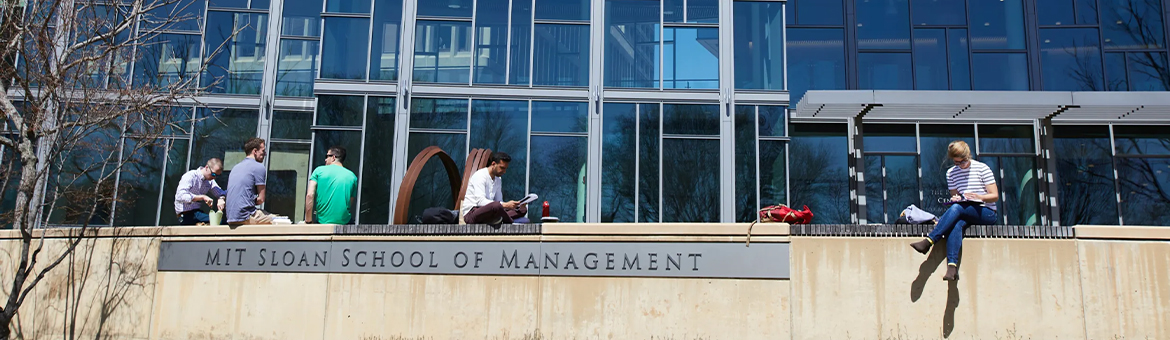

MIT’s Sloan School of Management Exterior. (Photo courtesy of MIT Sloan)
A Full-Time MBA program is considered the crown jewel of most business schools. It attracts the top young professionals – and produces big name alumni executives like Jamie Dimon and Sundar Pichai. Many times, coveted resources are funneled to them too, be it treks, events, financial aid, or projects.
Here’s a secret: Full-Time MBAs rarely constitute a minority of business students. There are Undergraduate Business Students, Executive MBAs, Online MBAs, Master’s Students, and even PhDs. In some cases, you’ll find celebrity faculty being shipped off for lucrative Executive Education junkets too.
MIT AND STANFORD LEAD THE WAY
That begs the question: Which universities deliver as a whole when it comes to business programming? After all, there is so much overlap between faculty, courses, and services. Why just measure one segment of the student population?
That’s an underlying question posed by Times Higher Education’s 2026 Business and Economics Ranking. The parent company of Poets&Quants, THE evaluates universities top-to-bottom against metrics related to teaching, research, industry partnerships, and international character. This year, MIT retained the #1 spot in Business and Economics, beating out Stanford University and Tsinghua University in the process. Rounding out the Top 5 are the University of Oxford and the University of California at Berkeley. Harvard University (8th), the University of Chicago (9th) and the University of Pennsylvania (10th) also cracked the Top 10.
One major change: Three Asian programs – Tsinghua University, Peking University, and the National University of Singapore – all made THE’s Top 10 in Business and Economics.
THE METHODOLOGY
Integrating three areas – Business and Management, Accounting and Finance, and Economics and Econometrics – the ranking covers 1067 schools across 91 countries. It is based on what THE calls its Five Core Pillars of Evaluation:
- Teaching: Evaluates teaching reputation, student-to-staff ratio, doctorate-to-bachelor’s ratio, doctorate-to-staff ratio and institutional income.
- Research Environment: Focuses on research reputation, income, and productivity.
- Research Quality: Includes citation impact, research strength, research excellence, and influence.
- Industry: Measures income from industry partnerships and patents.
- International Outlook: Accounts for international students, staff and co-authorship.
Overall, Research Environment accounts for 22.8% of the Business and Economics Ranking weight, with Teaching Reputation balancing it out at 21.1%. Citation Impact accounts for another 13% of the weight. Overall, 16 weighted dimensions are factored into the ranking. Like most subject areas measured by THE, Business and Economics must constitute 5% or more of faculty at a given university. At the same time, schools must produce 200 published research papers to be considered for the ranking.
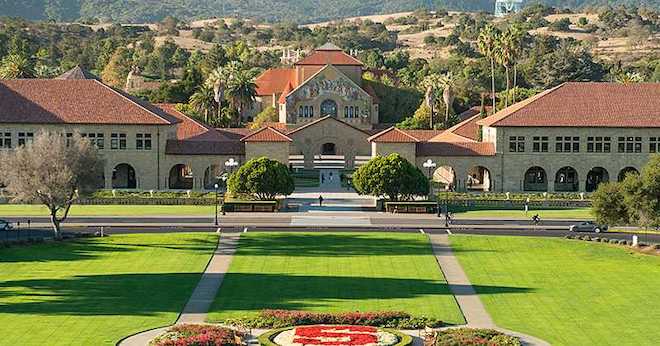
Stanford University
WHY MIT BEAT STANFORD
MIT’s Sloan School has long been an M7 stalwart in the Full-Time MBA space, ranking as high as 6th globally with The Financial Times and 3rd among senior executives surveyed by CEOWORLD. It also boasts highly-respected Executive MBA and Master’s in Finance and Analytics programs. While MIT undergrads can’t major in Business, they can complete a minor or related coursework in the field. In other words, the institute offers a wide and deep portfolio of coursework across various student segments.
What made MIT stand out again in this year’s World University Ranking? You could start with the faculty’s research prowess. It scored a 90.4 index score out of 100 in Research Quality, which is worth a quarter of the ranking’s weight. To put that score in context, it is higher than every Research Quality score in the Top 50 except UC Berkeley (91.5). With a 94.3 Teaching score, MIT also outpoints all but 4 schools in THE’s Top 50 in a category that makes up 29% of the ranking weight. MIT further differentiated itself in Research Environment, which encompasses a 31.6% share of the ranking. Here, MIT’s 95.0 score lagged behind just Tsinghua University, University of Oxford, and the National University of Singapore among Top 50 schools. More to the point, MIT outscored runner-up Stanford in all but one category (Teaching), while posting a near-perfect score in Industry. As a result, MIT remained a cut above its peers in 2026 according to THE.
By the same token, Stanford University fell short due to its 83.5 score in International Outlook, which ranked it 27th among its Top 50 peers. While Industry only represents a 4% weight, Stanford ranked 21st in this category. In contrast’s Tsinghua University’s Achilles Heel came in Research Quality, where it scored nearly 10 points lower than both MIT and Stanford. While Tsinghua University may seem out of place at 3rd according to THE, The Financial Times did rank the school 3rd and 4th globally for its Master’s in Finance and Management programs respectively.

Oxford MBAs decked out in sub fusc
SURPRISES GALORE IN THE WORLD UNIVERSITY RANKINGS
Looking at the 2025 THE Business and Economics Ranking, the Top 20 again consists of the same schools. That’s not to say there wasn’t any movement, however. Tsinghua University climbed from 6th to 3rd, buoyed by improved scores in every category except Teaching. UC Berkeley also improved three spots to 5th, thanks to a 7.5-point jump in Research Quality. The University of Pennsylvania also vaulted into the Top 10, courtesy of improvements across four categories that was capped by a 6.9-point rise in Research Quality.
That’s not to say THE’s Ranking doesn’t give short shrift to several distinguished business programs…particularly in Europe. In the 2025 Financial Times Global MBA Ranking, for example, there are six European programs found in the Top 10: INSEAD, London Business School, IESE, SDA Bocconi, Esade, and HEC Paris. However, none of these programs appear in the World University Ranking’s Top 50. The same goes for IE Business School and IMD, which traditionally finish among The Financial Times’ 20-best globally.
Among American programs, Dartmouth College – a perennial Top 10 MBA program – finished just outside the Top 50 at 51. That’s a better fate than the University of Virginia – with Top 10 programs at both Undergraduate and Full-Time MBA levels – which placed 64th. In fairness, it isn’t just European and American universities receiving questionable scores. In China, CEIBS and the Shanghai University of Finance and Economics traditionally rank as the mainland’s best in The Financial Times Global MBA Ranking. With THE, neither program is even ranked.
The ranking could be described as distinctly Western. Among the Top 50 Universities, 22 are found in the United States, with the United Kingdom (6), Germany (3), The Netherlands (2), Canada (2), Switzerland (1), and Australia (1) also featured in the mix. China accounts for 10 universities in the Top 50, with Singapore (2) and Japan (1) also represented. In a surprise, there are no universities included among the 50-best for Business and Economics from India, France, or Spain.
DOES THE METHODOLOGY HOLD UP?
What should you make of THE’s methodology? On the plus side, the ranking presents a healthy deviation from the usual segmented approach that ignores a university’s wider scope. Still, it shares the same flaw as Bloomberg Businessweek in that it fails to supply underlying data. As a result, it is impossible for readers to replicate the results, let alone compare universities side-by-side except in broader indexed categories.
At the same time, THE doesn’t necessarily analyze what really matters to the consumers of rankings: prospective students. For one, it derives over 50% of its weight from research-related categories. While these measures can reflect practical acumen – if not innovation – they miss a key point. Research and teaching are distinctly different talents. As a result, it potentially places greater emphasis on publication over classroom experience and individual growth. More to the point, the methodology eschews lived experience by failing to incorporate student surveys that would reflect satisfaction in areas like the quality of faculty instruction and career support. Along the same lines, THE ignores alumni, who could provide longer-term perspectives for items like career outcomes.
Bottom line: The World University Rankings is a tool that provides a rare 30,000-foot view of business programming as a whole. Unfortunately, it can’t hide that its data sets are all-too surface level, neglecting the hard work of digging into what really matters to its audience.
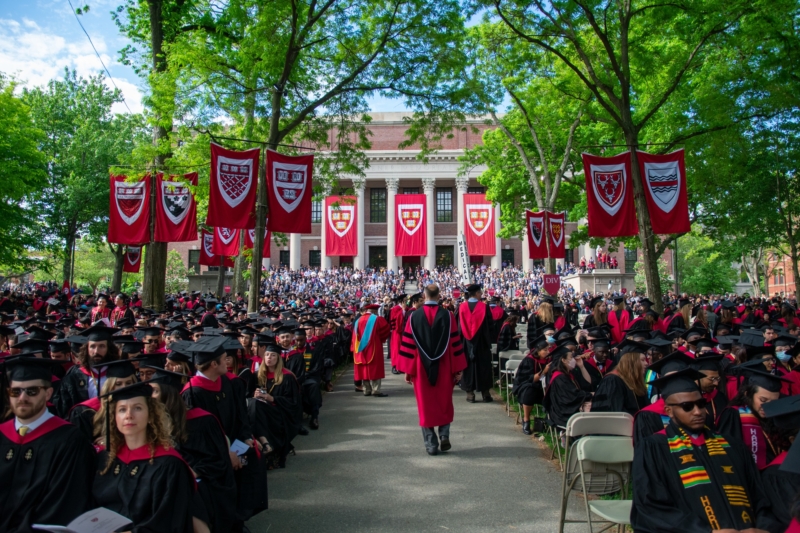
A Harvard Business School graduation. Harvard Crimson photo
RANKINGS BEYOND BUSINESS
Overall, the Times Higher Education World University Rankings cover 11 subject areas using the same methodology (with slightly different weights). Sure enough, MIT didn’t just excel in Business and Economics. It also tops THE rankings in the Arts and Humanities and Social Sciences. That may strike some as a major surprise. After all, MIT reputation’s is grounded in Engineering and Life Sciences. Add to that, there is a certain irony in MIT being beat out in these fields by Harvard University…just a mile up the St. Charles River.
Alas, MIT and Harvard weren’t alone in earning the top spot in multiple disciples. Stanford University claimed #1 in Education and Law, while the University of Oxford achieved the same distinction in Computer Science and Medical and Health. Rounding out the rankings, the University of Cambridge and the California Institute of Technology bested all comers in Psychology and Physical Sciences respectively.
Next Page: Top 50 Universities For Business and Economics
Page 3: Ranking Methodology Details
Page 4: Statistics For Top 25 Universities For Business and Economics
© Copyright 2026 Poets & Quants. All rights reserved. This article may not be republished, rewritten or otherwise distributed without written permission. To reprint or license this article or any content from Poets & Quants, please submit your request HERE.