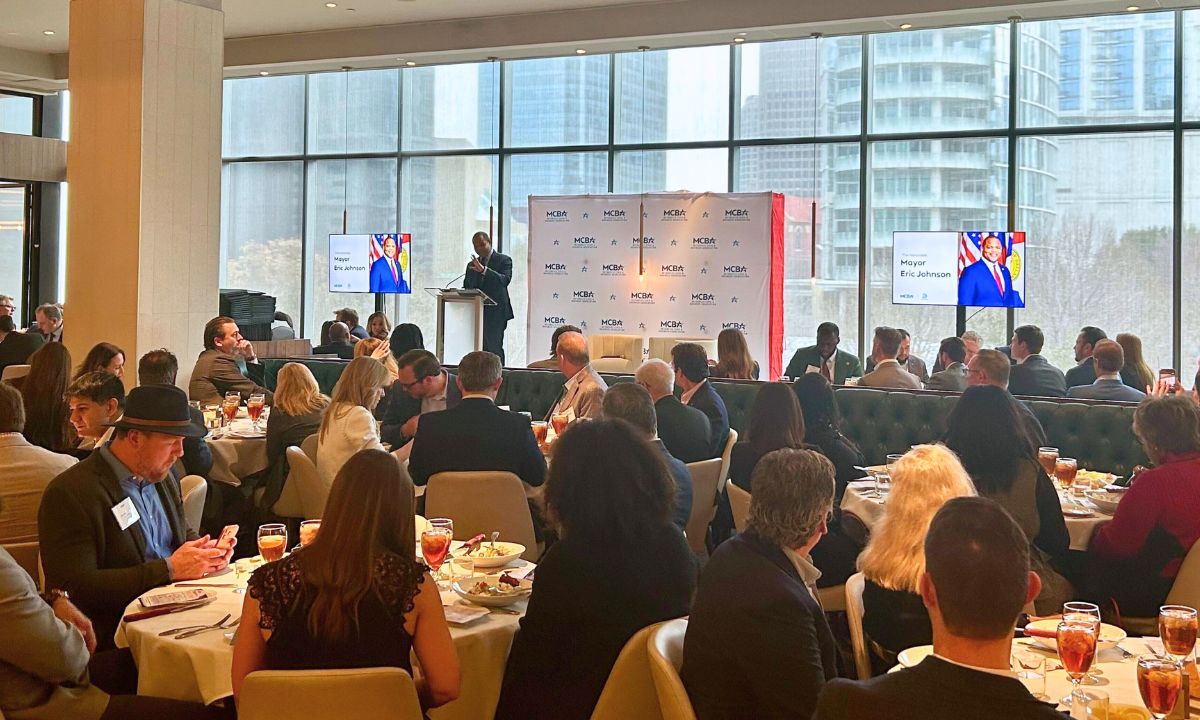
The Metroplex Civic and Business Association hosted its latest leadership luncheon on February 3, 2026 | Image by DX
The Metroplex Civic and Business Association hosted its latest leadership luncheon on February 3, where Mayor Eric Johnson delivered a straightforward address on Dallas’ recent growth and the business community’s role in sustaining it.
MCBA President and Chief Executive Officer Onyinye Akujuo kicked off the fireside chat alongside moderator Amy Robbins of Alexo Athletica, with Johnson promising a conversation rooted in truth and simple facts.
Doug Hutt, chairman and CEO of Dallas Capital Bank, introduced Johnson as a mayor known for understanding and appreciating business. Johnson then presented MCBA with a special formal recognition for its work addressing challenges ranging from crime to homelessness while convening executive leaders from more than 100 companies.
“It was a distinct honor to receive special recognition from Mayor Eric Johnson, highlighting the MCBA’s dedicated service to the City of Dallas and the five counties of the Metroplex. We deeply valued the Mayor’s candid dialogue regarding his vision for attracting premier corporations to our region,” Akujuo said. “Seeing nearly the entire Dallas City Council in attendance was a testament to our shared commitment to collaborative governance, which remains essential as we address our city’s most pressing priorities.”
Following the recognition, Johnson addressed both the city’s challenges and recent developments across Dallas, emphasizing transparency.
“I’m not going to spin you. I don’t do that,” he said.
Five Years of a Decline in Crime
Johnson cited reported public safety improvements, describing five consecutive years of overall declines in violent crime, including a 12% drop last year and a 24% reduction in homicides, despite Dallas’ population size.
“We say safest large city in America, because we want to be honest about the fact that we’re not Mayberry,” Johnson explained. “We’re the ninth largest city in America. It’s got big city problems.”
$27 Billion in “Real” Development
Johnson highlighted development milestones he said distinguish Dallas from other major cities. The city’s park system now reportedly serves more than 80% of residents within a 10-minute walk, up from less than 60% a decade ago, a change he said has improved quality of life and produced economic returns.
“The economic benefit of this park is immeasurable,” Johnson said, gesturing toward Klyde Warren Park in Downtown. “It’s in the billions already.”
Johnson cited $27 billion in new development since taking office, including Goldman Sachs’ planned investment of roughly $750 million expected to bring approximately 2,500 jobs, as well as Scotiabank’s expansion into Dallas with an estimated 1,000 new positions. He said Dallas continues to attract financial institutions relocating from higher-tax and higher-regulation jurisdictions.
Johnson also highlighted that Dallas leads the nation in both family migration and corporate relocations.
Leaning into a Modern Urban Identity
Addressing AT&T’s downtown departure, previously covered by The Dallas Express, Johnson refused to apologize for Dallas being an urban core, saying, “We can either cry about that as a city, or lean into who we are and the successful deals we have with companies who want to be in this environment.”
“We’re going to be aggressively going after companies who want to look out this window,” Johnson declared, before referencing financial firms and other corporations fleeing hostile regulatory environments outside of Texas.
One of Johnson’s most pointed remarks targeted the business community, saying, “One of my biggest frustrations has been with our business community. Voting is the bare minimum that we need from the business community.”
He would go on to challenge executives to understand what economic freedom means in terms of policy, and ask the audience to hold elected officials accountable year-round. “If you don’t have policymakers who make policies that reflect those values, we’re all just screwed.”
The mayor would also warn against supporting political leaders who oppose principles that promote economic freedom, simply because they might help with individual development deals, calling that thinking “shortsighted.”
Professional Sports in Dallas and Protecting Taxpayers
When asked about negotiations with Dallas sports franchises, specifically the future of the Dallas Stars, Johnson was blunt: “They all still want free stuff.”
Johnson explained the delicate balance of keeping teams while protecting taxpayers from wealthy owners seeking subsidies.
“We’ve never had a more sports crazy mayor in the history of the city,” Johnson said. “But I have to make sure that we are doing good deals for the taxpayers of Dallas.”
The mayor added that such negotiations can’t happen publicly. He defended maintaining discretion while working to keep the Stars and Mavericks close to the center of Dallas, unlike other pro teams that carry the city’s name but have moved their stadiums outside of the city.
Looking Forward with a World Cup Focus
When asked about 2026 priorities, Johnson spoke about the importance of executing a flawless World Cup – being the best host possible so that the city can reap the benefits of the global tournament.
Dallas is set to host more World Cup games than any other city, and after being named the sixth-best place to travel in the world in 2026 by the New York Times, the city is preparing for a huge tourism boom.
Johnson’s unvarnished approach appears to have resonated with MCBA’s business leaders, who have made the association’s luncheons regular forums for business leaders to engage with policymakers on Dallas’ economic direction.