

Business
The index climbed into an optimistic range as AI and earnings gains took hold, but before uncertainty tied to the Middle East conflict began.
Massachusetts employers were optimistic for the first time in a year last month, as stronger productivity from AI and higher corporate profits lifted sentiment.
However, the increase in the Associated Industries of Massachusetts Business Confidence Index came as the U.S. lost 92,000 jobs last month, and before the recent escalations of the conflict in Iran.
“The reported uptick in confidence is welcome, but these results largely predate the military conflict in the Middle East,” said Michael Goodman, a professor of public policy at UMass Dartmouth and an AIM Board of Economic Advisors member. “That matters.”
“Continued conflict has direct implications for energy prices, inflation, and supply chains — all of which weigh heavily on business confidence,” he continued.
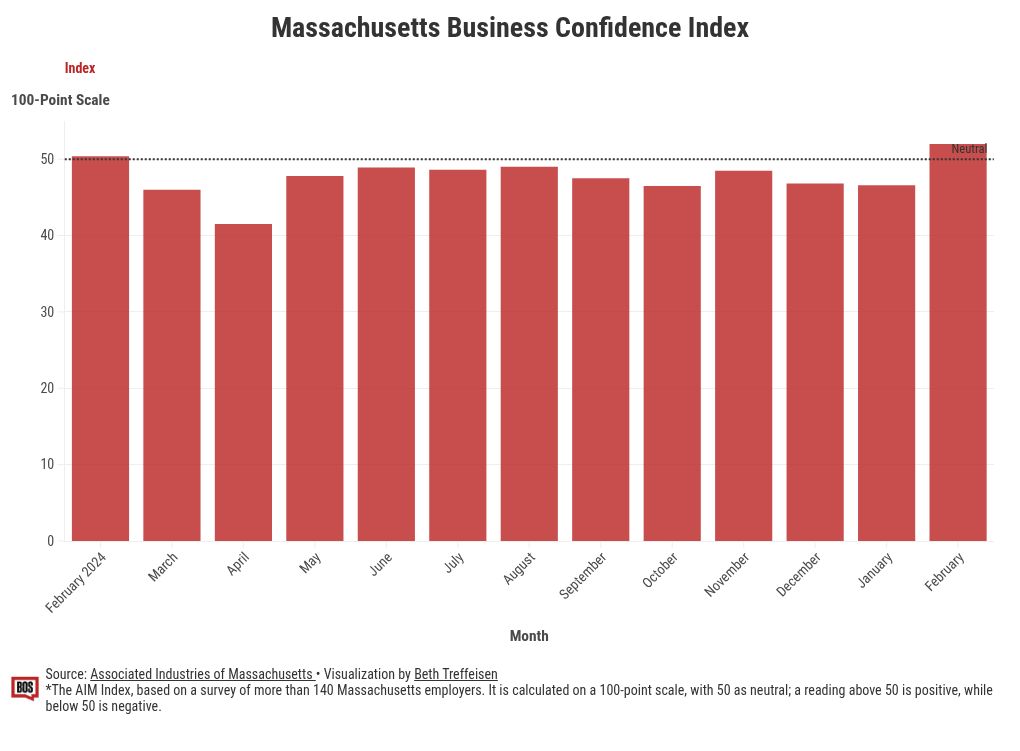
The AIM Index is a survey of more than 140 Massachusetts employers that has run since 1991. It is calculated on a 100-point scale, with 50 as neutral; a reading above 50 is positive, while below 50 is negative. The state’s February rating was 52, up from 46.6 in January.
According to Sara Johnson, chair of the AIM Board of Economic Advisors, which oversees the Business Confidence Index, the deployment of artificial intelligence, especially at larger companies, boosted productivity and helped Massachusetts employers cope with labor supply constraints.
In addition, Johnson said that sustained economic growth and favorable federal tax policies are encouraging business investment.
However, companies that participated in the survey continued to express concern about tariffs and inflation.
In addition, AIM President and CEO Brooke Thomson said that employers remain concerned about the cost of everything from energy to housing to health care in the state.
She noted that the state recently passed legislation to help curb rising energy costs and strengthen oversight of energy efficiency programs.
“These are real issues for companies and employees alike,” Thomson said in a statement. “The effort to stem the outmigration of working-aged residents begins with moderating costs that make Massachusetts an outlier among states.”

Sign up for the Today newsletter
Get everything you need to know to start your day, delivered right to your inbox every morning.