Sean Wilkerson was fired up when the phone started ringing again.
Over the course of a few days last month, three out-of-town customers checked in to buy old doors, shutters and other items from The Bank Architectural Antiques, the Wilkerson family’s 54-year-old architectural salvage business based in New Orleans’ Central City.
After a typically slow summer turned into an atypically slow fall and winter, the local salvage industry veteran was more than ready to hear from clients looking to acquire some of the 10,000 cypress doors and other treasures he has stockpiled in a block-long warehouse stretching between St. Andrew and Felicity streets.
Wilkerson and other architectural salvage pros in south Louisiana say demand for their products has been down the past several years because of high interest rates, spiking insurance costs, a statewide film industry slump, a shortage of tradespeople skilled at working with old materials, and a nationwide shift toward contemporary styles and open floor plans.
Several multi-generational family businesses like The Bank — along with a few newcomers — have been leaning into other products and services as they wait out the downtown and make plans for what they hope will be a homebuilding and renovation comeback that will boost their corner of the nearly $60 billion global reclaimed lumber marketplace.

Sean Wilkerson, owner of The Bank Architectural Antiques, looks through doors on display at his warehouse and retail store in New Orleans’ Central City neighborhood on March 16, 2026.
The Bank, for its part, has been focusing on services like rebuilding shutters and stripping paint from items customers bring in while continuing to build up inventory that Wilkerson considers a bet on the future of his business.
“All of this is going to pay off,” he said. “The market is going to hit us again like it was 2018 through 2020, and we’re going to be flowing.”
Challenges to salvage
Though the practice dates back centuries, architectural salvage in the United States emerged as a defined business category in the 1970s in response to the nation’s new focus on preservation and sustainability. The trend took off further over the following decades, fueled in some cities — like New Orleans — by urban decay that led many older homes to deteriorate and face demolition.
Businesses like The Bank — and its chief competitor Ricca’s Architectural Sales — began acquiring valuable doors, floors, molding, fixtures and other elements from homes before they were demolished. Then came Hurricane Katrina, which destroyed or led to the demolition of thousands of houses in the metro area.
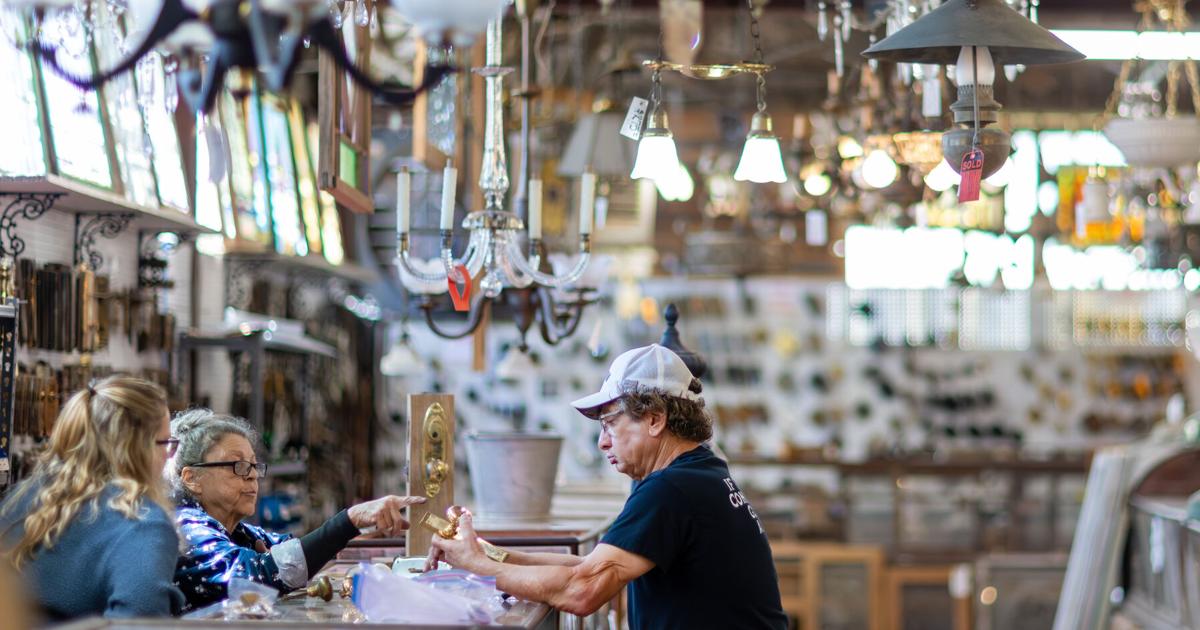
Julie Hoy talks with a customer at Ricca’s Architectural Sales in New Orleans on Friday, March 13, 2026. (Staff photo by Brett Duke, The Times-Picayune)
For a while, that destruction and the rebuilding process that followed meant a seemingly endless supply and demand for salvaged items. Now, though, that post-Katrina era is over — and salvage supply and demand are both lower this decade than they were during the last one, according to longtime operators in the field.
Julie Hoy, third-generation co-owner of Ricca’s, said the post-pandemic rise in home loan interest rates, combined with the storm-related spike in flood and homeowners’ insurance costs in the Gulf South mean fewer people are buying and renovating houses, which means there’s less demand for salvaged architectural elements.
“People don’t want to invest where they’re not sure if the market will be stable,” said Hoy, whose Mid-City showroom is filled with antique and vintage lighting, hardware and other finds.
Kavanaugh Farr, owner of Strip-Ease, located a few blocks away, has seen the same thing.
Kavanaugh Farr stands among salvaged doors at Strip-Ease of New Orleans Inc. in New Orleans on Friday, March 13, 2026. (Staff photo by Brett Duke, The Times-Picayune)
“I talk to a lot of contractors, and there aren’t that many jobs starting or houses changing hands,” said the second-generation owner of a family business that provides paint stripping, millwork and sales of salvaged goods.
Hoy also believes stricter short-term rental regulations in New Orleans are discouraging investors from buying and renovating properties, and she said the slowdown of the Louisiana film industry has been bad for business.
“Set decorators used to buy light fixtures and other things from us,” she said. “During the pandemic, the TV series ‘Interview with the Vampire’ provided up to 20% of our income one year, but it’s not like that anymore.”
Willie White, who has been deconstructing homes in the New Orleans area for four decades, said business has slowed down because homeowners are renovating more rather than starting from scratch. That means there are fewer houses to work on, and what’s in them is in worse condition.
“I used to have one lined up right behind another,” White said. “Now, it’s maybe one every six weeks.”
Ornamental iron pieces at Ricca’s Architectural Sales in New Orleans on Friday, March 13, 2026. (Staff photo by Brett Duke, The Times-Picayune)
Elsewhere in the state, salvage operators are experiencing similar things. Don Charlet, co-owner of The Corbel home decor and furniture gallery in St. Francisville, said he’s seen demand for salvaged items dip as the number of high-end residential projects is down.
Matthew Latiolais, owner of Cajun Salvage in Lafayette, said he still sees demand for salvaged items in certain cases, but the material is getting harder to find.
In Baton Rouge, Garrett Kemp, who has owned Circa 1857 for the last decade, said he’s moved away from selling salvaged goods to focus instead on imported European antiques.
Kemp said consumers who watch renovation shows suffer from the “HGTV effect” and have unrealistic expectations about what salvaged items should cost.
And, because of scarcity, Wilkerson said the way he searches for items has changed dramatically.
“The easy stuff has been exhausted,” he said. “Now, we scour Facebook posts and estate sales, going farther for fewer items. I’ll go all the way up to the third floor of an attic on Bourbon Street to retrieve something.”
‘Economic development rather than trash’
Fashion is another reason for the drop in demand for salvage. The current trend in home renovations is to open up floor plans, which reduces the need for interior architectural details like doors, trim and mantels. This is especially true for homes that have been renovated to use as short-term rentals.
The trend caught the attention of the Louisiana Landmarks Society, which last fall put architectural interiors on its list of the most endangered landmarks in New Orleans.
Window cornices are seen at Ricca’s Architectural Sales in New Orleans on Friday, March 13, 2026. (Staff photo by Brett Duke, The Times-Picayune)
“It’s fairly common to see a pristinely preserved home exterior and it might feel gutted, generic and modern inside,” said MaryNell Nolan-Wheatley of the Preservation Resource Center, a 52-year-old nonprofit founded to preserve the historic architecture, neighborhoods and cultural identity of New Orleans.
Over the decades, salvage companies have been criticized by preservationists and others over the ethics of stripping old New Orleans homes of materials — and for potentially buying stolen items. But Nolan-Wheatley said the PRC supports the companies keeping the material in commerce.
“Salvage has an intrinsic value and should not be thrown away,” she said. “The city should be doing more to incentivize deconstruction and salvage over pure demolition. When the materials are re-sold, the city gets sales tax dollars and jobs. It’s economic development rather than trash.”
Nolan-Wheatley said her organization also advocates for reforms to the renovation permitting process and to rental regulations that make it easier for homeowners to improve their houses, make extra income and help bring vacant and blighted properties back into commerce. In general, the PRC favors policies that will encourage more investment in housing stock in a city that struggles to maintain its infrastructure with a population that’s approximately half of what it was at its peak in the 1960s.
“People don’t understand the reality of the situation,” she said. “We don’t get enough money from tourists to make up the difference.”
Looking ahead
Despite the pressure points, Wilkerson, Hoy and the rest are optimistic about the future of their businesses. And during the recent downtown, they’ve been joined by some new competitors.
Door plates line a wall at Ricca’s Architectural Sales in New Orleans on Friday, March 13, 2026. (Staff photo by Brett Duke, The Times-Picayune)
Two years ago, Kristin Gisleson Palmer, executive director of the PRC, and her husband Bobby Palmer opened a retail business called Bargeboard to sell material they accumulated over the last decade after renovating roughly 80 homes on the West Bank.
“When you open up a room or change a floor plan, you always end up with leftovers,” said Bobby Palmer, who said the salvage sales are a small percentage of the company’s overall income.
Kavanaugh Farr, the Strip-Ease owner, sees mostly good things ahead.
“We have a new mayor, and interest rates are starting to drop, so hopefully that will get the market stimulated,” he said. “Although I don’t know how the insurance problem will get solved. They don’t tend to lower their rates, and we’re in a high-risk market with hurricanes.”