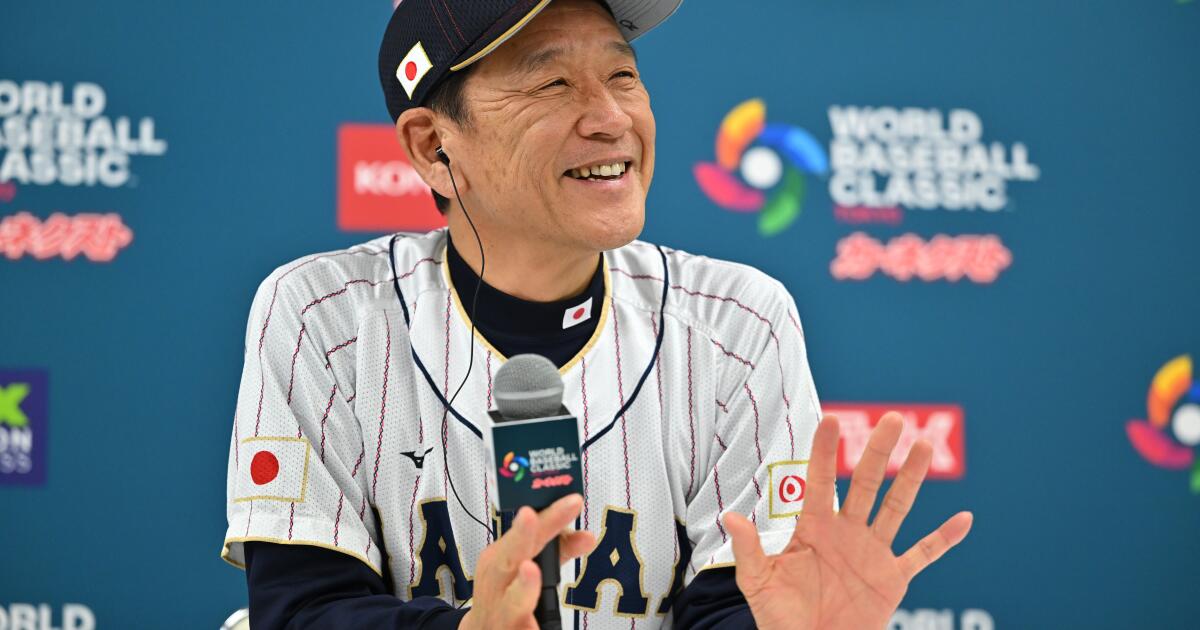
PHOENIX — The man who managed Shohei Ohtani in Japan dropped by the Dodgers’ training camp the other day, camera crew in tow. He was there to interview Andrew Friedman.
Friedman, quite naturally, assumed the questions would be about Ohtani.
Not at all. The questions were about Friedman, and what he had in common with the people who lead companies that make bullet trains and electron microscopes and Hello Kitty.
Hideki Kuriyama managed Ohtani on the Nippon Ham Fighters, the team that nurtured Ohtani’s ambition of pitching and hitting at an elite level. Today, in addition to serving as the Fighters’ chief baseball officer — the equivalent of Friedman’s role as the Dodgers’ president of baseball operations — Kuriyama hosts a prime-time television show in which he interviews the top executives of global corporations based in Japan.
These companies are household names in Japan, and often in the United States: Hitachi. Suzuki. Japan Airlines. Nippon Steel. Rakuten, the e-commerce giant. Sanrio, the Hello Kitty people.
The Dodgers are a household name in Japan.
The Dodgers are the brand. Nippon Ham is a brand too, but that brand is a food processing company.
Remember when Fox owned the Dodgers and Disney owned the Angels? That is baseball in Japan: teams owned by companies that can be more interested in their core business of financial services or transportation or media or whatever than in their team.
“The Japanese baseball market is stuck,” Kuriyama told me through interpreter Chinami Inaishi. “Ownership belongs to the owner-corporations. They really see the teams as part of their branding and marketing. Their efforts to focus on the team strength seems very different than that of Major League Baseball.”
That, really, was what Kuriyama wanted to talk about with Friedman: What could Japanese teams learn from how Friedman leads?
“One of the things that we talked about was patience,” Kuriyama said, “the ability to wait. I felt that. A lot of people have said that about him, so I’ll take that to heart.”
The Dodgers’ Shohei Ohtani, left, is congratulated by team president of baseball operations Andrew Friedman after the Dodgers clinched the National League pennant last October.
(Robert Gauthier/Los Angeles Times)
Beyond that? Friedman talked about integrating the work of different departments, no matter how unrelated those departments might appear from the outside.
“One of the things I learned is that an organization is not just the sum of people,” Kuriyama said. “To have a really good organization, everyone has to be united in what they want, and each person has to contribute. It’s kind of like multiplication rather than addition.”
To Friedman, championship math is about more than wins and losses.
“We spent time talking about the quest we are on to create a destination spot,” he said. “Obviously, the primary goal is to win championships. But that’s an outcome. We believe the process part of increasing your chances of getting there is by creating a destination spot where your really good players don’t want to leave, and where players on other teams are longingly looking at, like, ‘Oh man, I want to play for them.’
“We are way better at it today than we were five years ago, but it is like a living organism that we have to continue to nurture. It is not something where we will ever take our foot off the gas and say, ‘OK, we’ve got it.’”
Nothing beats winning — or, for the cynical, high salaries. But, when the Dodgers go beyond the scoreboard and payroll to provide innovative biomechanical and nutritional analysis to their players; expand the home clubhouse twice in barely a decade and take special care of player families; and add a second chartered team flight so the players can take their own plane, players take notice.
“We’re on a quest to get better at everything we do,” Friedman said. “If you listen to some of our internal meetings, and you listen to us challenge each other to get better in different areas, you would think we finished in last place last year.
“We take a very critical look at what we’re doing and what things we do better and what things we are not doing as well, and how to enhance those parts of our operation. That is our mindset: figuring out a way to continuously get better at everything we do.”
Kuriyama brought up an interview Friedman did three years ago, after Friedman visited Japan and marveled at how many fans gathered to watch Team Japan workouts in advance of the World Baseball Classic.
“It also struck me how many different team hats were there,” Friedman said. “You’d see a Dodgers, and a Cubs, and a Yankees, and a Red Sox. You saw a smattering of different teams. And that’s what got us thinking like, ‘Man, if we could actually convert more fans here into loving Dodger baseball, the benefits that come with that.’”
In the ensuing 20 months, the Dodgers signed Ohtani. Yoshinobu Yamamoto and Roki Sasaki have followed, as have back-to-back World Series championships and a burgeoning Japanese fan club.
“They are, absolutely, bar none, the most popular team,” Kuriyama said.
The Dodgers are the favorite MLB team of 59% of Japanese sports fans, according to a YouGov poll released this week. The New York Yankees rank second at 14%; no other team polled at even 10%.
According to the poll, 78% say Ohtani is one of their favorite MLB players, 79% say Ohtani has increased their interest in MLB since he signed with the Dodgers, and 87% say they have a positive impression of him.
Ohtani made an estimated $100 million last year in sponsorships and endorsements, including the promotion of a skin care product that the 64-year-old Kuriyama said he has tried. I asked Kuriyama how far he could walk in Japan without seeing an advertisement for Ohtani.
“Less than 10 steps,” he said.
Kuriyama held firm that Ohtani could prosper as both a pitcher and hitter at a time that opinion was far from universal. Now that Ohtani is the game’s best player, and an international superstar that transcends sports, Kuriyama must feel like a proud father.
“He was incredibly talented,” Kuriyama said. “So, rather than being a proud dad, I feel like, ‘Thank you for not injuring yourself, and thank you for putting the work and effort into being where you are today.’ I am actually a little relieved.”
I asked Kuriyama if there was anything Ohtani could do that he has not already done.
For one, Kuriyama said, the Cy Young Award.
“He’s actually more talented than people think he is,” Kuriyama said. “I firmly believe that he is going to surprise many of you.”
He only — and, yes, Kuriyama used the word “only” — hit 55 home runs last season. Does Kuriyama believe Ohtani could reach the single-season MLB record of 73?
“Yeah,” Kuriyama said.
If Ohtani does that this year, the Dodgers might well become the first team in National League history to win three consecutive World Series championships. If the Dodgers do that, flooded with cash from Japan and all over the world, the interview Friedman does next spring might be with the Harvard Business School.