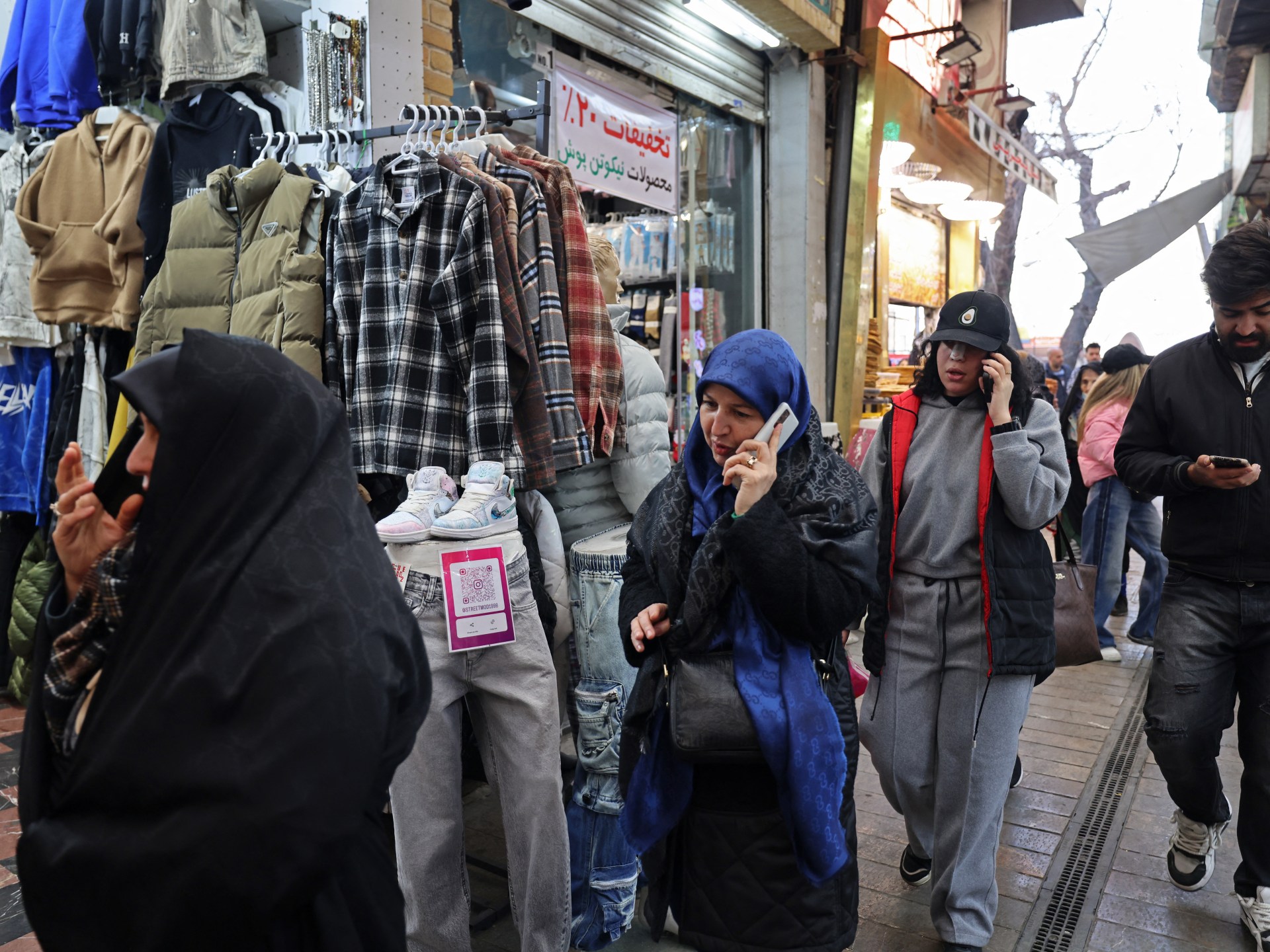
Tehran, Iran – Iran’s economic outlook appears increasingly grim more than three weeks after the start of what became one of the most comprehensive and prolonged state-imposed internet blackouts in history, impacting a population of more than 90 million people.
Iranian authorities abruptly cut off all communications across the country on the night of January 8, at the height of nationwide protests that the United Nations and international human rights organisations say were suppressed with the use of deadly force.
Recommended Stories
list of 3 itemsend of list
Most of Iran’s internet bandwidth, local and international phone calls and SMS text messages have been restored over recent days. But most of the country is still unable to freely connect to the global internet amid heavy filtering by the state.
The increased bandwidth allows more people to circumvent state restrictions using a variety of proxies and virtual private networks (VPNs), but solutions are often costly and temporary.
Last week, Information and Communications Technology Minister Sattar Hashemi told reporters his ministry estimates that the Iranian economy suffered at least 50 trillion rials (about $33m at the current exchange rate) in damages on a daily basis during the blackout.
But the minister admitted that the true toll is likely much higher, and said that other ministers and economic officials have privately offered heftier estimates that he did not expand upon.
‘Can’t do anything without the internet’
The government of President Masoud Pezeshkian has said the decision to fully block connectivity was taken outside of its control by the Supreme National Security Council.
Pezeshkian, who had made scaling back internet filtering a main campaign promise, has refrained from talking about Iran’s largest internet blackout to date, instead focusing on economic reforms and cash subsidies.
The administration has promised to offer online businesses financial support, but the losses have already been sudden, acute, and too heavy to bear for many.
Simin Siami, a travel agent working in Tehran, told Al Jazeera that her company lost most of its income and had to lay off a number of employees.
“Most international flights were cancelled, and there was no way to purchase tickets or compare existing flights,” she said, adding that her company was also unable to book hotels for customers, who were initially even unable to renew their passports.
“Unfortunately, that limited our services to selling tickets for local flights and booking local hotels, and cancelled all our previous international tickets and bookings.”
Saeed Mirzaei, who works at an immigration agency in the capital, said 46 employees at his company had to go on mandatory leave for weeks amid the shutdown.
He told Al Jazeera that they suddenly lost all contact with foreign counterparts, were unable to get updated information from embassies, and missed deadlines to apply for universities on behalf of their customers wishing to leave a heavily sanctioned Iran for better opportunities.
“We can’t do anything without the internet because our work deals directly with it,” Mirzaei said.
National internet a ‘bitter joke’
During the blackout, Iran’s theocratic establishment even struggled to sustain basic services using the so-called National Information Network, a limited nationalised intranet.
The connection to the intranet was slow and patchy, many companies remained disconnected from it, and those that were allowed to connect retained only a fraction of their customer base amid general economic stagnation across the country.
Hashemi, the communications minister, said a demand by hardliners within the establishment to move away from using the international web in favour of a domestic connection was a “bitter joke” that is not feasible to enforce.
He said his ministry estimates that the country’s online businesses could survive under a blackout for roughly 20 days, signalling that the state had no choice this week but to gradually restore internet bandwidth.
Figures for economic damages incurred by the blackout published by officials reflect only the visible costs and do not account for hidden losses, according to Abazar Barari, a member of Iran’s Chamber of Commerce.
“In the import and export sector, processes are heavily dependent on the internet from the very initial stages – such as price negotiations, issuance of pro forma and other invoices – to coordination with transportation companies and the verification of documents. As a result, the internet shutdown effectively disrupted foreign trade,” he told Al Jazeera.
“During this period, customer attrition also occurred, with the damage being particularly severe in certain food commodities, as many countries are unwilling to tie their food security to unstable supply conditions.”
‘They have no right to do this’
In a tumultuous country with one of the highest inflation rates in the world, numerous Iranians who tried to make money online to stay afloat are now deeply anxious as well.
From owners of small online businesses to teachers, chefs, crypto traders, gamers and streamers, people are taking to social media to ask others for extra support after the gradual reconnect this week.
Mehrnaz, a young video editor in Tehran, said she only went back to work this week after her company put her on forced leave without pay from the start of the protests in the city’s business district in late December.
“I was on the verge of having to move back to my parents’ house in another city. I’m only 25, and I hit near-zero for the second time this year. There might not be another time,” she said, pointing out that the first time was during the 12-day war with Israel and the United States in June.
Iran’s National Post Company announced on Sunday that postal deliveries experienced a 60-percent fall at the height of the blackout, mainly damaging small and home-based businesses that depended on mailing their products.
But beyond livelihoods, many in Iran are also angered by the fact that the state can cut off communications on command, violating the people’s right to benefit from the internet.
“They had the nerve to create a tiered internet and decide which type of use is ‘essential’,” said a woman who asked not to be identified for safety reasons.
“My child wants to search about his favourite animation movies, my mom wants to read news on Telegram, and my dad wants to download books. I want to go online and write that they have no right to do this.”