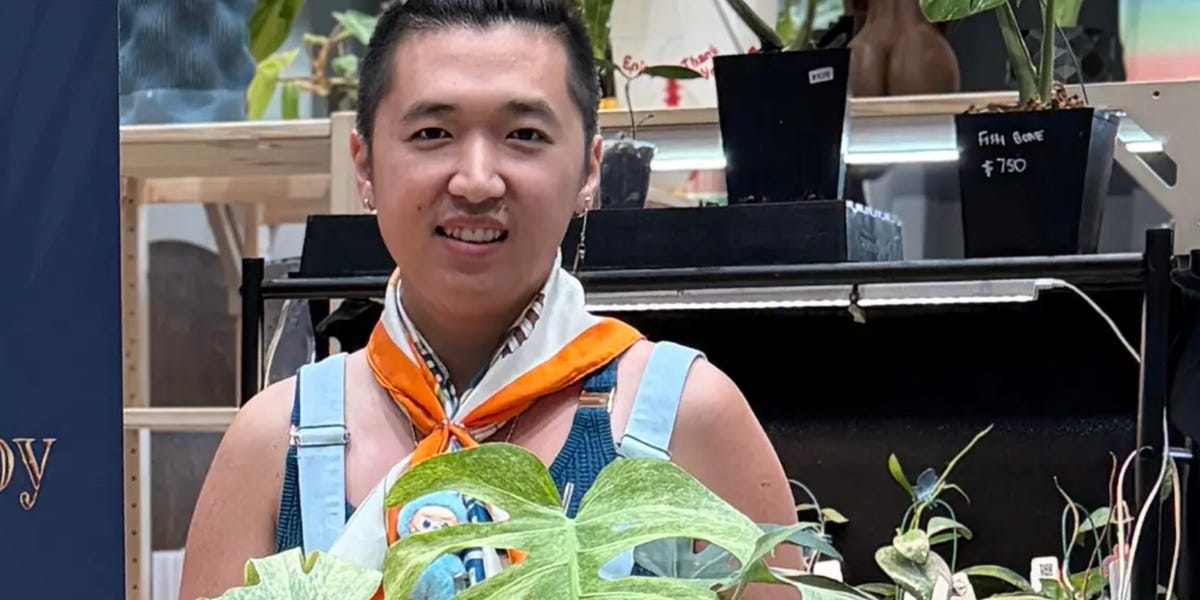
This as-told-to essay is based on a conversation with Harry Luu, owner of PlantZaddyTherapy. It has been edited for length and clarity.
I’ve always been a gardener and enjoyed being around plants. While I was in graduate school studying math, my collection of houseplants grew. There’s an attention to detail and a hyperfocus that I found in both mathematics and plants, so my hobby complemented my academic career.
During the pandemic, my interest in rare plants blew up. I started getting a bigger collection and trading up for more valuable plants.
Eventually, my hobby transformed into a business. I finished my graduate degree and started teaching math in California, but three years ago, I left academia to sell plants full-time.
My academic career was a safety net for my family of 8
I grew up in Vietnam, and I’m the embodiment of the American dream for my family. They put all their eggs in my basket, which allowed me to come to America and study. Now, I feel it’s fair to return their investment. I support not only myself and my husband, but also my parents, my brother, my sister-in-law, my niece, and my nephew.
Leaving my job while supporting a family of eight in California might seem risky, but it was calculated. I had reached the point where I saw the potential for financial freedom from investments I had made during grad school that had very good returns. I had years of data on plant sales, and also knew I could return to academia if needed, so I had a safety net.
I price based on rarity and desirability, without going too high
I was already connected to the rare plant community, so selling increasingly expensive plants felt like a natural progression. I grew my platform on Palmstreet, an online marketplace.
This year, I had two record-breaking sales in one day. I sold a $16,000 plant (an Anthurium Variegated Forgetii x Heinz, one of only two in the world), then a $26,000 plant (the only specimen of the True Variegated Lux Albo Mother Plant).
Courtesy of Palmstreet
I’m a math person, so I use a formula to price. I calculate rarity and desirability and compare them with price data from the previous three years. These plants were both very rare and highly desirable, which drove prices up. However, I didn’t want to price them too high, because I’m thinking about the long-term viability for my brand: people have to be able to purchase what I’m selling. Given how rare the plants were, their five-figure prices weren’t too big a splash.
I want to be able to connect with the community more
Despite those big numbers, the business’s income fluctuates dramatically. My best single week was over $200,000 in sales, but other weeks I might have no sales. The market is seasonal, and winter is slow. I’ve had to adapt to not having a steady, reliable income.
The money comes and goes, but the work never stops. Right now, I spend about 100 hours a week on the business. We have plants in our home, and also a large greenhouse on our property. My brother does some of the maintenance care for the plants, but all the breeding decisions are made by me.
I’m on the cusp of the company being able to sustain itself without me working so much. I look forward to that — when I can step back from the business side and focus more on the joy of growing. I would like to share my knowledge about rare plants and take the plants on the road to connect with my community more, since that’s what got me hooked on growing in the first place.