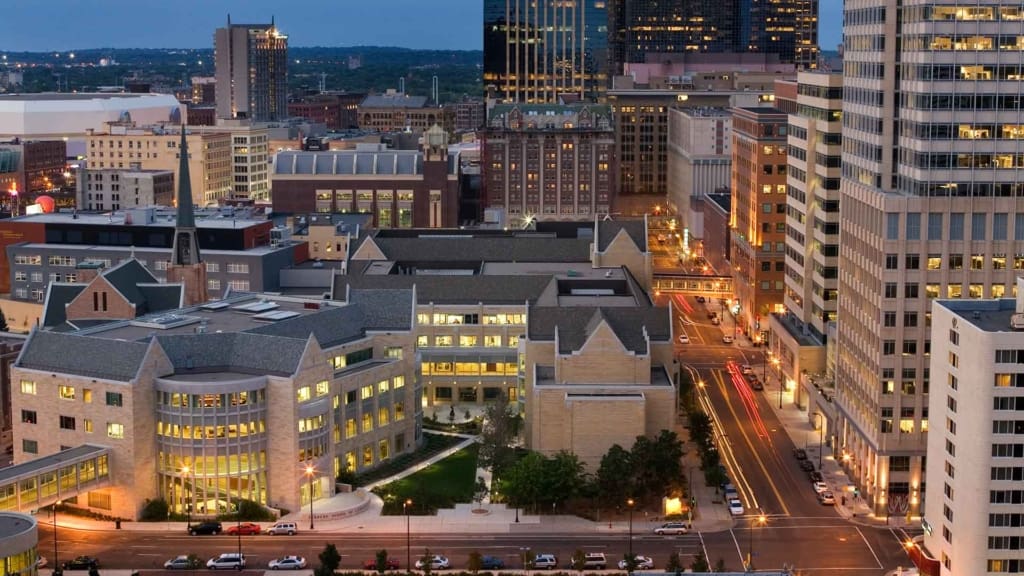
The University of St. Thomas Opus College of Business campus in downtown Minneapolis, where administrators say students have reported feeling safer on campus than in surrounding neighborhoods amid heightened federal immigration enforcement across the Twin Cities.
From the windows of the University of St. Thomas Opus College of Business, Minneapolis has likely looked deceptively calm the last several weeks.
One campus sits just blocks from downtown streets that have filled with federal agents and demonstrators amid Operation Metro Surge, the Trump administration’s expanded immigration enforcement effort in the Twin Cities. Another lies along the Mississippi River in St. Paul, physically removed from the surge but not from its emotional weight.
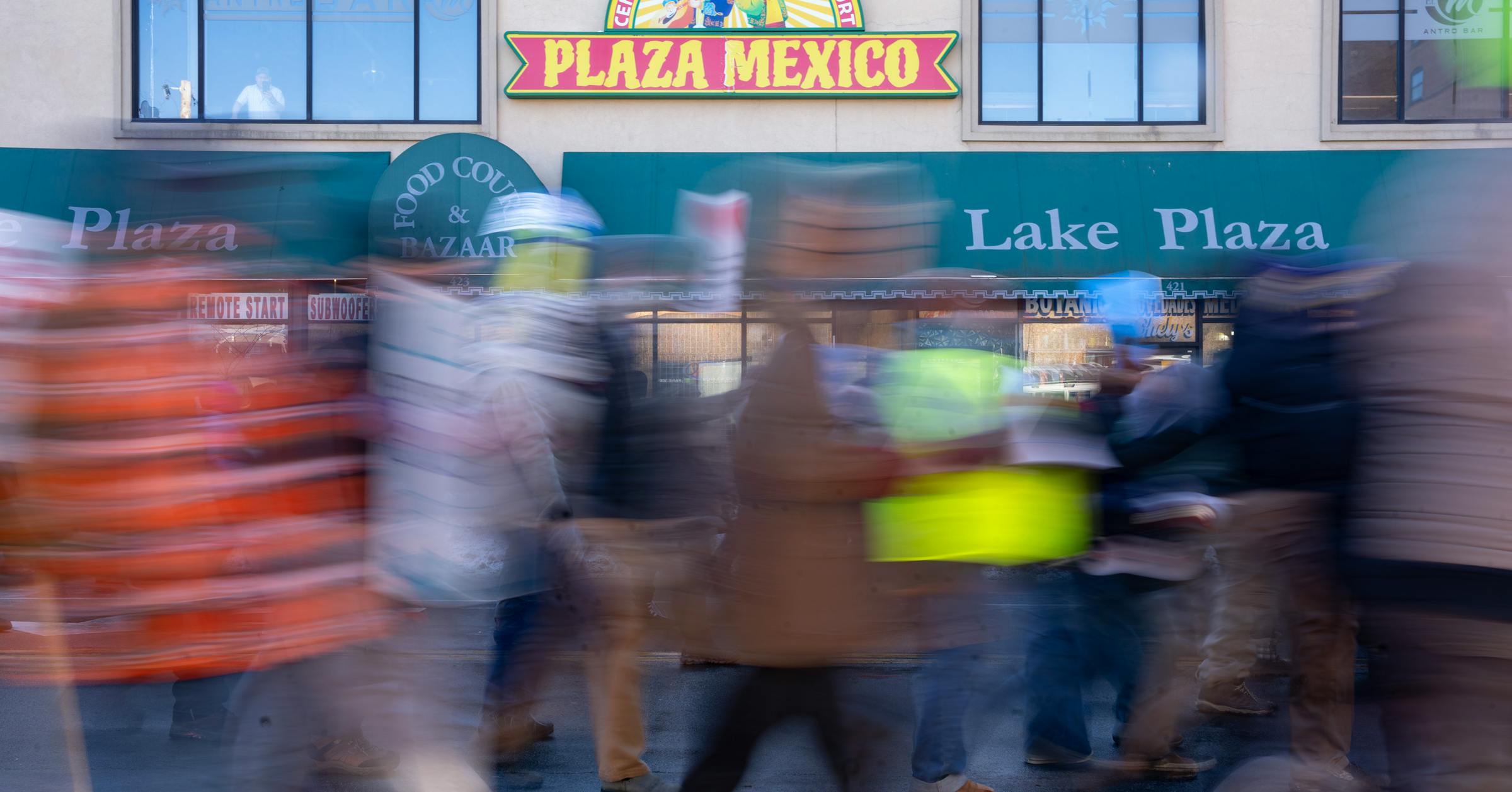
Well before the latest surge erupted with the killing of U.S. citizen Renée Good on January 7, cell phone videos capturing agents pulling people out of cars, staking out schools and daycares in unmarked vehicles, and lodging gas canisters at crowds in neighborhood streets had spread across the world and heightened fear across the region.
Saturday’s killing of Alex Pretti, a 37-year-old ICU nurse shot by federal agents, threw flames on the fire.
“This is an incredibly hard time,” Opus dean Laura Dunham tells Poets&Quants. “Whether you live in a neighborhood that’s been impacted, know someone who has been affected, or are trying to make sense of what you’re seeing on social media versus your own community, it takes a psychic toll.
“Especially after the tragedy over the weekend.”
While federal agents have not carried out enforcement actions on campus, at least to date, the school has for months been preparing students, faculty and staff on what to do if federal agents come to campus.
“I’m happy to tell you that there hasn’t been, so far, a lot of ICE presence in this immediate community, and certainly not on campus. So that’s been really important and a good thing,” Dunham says.
“Actually, we’re hearing from our students that they feel safer on campus sometimes than they do at home.”
A BUSINESS SCHOOL IN THE EYE OF A POLITICAL STORM
Perhaps luckily, the federal surge arrived during Opus’ J-term, an intensive three-week academic session between fall and spring semesters. Many undergraduates are abroad for short-term international business courses or enrolled in hybrid classes, often online.
Students officially return to campus for Spring Semester on Monday, February 2. As the date draws closer, faculty and administrators are hearing more from students nervous about the return.
“We have international students. We have immigrant students, and we have students from refugee communities who are all here legally, but of course they’re scared,” Dunham says.
Laura Dunham, dean
“It’s interesting to me that our student workers still want to come in for their jobs because they feel safe on our campus. And, because a lot of them are hunkering down at home and otherwise not really getting out, this provides a sort of human contact, community, and a sense of welcome.”
Throughout the surge, university leaders have been bringing together the president’s cabinet, deans, faculty, staff, and student leaders to assess how best to support the campus community.
Protocols for federal presence on campus have been disseminated through town halls, community messages, and online resources. If an agent arrives, staff are trained to contact campus public safety and legal counsel immediately. Public safety then asks whether the agent has a judicial warrant signed by a judge before anyone engages further. While agents are generally able to enter public spaces on campus, classrooms, dorm rooms and other spaces are considered private.
The university’s SafeZone app allows students and staff to request help quickly, connecting them with campus safety or emergency services when needed.
“We ask them to please wait until somebody who is authorized to interact with them comes along,” Dunham tells Poets&Quants. “We have people here watching so that if anything happens, there is an immediate response from people who are trained to manage the situation in a way that will hopefully deescalate absolutely, but keep everybody safe, and keep it legal.”
So far, courses have not been moved online or class sessions cancelled. Doing so could jeopardize international students’ visa status, since many are required to maintain significant in-person engagement and can take only one online course.
Instead, the school is building flexible, individualized options. Students are encouraged to reach out to faculty or the Dean of Students Office if they feel unsafe commuting, waiting at bus stops, or leaving family members. The school does not inquire about legal status, but works to accommodate students’ circumstances in ways that keep them academically engaged.
Those accommodations may include joining classes remotely, recorded lectures, special assignments, or additional online sessions, depending on a student’s situation. Faculty, staff advisors, and the Office of International Students and Scholars have been briefed and are in close contact with students.
Dunham emphasized that Opus’ relatively small class sizes and teaching-focused culture make that responsiveness possible. As the spring semester approaches and more students return to campus, she said the school is prepared to respond creatively and case by case, drawing on lessons learned during COVID but applying them in a more targeted ways.
CHOOSING COMMUNITY OVER ISOLATION
After border patrol agents shot Pretti up to 10 times on Saturday morning, thousands of Minnesotans flooded the streets in sub-zero temperatures to demand ICE leave the state. News has developed quickly since. Border Patrol Commander Greg Bovino was ordered to leave late Monday, and there have been rising calls for the resignation or firing of U.S. Secretary of Homeland Security Kristi Noem.
Nevertheless, there are still about 2,000 federal agents on the ground in Minneapolis and its surrounding neighborhoods, an astonishing number in what many see as a federal occupation of an American city.
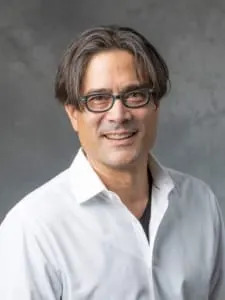
Christopher Michaelson
For Christopher Wong Michaelson, a philosopher and professor of business ethics at Opus, the return to campus in this moment is not just a logistical question. It is a human one.
He is reminded of the early days of the pandemic when many schools rushed to find ways to deliver content online, only to discover that many students wanted to return to campus as soon as they safely could.
“There’s a sense in which campus is a safe and familiar and friendly place,” he tells Poets&Quants. “They want to be with a community that they care about and that cares for them.”
That instinct reflects what education is meant to provide: Not just credentials, but a moral community where students learn how to live alongside people who see the world differently. At Opus, that idea is often described as a “culture of encounter.”
“One thing I think our university has tried to do is be respectful of viewpoint diversity without being relativist,” he says. “We’re willing to talk respectfully with people who have different views, and we’re not going to push them away.”
That approach feels especially urgent now, when students return to classrooms carrying fear, anger, and uncertainty, often shaped by sharply opposing narratives. Michaelson does not pretend those tensions disappear at the campus gates. But he believes education gives students a place to wrestle with them openly.
BUSINESS CLASS LESSONS FROM THE SURGE
For now, the St. Thomas’ top priority is personal safety and community wellbeing while maintaining the school’s vital academic mission, Dunham says. As a Catholic university, that commitment is rooted in human dignity and responsibility to one another.
For faculty like Michaelson, the questions raised by the ICE surge will not end when the agents leave. They are likely to surface in classrooms, case discussions, and ethics courses, where students are asked not just what happened, but what it means for leadership, responsibility, and the role of institutions under moral strain.
Michaelson has spent years studying how people relate to their work. He is the author of Is Your Work Worth It? and host of the podcast Work in Progress. At Opus, he also serves as academic director of the Melrose and The Toro Company Center for Principled Leadership.
He often describes work in three ways: as a job that pays the bills, as a career that enables advancement, and as a calling that feels deeply meaningful. All three exist in the economy, he says, and not all are admirable. Some work feels like drudgery. Some is essential but unwanted. And some feels sacred to the people who do it.
That framework shapes how he views responses to federal enforcement in Minnesota, both as a philosopher and as an educator. Essential work that keeps communities running, such as health care, construction, and food service, often goes unnoticed until it is threatened. But work framed as a calling can become dangerous when a sense of moral purpose goes unchecked.
Consider how federal immigration agents are being recruited, Michaelson said. Many were told they were fulfilling an urgent mission. That sense of purpose can be powerful. It can also be misapplied.
“I worry that some of the overzealousness of their enforcement tactics is a result of having this inflated sense of purpose about the work that they’re doing,” he said.
The moment has also exposed a stark contrast in how businesses respond under pressure. Many small, locally owned companies across Minneapolis have taken public stands against the surge, closing during the citywide economic blackout or issuing statements that reflect their ties to the community.
Large national brands face a different calculus. Their customers, employees, and shareholders span regions and ideologies, a complexity that often produces caution or silence.
Take Target, the national retailer headquartered in downtown Minneapolis, which refers to customers as “guests” and employees as “team members.” That language signals care and belonging. Yet activists alleged the company allowed ICE to use its parking lots as staging areas and criticized it for not more proactively standing up for two employees detained by federal agents inside one of its stores.
The issue, Michaelson said, is not whether companies choose the correct political position. It is whether their actions align with the values embedded in their own language. Students notice when rhetoric and reality diverge.
He views moments like this not as interruptions to education, but as part of it. Business schools cannot control federal policy. They cannot resolve every fear or injustice. But they can shape how future leaders respond when moral complexity is unavoidable.
“It seems to me that this kind of thinking is especially important when our students are aware of how tenuous our democracy is and how fragile justice can be,” he says. “It doesn’t solve our immediate problems, but it helps educate a future generation of problem solvers who can do work that matters to others, not just to themselves.”
DON’T MISS: TRUMP’S ICE CAMPAIGN ISN’T JUST UNWELCOMING – IT’S DEADLY, AND IT’S UNDERMINING AMERICAN HIGHER EDUCATION and WHEN FREE SPEECH STOPS AT THE STUDENT VISA
The post How One Business School In Minneapolis Is Navigating The ICE Surge appeared first on Poets&Quants.