While global attention often focuses on Japan’s automotive and semiconductor sectors, many overlook the fact that Japan’s chemical industry is the fourth largest in the world. It employs around 12% of the national workforce and contributes over JPY 21 trillion to the economy each year. In your view, what are the main strengths and weaknesses of Japan’s chemical industry today, and how does it compare to regional and global competitors?
After World War II, Japan faced the enormous challenge of rebuilding. As an island nation with limited natural resources, our country had to focus first on securing raw materials and finding ways to export products. That mindset marked the true starting point of our industry.
Today, Japanese chemical industry has strong advantages in advanced technology, quality, and reliability. These are essential for building a strong presence both in Japan and internationally. Over time, there’s been a shift from semiconductor device manufacturing to production of advanced materials for semiconductors, and in these fields, Japan’s strength lies in its technology and quality. If you look at industries like automotive and semiconductors, Japanese companies have earned global trust through a consistent commitment to high quality and cutting-edge technology.
In terms of innovations related to the advanced technology, this attribute is deeply embedded in our chemical industry. In fact, many Nobel Prizes have been awarded to researchers in Japan, and our country has been attracting some of the world’s top scientists. They are the ones laying the foundation for this industry. At Nissan Chemical, precise organic synthesis skills and knowledges based on the freewheeling thinking by our researchers are the major backbone of our business. These are integrated into our current business segments of chemicals and performance materials, reflecting the core strengths of our company.
Another strength lies in our environmental awareness. Japan has faced its share of ESG challenges, particularly with air and water pollution in the past. But we’ve made substantial progress on those fronts.
Of course, it’s important to consider our competitive landscape as well. China, in particular, has emerged as a major rival. One of the Japan’s current weaknesses is the high cost of productions. This issue is made worse by the rising costs of importing raw materials, creating a gap in cost competitiveness, especially compared to regional players in China and Southeast Asia. Japanese quality remains high, but so do our production costs.
Another concern is the environmental impact that can come with the growth of the chemical sector. And perhaps the most significant challenge is Japan’s aging and declining population. We now have the oldest population in the world, and low birth rates are contributing to a growing labor shortage. This demographic shift will force major changes in how we run our businesses in the years ahead.
The shrinking labor force is clearly one of the biggest challenges facing Japanese companies today. There are two sides to this issue: the contracting domestic market and the decreasing number of researchers and skilled professionals entering the workforce. How is your company addressing these demographic challenges, both in terms of market demand and attracting top talent?
In terms of recruitment, we maintain strong relationships with universities and place a particular emphasis on technology. Department heads engage in in-depth conversations with student candidates to evaluate both their passion and their technical skills and knowledges. This approach helps us identify and attract the best possible talent.
We also encourage rotation between technical and sales roles. This allows employees to better understand the link between customer needs and technical development, helping to break down silos between departments. Ultimately, we want our staff to think about how they can walk alongside the customer and build mutually beneficial, win-win relationships.
In 2022, you launched your six-year mid-term plan, Vista2027. With Stage I now complete, you’re entering Stage II, which focuses on strengthening growth sectors and advancing new technologies. Could you share the core vision and guiding philosophy behind Vista 2027?
A core part of our mission when our company was established in 1887 was “利農報国” ― to contribute to society and the nation through the advancement of agriculture. Our Vista2027 vision was built on that founding philosophy. We’re focusing on delivering value that aligns with societal needs, including environmental sustainability and evolving human requirements. At its heart, our goal is to make a meaningful contribution both in Japan and globally through our products.
Our agricultural chemicals division plays a central role in supporting human well-being. Alongside that, our performance materials and healthcare divisions are also guided by the same commitment to contributing to society.
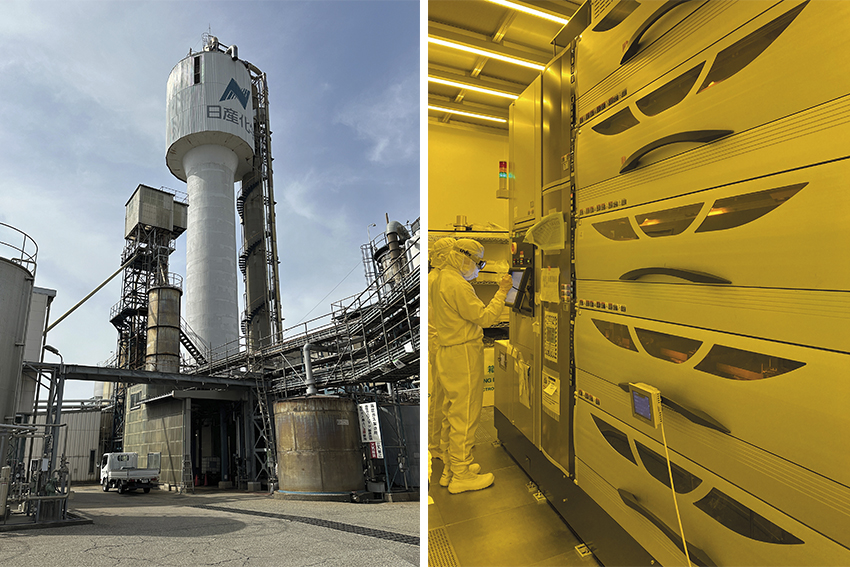
Basic chemicals plant (left) / R&D clean room (right)
Stage I of Vista2027 concluded in 2024 with strong financial performance, particularly in performance materials and agricultural chemicals. Sales increased by more than JPY 20 billion, and operating profit rose 18% year-on-year. Looking back, what were the key factors that drove this success? And as you move into Stage II, what lessons or insights from Stage I will guide your next steps?
We operate across four main divisions, and the strongest performers during Stage I were performance materials and agricultural chemicals. Insecticide sales alone (product brand name, Gracia) generated JPY 10 billion, and our animal healthcare product represented by our API Fluralaner also saw significant growth. In the field of performance materials including semiconductor, the widespread adoption of AI has driven growth of our advanced materials such as EUV underlayers and temporary bonding materials for HBM. These are niche products, but our innovations have made us highly competitive.
As we look to expand for the future, we have been also increasing our capital expenditure. This includes establishing in Stage I a new pesticide factory in India and opening a third facility in Korea to support our semiconductor materials business.
Regarding the lessons learned from Stage I, one key insight was how to adjust to the changes of market circumstances. There was the volatility happened in the semiconductor market, which performed below our expectations. In the chemicals segment, price competition from China also created downward pressure. These were external challenges, but we also faced internal issues, such as delays in launching new products. These setbacks meant we didn’t fully achieve the Stage I targets we had set.
Stage I wasn’t solely about financial performance. We also saw an achievement to the target of 55% or more of consolidated net sales from products and services that contribute to address social issues. You’ve reached a 18% ratio of female researchers, and you’re progressing toward a 30% reduction in greenhouse gas emissions. Looking ahead, how is this broader push for sustainability shaping the company’s direction and operations?
When it comes to sustainability, one of our key performance indicators is what we call our “sustainable agenda.” This involves measuring the ratio of how much our products contribute to society. Improving that ratio is a central objective for us.
Historically, we’ve taken clear steps toward sustainability, such as exiting the petrochemical segment and working to reduce greenhouse gas emissions. We’ve set a target to cut CO₂ emissions by 30% by 2027 compared to 2018 levels, and we’re already looking beyond that timeline.
Diversity is another important focus. We’re committed to increasing the representation of both women and foreign nationals across the company. Our goal is to create a truly diverse workplace. Currently, our company aims to recruit women accounting for over 30% of new graduates in the regular position.
As you move into Stage II of Vista 2027, you’ve set ambitious financial targets, including JPY 293 billion in sales and JPY 65 billion in profits, with a 5% compound annual growth rate. What do you see as the core drivers of growth that will help you achieve these goals?
First, in the area of development, we place strong emphasis on quickness when bringing new products to market. At the same time, we must ensure we can scale production to meet market demand, which is key to increasing both sales and profitability. Semiconductors and agro-industries are areas where we see opportunities to grow volume. In fact, our mid-term strategy outlines that 70% of our operating resources will be allocated to agricultural chemicals and performance materials divisions.
In performance materials, we’re focusing on developing next-generation, such as cutting-edge semiconductor materials for AI application to maintain our competitive edge. In agricultural chemicals, we already have strong pesticide pipelines, but we’re also exploring bio-agricultural products as a future growth area.
Environment and energy are another important focus. We’re actively researching materials that can contribute to this field, with particular interest in secondary battery and hydrogen energy materials, both of which we believe hold significant promise.
We’re also expanding into the healthcare field, where we’re developing pharmaceuticals, and also materials for regenerated medicines. In this space, we’re looking to collaborate on the development of oligonucleotides and related technologies and products.
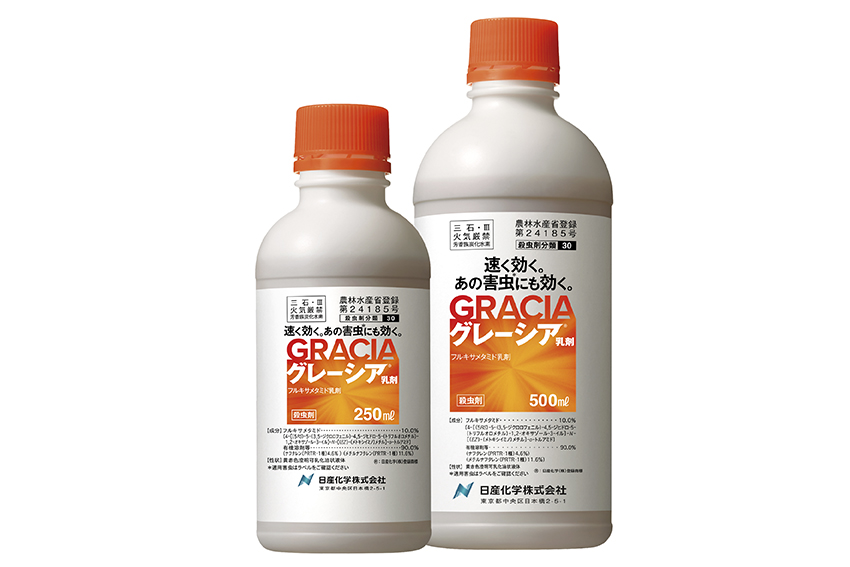
Agricultural products GRACIA
You mentioned the importance of commercializing promising innovations and bringing them to market. Part of this effort involves the revamp of your planning and development department to better support next-generation product development. In April, you also underwent an organizational restructuring. How do you expect these changes to improve both the speed and success rate of bringing new technologies to market?
Speaking from my personal philosophy, I believe people naturally align themselves with the time frames they’re given. If you set a timeline, they’ll work within it. That’s why I think it’s important to remain flexible—not just with timelines, but also with the structure or “rails” we set for development.
With this in mind, we’ve structured our teams based on the specific developments they’re working on. Each project is given a clear goal and set timeline. It’s essential to define both the intended destination and the point at which we would consider stopping. This also requires a strong sense of foresight and anticipation.
Researchers, by nature, tend to resist the idea of giving up. That’s why part of the challenge is shifting mindsets. Every product to be developed and launched should go through clearly defined stages—planning, development, and expansion. At each stage, we must assess whether to proceed or halt the project. Making these decisions at the right time is key to improving our overall success rate.
Hydrogen fuel cells, PFAS-free materials, lithium-ion technologies, and other high-performance liquid metal composites are all areas your company is exploring. Which of these emerging material technologies do you believe will be the most transformative and hold the greatest potential for your business in the years ahead?
Some of these technologies are being applied in semiconductor and data center fields, both of which carry significant potential. We also see strong opportunities in the area of secondary batteries, where our product has already reached the commercialization stage.
As data centers continue to expand, the demand for electricity and the amount of heat generated will also increase. We have technologies that can help reduce this thermal burden, which positions us well to support future developments in this space, alongside the other areas we’ve discussed.
Mergers and acquisitions are a key growth strategy, enabling companies to strengthen their position in high-priority sectors. What specific areas are you targeting for potential acquisitions, and how do you see these moves reinforcing your core businesses?
At the moment, our primary M&A focus is on agricultural chemicals. We manage a number of products globally and are currently in discussions with several companies to explore potential opportunities in this area.
One of our main goals is to double the sales amounts of new products by fiscal year 2027 compared to fiscal year 2024. Another key objective is to expand our business portfolio through strategic M&A activity.
For more information, please visit their website at: https://www.nissanchem.co.jp/eng/