
To begin, if we look at Japanese retail in a macro trend, it is, of course, world-famous for its attention to detail, which has given it a strong reputation internationally. Over the past few decades, however, we’ve seen competitors across Asia attempting to replicate elements of Japan’s retail success, putting pressure on certain mass-market categories. Yet, despite this, many Japanese fashion brands remain admired around the world. From your perspective, what do you see as the unique strengths of the Japanese approach to retail—both in general terms and specifically in relation to your own company? And what added value do you aim to deliver to customers to truly differentiate your brand?
Living in Japan itself influences people profoundly. Visitors are struck by the precision, punctuality, cleanliness—there’s no garbage, everything is orderly, and people treat each other with courtesy and kindness. In that sense, Japan is truly unique.
Historically, Italy held that same position of influence—people were inspired by Italian culture, design, and fashion. France and England, too, had that aura. But today, Japan seems to occupy that spot. I don’t know exactly why, but I was astonished, for example, when Marie Kondo’s book sold more than 10 million copies in the U.S. Here was one of the most materialistic countries in the world, yet millions of people were embracing this minimalist, spiritual philosophy.
Anime has also become a powerful entry point, opening the door for global audiences to connect with Japan. From there, companies like Muji and Uniqlo were able to expand worldwide, building on the broader appeal of Japanese culture—its simplicity, quality, and sense of refinement.
But beyond those two, I’m not convinced Japanese retail as a whole is yet strong globally. We still have a long way to go to fully translate our cultural strengths into consistent international success.
That’s very interesting. As you say, some people may only know those two brands—Muji and Uniqlo—but Japanese culture overall has never been more popular. For example, over 35 million tourists visited last year, and projections suggest it could be 40 million this year. Many visitors, as you noted, admire Japanese quality and purchase items made in Japan. Has this surge in inbound tourism impacted your business? Do you see it as a business opportunity?
Not significantly yet. But when I launched DoClasse in 2007, I was already anticipating this trend. Around that time, Hoshino Resorts and Goldman Sachs established a fund emphasizing tourism as a future pillar of the Japanese economy. I thought: if 35 or 40 million people visit Japan each year, that would be extraordinary.
At the same time, Japan was becoming one of the fastest-aging societies in the world. I myself was 47 then—already aware that I was entering a new stage of life. I reflected that I might live until 80, giving me another 30 years. Reading Samuel Ullman’s poem Youth gave me courage. It reminded me that youth is not about physical age but about spirit—staying vibrant, engaged, and confident even as the body changes.
That philosophy became central to DoClasse. I imagined tourists visiting Japan not just for the temples, shrines, and food, but also being impressed by the people—how youthful, active, and attractive they could be at any age. That’s the vision I wanted our apparel to embody.
But in reality, our growth hasn’t been as fast as I imagined. We are progressing, but more slowly.
The government expects inbound tourism to eventually reach 60 million people. Are you putting strategies in place to capture this market?
My first priority has been establishing the brand firmly in Japan. We now have a customer database of more than 3.7 million names, and we operate flagship stores in prime locations. Those stores themselves are powerful marketing tools—tourists naturally discover us. Some become customers, and from there, e-commerce allows us to serve them globally without immediately building physical stores abroad.
That said, the pandemic was a major setback. We had to close six flagship stores in major cities—Shinjuku, Osaka, Kyoto, all high-traffic locations. That was painful. Over the next two years, rebuilding those flagship stores is a top priority.
Japan’s domestic population is shrinking by around one million people annually, and the society is rapidly aging. Even though you cater to older demographics, eventually that market will contract. How do you see this influencing your strategy?
For the next five years, the population aged 40 to 65 will remain stable, perhaps even grow slightly, before it begins to decline. That gives us about five years to strengthen our domestic base while simultaneously moving overseas. So yes—we must move quickly.
Is your overseas expansion primarily to compensate for the shrinking domestic market? And if so, which countries are your main focus?
Yes, overseas growth is essential. Given my experience, the U.S. and Asia-Pacific are natural priorities. Initially, I thought China would be central, but the risks there—both political and commercial—are significant. So instead we’re focusing on the U.S., Australia, and other Asia-Pacific countries.
I also created our J. Dot line specifically with the global market in mind. DoClasse serves primarily Japanese customers, but J. Dot is designed for the growing number of affluent consumers worldwide, particularly in Asia where the wealthy population is expanding rapidly. E-commerce gives us direct access to them.
You mentioned global expansion and influencers. Are you looking for partnerships—either with social media figures or companies—to help accelerate this? For example, you already partner with ZigZag for international shopping. How has that worked for you?
Our approach is multi-staged. First, we want to work with both individual and organizational marketing influencers—people who truly understand their markets. Direct marketing is essentially a one-to-one conversation with customers, so identifying the right media channels is crucial. Even having physical stores in key Japanese locations acts as a form of media, sending a message about our brand.
At the same time, we’re looking for key opinion leaders globally to help amplify our reach. Logistics are another key factor. We currently use ZigZag, and our policy is to offer a 100% satisfaction guarantee with free returns. If a customer isn’t happy, they must be able to return the product easily. Companies like TEMU have shown how efficiently this can be done, and we must ensure we can deliver the same standard worldwide.
Do you see potential for partnering with major U.S. retailers such as Walmart, JCPenney, or Target as part of your global strategy?
Yes, that’s possible. Earlier in my career, I was CEO of Lands’ End Japan, and Lands’ End was later acquired by Sears. So I understand how partnerships with large retailers can work. Walmart, Target—those are interesting possibilities, though we haven’t made any firm decisions yet.
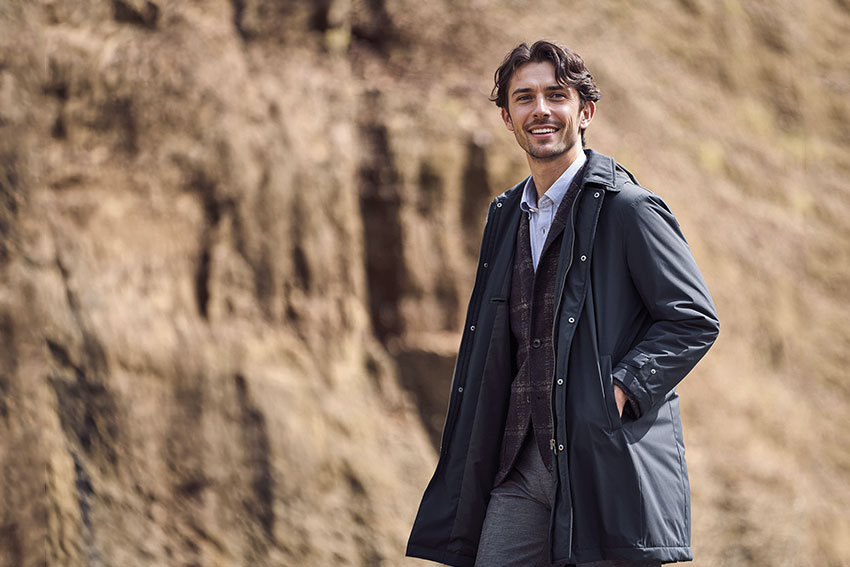
Let’s talk about J. Dot. It draws from Japan’s rich textile traditions, such as Nishijin and Bishu. Could you explain the concept behind this line, and how using Japanese fabrics influences the collection?
I noticed how Italy excels at marketing local products—their fabrics, for example, are world-famous, not just for quality but for the way Italians communicate their story to the world. In Japan, by contrast, there’s a cultural tendency to be modest, not to boast. As a result, our incredible fabrics often remain underappreciated abroad.
J. Dot was inspired by that gap. The “J” stands for both Japan and for Junko, my business partner and creative director. Junko has a remarkable gift for transforming flat fabrics into beautiful three-dimensional garments. We wanted to showcase that creativity, while also celebrating Japan’s heritage in textiles.
The concept is simple but powerful: every woman is precious, every woman deserves the finest. J. Dot is about delivering that sense of value through exceptional fabrics—Japanese where possible, though we sometimes use Italian as well. And because e-commerce enables us to connect globally, if the right customers and influencers appreciate our taste, the brand can take flight worldwide.
Personally, I had also reached a point where I wanted to re-engage with the global stage. I love Japan deeply, but after years of working in international companies, I felt the need to once again look outward. J. Dot became that bridge.
Your company itself has a fascinating history. Founded only in 2007, you’ve grown from an IKEA table and four phones in a garage into a business with over 15 billion yen in sales, hundreds of employees, and this headquarters. Can you share how you managed such rapid growth in under two decades?
Honestly, I don’t feel it was that fast. But compared to many Japanese companies that take 100 years to grow, perhaps it is. The key has been our business model—direct marketing. Direct marketing allows you to communicate directly with customers through media. If you select the right channel, you can reach millions instantly.
Equally important has been our philosophy: “Ageless Beauty.” We encourage women never to say, “I can’t do this because of my age.” That spirit resonated strongly. I remember our very first catalog in 2007—we printed 300,000 copies, which felt like an enormous risk. But we laid out our philosophy clearly: be yourself, be confident, enjoy your life at any age. That message connected.
We’ve also built our brand on trust. Our creed is simple: we cannot earn money without gratitude. That’s why we offer a 100% return policy—if a customer isn’t happy, we don’t keep their money. This has built loyalty and confidence, which is especially important in e-commerce.
You mentioned retail. After starting with catalogs and e-commerce, you later expanded into physical stores. How did that evolve?
Yes, in 2011 we opened our first store because customers wanted to touch and try the products. It was a tiny store near our office in Jiyugaoka. But the conversion rate was 100%—everyone who made the effort to visit purchased something. That gave us confidence to expand into retail.
That said, retail is not my natural strength, so I’ve been cautious. Physical stores require heavy capital investment. But they also act as powerful media. Our Shinjuku flagship, opened in 2018, was an example—unfortunately we had to close it during the pandemic in 2021. Rebuilding our retail network is one of our major challenges.
Turning to design: you offer women’s wear, menswear, footwear, and more. Which product categories are seeing the strongest demand? Are there new lines in development?
Menswear is an area we’re working to reinvent. Footwear has also been evolving—sneakers have become both fashionable and practical, reducing demand for casual shoes. Our FitFit brand faced challenges, but we believe it will recover, and we’re considering expanding it into men’s shoes as well.
The broader DoClasse brand still has untapped potential. Our focus is not on chasing every passing trend, but on solving the specific challenges of middle-aged customers. Bodies and faces change with age—our mission is to design products that make people look ten years younger, five kilograms slimmer, while still elegant and confident. That’s where we can differentiate.
Looking ahead, how do you see your e-commerce and international operations evolving? Will you build your own global platforms, or rely on partners such as Amazon?
ZigZag currently handles our logistics well, but marketing is the challenge. Right now, our website often appears in Japanese abroad, which isn’t effective. Google Translate helps, but we need a true global site in English, and potentially other languages.
At the same time, we are open to working with major platforms like Amazon, as well as leveraging key opinion leaders. If we identify a market where our products resonate, then we can consider opening physical stores—but those require significant capital. My view is that we should first establish e-commerce franchises before expanding into bricks-and-mortar internationally.
Finally, imagine we return five years from now for another interview. What would you like to have achieved by then? Where do you see your company?
In five years, my goal is to have firmly established our core competencies across multiple channels. Multi-channel retail is challenging—direct marketing is my expertise, but media is evolving rapidly. Key opinion leaders and digital influencers are becoming more effective than traditional methods, so we need to catch up.
What will remain constant is our philosophy: putting the customer first. That cannot easily be copied, and it will continue to be our strength.
On the retail side, I want to have at least ten large flagship stores in Japan—profitable stores, perhaps smaller than Zara’s but still substantial. Physical retail must be both impactful and profitable. Combined with strong advertising investment, that will give us a highly sustainable business model.
Most importantly, I want to attract and nurture capable people. In five years, I will be older, and I’d like to transition into more of a chairperson role—cheerleading and guiding, while empowering the next generation of leaders to take the company forward.
That is a very strong and inspiring vision. Thank you so much for your time today.
Thank you very much. I truly appreciate the opportunity to share our story, and I look forward to what the future holds.
For more information, please visit their website at: https://www.doclasse.com/