- Frankfurt-Hahn Airport achieved cargo growth in 2025 despite volatile European market conditions, driven by 24/7 operations, fast handling, and strong coordination with customs and ground partners.
- The airport is positioning itself as an e-commerce-focused gateway by prioritising speed, flexibility and reliability over physical expansion, supported by unrestricted slots, short distances, and rising international partnerships.
- While regulatory burdens continue to limit German airfreight competitiveness, Hahn is targeting high-growth segments such as e-commerce and direct Germany-bound flows rather than pursuing scale alone.
Frankfurt-Hahn Airport recorded steady cargo growth in 2025, driven by its round-the-clock operations, streamlined processes, and growing role in e-commerce logistics. While broader market conditions across Europe remained unpredictable, Hahn focused on speed, coordination, and flexibility.
Frankfurt-Hahn Airport managed to grow cargo throughput in 2025, defying market headwinds and Europe’s shifting freight dynamics. In the first six months, the airport processed over 50,000 tonnes—a rise of approximately two and a half percent compared to 2024. November delivered an even sharper boost, with volumes up approximately 33 per cent year-over-year.
“While the overall balance for 2025 will depend on December and the holiday season,” said CEO and Managing Director Rüdiger Franke, “we anticipate a slight overall increase in cargo volumes for the year of approximately six percent.”
Freight flows shift beyond Germany
Freighter traffic is being reshaped by global instability and changing logistics demands, Franke noted. “The market is highly dynamic—one might say that what applies today can be completely different tomorrow.”
e-commerce, however, continues to climb. But the gains are not equally spread. “From a German perspective, it is evident that airports in other European countries are achieving significantly higher growth rates. Germany is falling behind due to less favourable regulatory conditions,” he said.
Rather than expanding physical capacity, Frankfurt-Hahn has prioritised speed and coordination in response to the e-commerce boom. “We are now in a position to state that Hahn Airport, together with its local partners, is capable of processing e-commerce shipments quickly and reliably,” Franke said. That came after intensive planning with customs, ground handlers, and the airport’s own teams.
Hahn’s clearest advantage lies in what it doesn’t restrict. “Our greatest advantage remains our 24-hour operating permit. This authorisation is by no means a given in Europe and makes Frankfurt-Hahn Airport highly attractive for customers,” said Franke. “Furthermore, we have no slot restrictions… we can offer our customers maximum flexibility in planning their flight movements.”
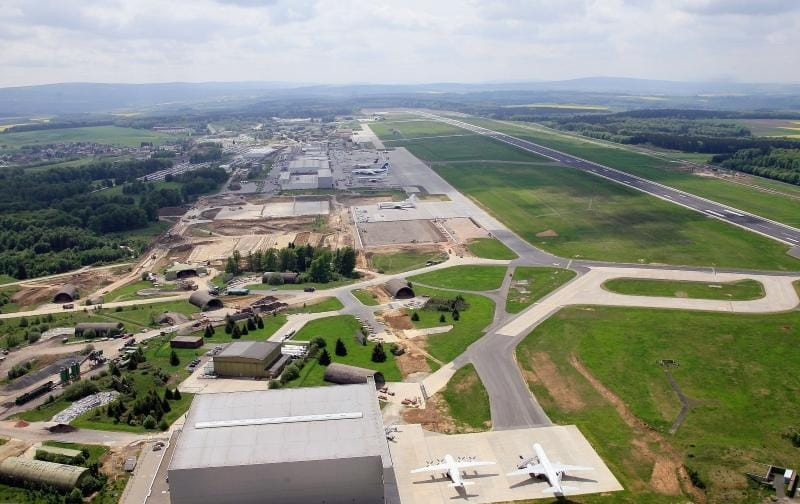
With on-site authorities and a compact layout, the airport can also offer short distances and fast handling—a contrast to larger, congested hubs.
Despite these strengths, Hahn faces growing competition from regional airports across Europe that are expanding cargo facilities and forming cross-border alliances to attract freight flows. These include efforts by airports in Belgium and the Netherlands to tap into the same e-commerce and express segments.
International partnerships are also part of the long-term plan. A new cooperation with Greenville-Spartanburg Airport in the US is aimed at sharing best practices in areas such as security, customer service, sustainability, and operations. “Through this and other partnerships, we focus on an intensive exchange,” said Franke.
Although Frankfurt-Hahn has the capacity to handle up to 450,000 tonnes annually, regulatory barriers continue to weigh down the German airfreight sector. “Germany is characterised by an extensive array of regulations, taxes, and fees,” Franke said. “We would welcome a more level playing field within the EU.” Heading into 2026, Hahn’s strategy remains focused on capturing high-growth segments rather than chasing scale alone. “Given the continuous global surge in e-commerce—set to represent a third of all air cargo soon—this segment is a key opportunity for us,” Franke said.
With forwarders increasingly looking for direct links into Germany, bypassing slower routing through other countries, Hahn is positioning itself as a more agile alternative.
“As mentioned, we have established the ideal environment for e-commerce here. Parallel to this, we remain committed to our core strategy, consisting of three parts: strengthening the cargo business, expanding passenger services, and driving sustainable real estate development at the airport.”
Looking ahead, the airport’s growth strategy centres on three pillars: expanding its cargo business, developing passenger services, and building sustainable real estate on site.