
The pandemic forced millions of young adults such as Bernicker to miss out on in-person interactions during a formative time in their professional lives, and companies are dealing with a wave of workers who are used to occupying an online world. To navigate this new reality, some employers are investing in business etiquette training to guide new hires through the ins and outs of dealing with clients and co-workers without a screen between them.
A 2023 survey of 800 business leaders by Intelligent.com, a Seattle-based higher education publication, found that recent college graduates had difficulties navigating interpersonal interactions in the office. One in five employers said a recent grad had brought a parent with them to a job interview, while 53 percent said young workers have struggled with eye contact in an interview.
Bernicker’s first and only in-person interview was with Gupta Media, a Boston-based creative marketing agency. Bernicker didn’t own a single item of professional clothing, and borrowed a suit from her roommate before her first interview. She landed the job but says navigating an in-person office setting was nerve-wracking at first.
Gupta Media was ready for her. The agency had developed its own in-house training program for new employees, Medley, and formally launched it shortly before Bernicker was hired. It started with the basics: professionalism in the workforce, dressing for and speaking at work, being open to feedback.
“Sometimes, when you’re behind a screen for a long period of time, you start to lose awareness of those skills,” says Kelly Heath, the company’s head of people. “We are a professional services organization and as such you have to be able to speak professionally and conduct yourself in a professional way. . . . You can’t have the technical skills without the soft skills and be successful.”
Bernicker went through the program right away and says it helped boost her confidence.
“Knowing that I was walking into a training program set up exactly for me to develop those skills definitely made me a lot less nervous,” Bernicker says. “I wasn’t going to be thrown into the fire, completely on my own.”
Gupta has also expanded Medley to mid-career employees and beyond, featuring more nuanced training focused on making difficult decisions, executive presence, and emotional intelligence.
Many of Gupta’s employees had never been on an in-person client visit after business travel slammed to a halt during the pandemic. As travel ramped back up, Gupta launched a “road show” training that involved what to talk about, how to dress, where to sit at dinner or drinks. The training even features role-playing with managers.
Investing in employees at a personal level has been well-received.
“They recognize that we’re looking to help them grow as professionals, not just to build up Gupta,” Heath says.
That’s helpful at a time when employee satisfaction is at an all-time low, and people are looking for new jobs at the highest rate in nearly a decade, according to a 2024 Gallup survey.
The Waltham-based software company Allego is also using role-playing to help young sales reps, employing its own artificial intelligence product to assist, ironically enough, with in-person exchanges. It has since expanded to help seasoned managers have more effective conversations with their teams.
“We call it AI role-play,” says Lena Finch, the company’s vice president of people and culture. “It looks like a real human, acts like a real human, does things like ask questions. It can say, ‘No, I don’t want to talk to you,’ and the rep has to practice how to engage in that conversation.”
Because the simulator is Allego’s own proprietary AI, it’s constantly evolving with in-house technical expertise. The company used the tool when it partnered with Babson College’s sales and marketing program, and ended up hiring a few students post-graduation. Those students said the dialogue simulator helped them become comfortable with the kind of professional conversation needed for sales and outreach, Finch says.
Allego has many first-time managers who have excelled in their careers but haven’t navigated the complexities of how a professional relationship can shift when a person goes from peer to manager. The AI tool helps there, too, Finch says.
“AI role-play gives them a safe space to practice that conversation before going live with their direct reports,” Finch says, noting that conversations can go south quickly. “This creates an environment for them to feel confident.”
Allego even hired a neuroscientist to test workers’ reaction to receiving feedback from AI instead of a human. “Believe it or not, the reception was pretty positive,” Finch says.
For employers that have become fully remote, navigating business interactions and defining company culture requires a different kind of investment, says Dan Levine, president and founder of Newton-based tutoring company Engaging Minds. Prior to the pandemic, Engaging Minds was almost entirely in-person; now, it’s 100 percent virtual.
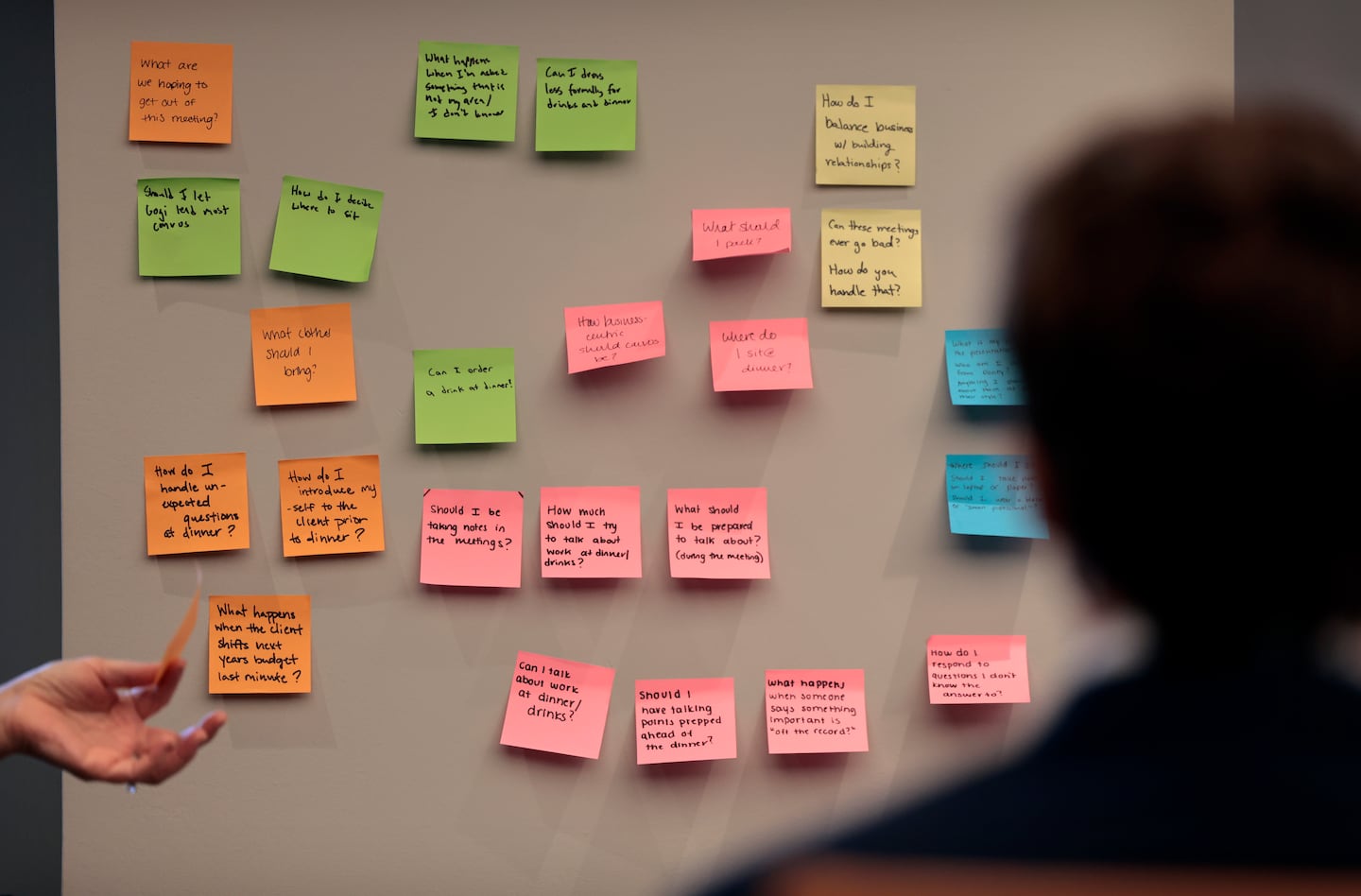
Engaging Minds’ administrative team recently went through some major changes, with retirements and new hires, and in August each member did a personality assessment to determine what every staffer finds important in their working life and how they communicate.
“We have to be able to learn and work together as effectively as possible,” Levine says. “It helped us understand communication styles and team dynamics.”
Helping young workers understand professional norms was something Chris Greene and Trish O’Leary thought about when launching YoPro, a Cohasset-based coaching company, in September of 2024.
Greene says he was tired of hearing stereotypes about Gen Z workers. He’d read articles in which older generations “were all punching down on this generation, saying ‘They’re not prepared. They’re bringing their parents to their job interviews. They’re letting their parents write their resumes.’ I said, ‘Wait a minute, let’s flip this. The parents are over-involved. The parents are overhanging. The parents should know not to come to the job interview.’”
More than 70 young adults have gone through the program so far: 10 hourlong one-on-one coaching sessions, each built around a skill: elevator pitches, what makes you unique, networking strategies. The coaching holds them accountable and has shown they are resilient, Greene says.
“The last thing these students need,” he adds, “is another app.”
Catherine Carlock can be reached at catherine.carlock@globe.com. Follow her @bycathcarlock.




![[2026 The Leaders] VP Hanul Park, Head of Global Talent](https://bigbcc.com/wp-content/uploads/2026/04/1775434418_2026-The-Leaders-VP-Hanul-Park-Head-of-Global-Talent.jpg)