E-Invoicing Market

Dublin, March 31, 2026 (GLOBE NEWSWIRE) — The “E-Invoicing Market Report by Channel, Deployment Type, Application, and Region 2026-2034” has been added to ResearchAndMarkets.com’s offering.
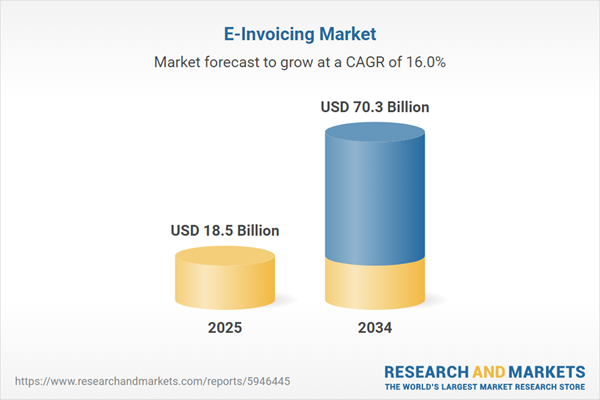
The global e-invoicing market is on a rapid growth trajectory, with a market size estimated to reach USD 18.5 billion by 2025 and projected to expand to USD 70.3 billion by 2034, reflecting a compound annual growth rate (CAGR) of 15.96% from 2026 to 2034. This remarkable expansion is fueled by factors including the burgeoning e-commerce industry, widespread use of advanced IT solutions across various sectors, and technological advancements in web and software-based invoicing applications.
As businesses pivot towards digitalization and automation, e-invoicing systems are gaining traction, replacing traditional paper-based processes with faster, more accurate, and cost-efficient methods. Regulatory mandates are further accelerating this transition, with many governments requiring e-invoicing to mitigate tax evasion and enhance financial transparency. Additionally, the global push towards sustainability is motivating organizations to adopt e-invoicing, thus reducing their environmental impact by decreasing paper usage and waste.
Increasing Globalization and Digital Transformation: The move towards globalization and digital transformation is catalyzing e-invoicing adoption. By facilitating seamless and real-time invoice exchange across borders, e-invoicing mitigates the inefficiencies of traditional invoicing. Furthermore, the shift towards cloud-based solutions, mobility, and remote work drives the necessity for digital invoicing processes, ensuring faster and more efficient financial interactions in today’s interconnected business arena.
Various Technological Advancements: Technological progress and a focus on automation are revolutionizing the e-invoicing landscape. Integration of AI and machine learning enhances the invoicing process by automating data extraction, validating accuracy, and predicting discrepancies. Additionally, blockchain technology offers secure, immutable transaction records, strengthening data integrity and reducing fraud risk. These innovations improve invoicing efficiency and build stakeholder trust.
Expanding E-Commerce Industry: The rapid expansion of e-commerce necessitates efficient invoicing systems capable of handling increased transaction volumes. E-invoicing addresses this demand by streamlining invoice generation, delivery, and processing. The digital nature of e-commerce aligns with e-invoicing, enhancing customer experience through prompt and seamless invoicing, which aids in timely payment initiation.