E-commerce sites, forgeries shake up future of Native American art market | Local News
Table of Contents
Finding an original Fritz Scholder painting online for less than $10,000 is like finding an original Van Gogh in a thrift store.
In other words: It’s highly unlikely.
Nevertheless, authorities believe more than 20 people — including two in Santa Fe and one in Taos — have purchased more than $54,000 worth of paintings fraudulently represented as being by Scholder, a well-known Native American artist who was an instructor in the early days of the Institute of American Indian Arts in Santa Fe.
The rise of e-commerce sites and online auction platforms has made it easier to acquire Native American art — and also made it easier for criminals to offer forged artwork. These sites are not required to provide an artwork’s provenance information, often used by art collectors to trace a piece’s roots and determine its authenticity. Maybe the fine print in the description clarifies the work is merely “in the style of” the famed artist. Maybe it doesn’t.
“There’s a really strong market in forgeries in the Native American art world,” said contemporary Navajo artist Tony Abeyta. He said forgeries begin appearing when the value of an artist’s work rises. “Somebody’s actually following that market and creating new works and then salting the auction market,” Abeyta said.
The man accused of selling the fraudulent Scholders, Gregory McBride of Texas, will be arraigned Feb. 26 before a Magistrate Court judge in Santa Fe. Two of the paintings McBride is said to have sold to one New Mexico victim were purchased through eBay, according to the arrest warrant affidavit. The victim’s communications with McBride also took place on the site and via phone.
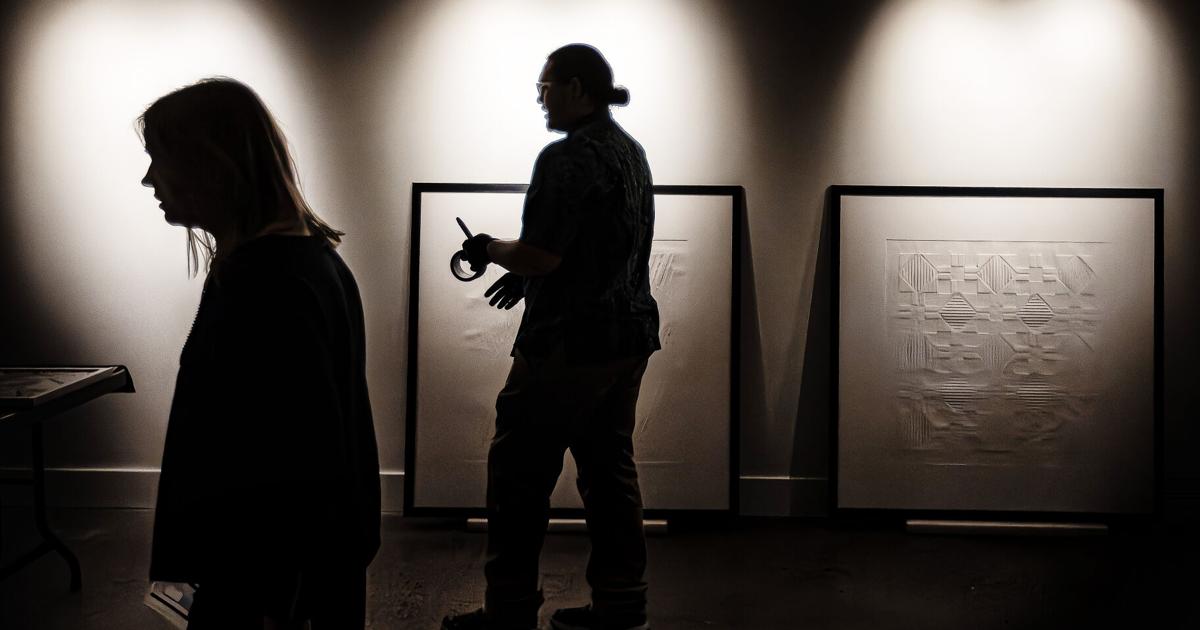
Manuela Well-Off-Man, chief curator at the IAIA Museum of Contemporary Native Arts, left, and collections worker Robyn Tsinnajinnie work on installing a new exhibit, Paper Trails, Thursday at the museum.
Jim Weber/The New Mexican
The federal Indian Arts and Crafts Act of 1990 prohibits misrepresentation in the marketing of American Indian and Alaska Native arts and crafts products in the United States. It makes it illegal to sell art in a way that falsely suggests it is made by an Indigenous artist, or the product of a particular tribe or arts and crafts organization.
A first-time violation can result in up to $250,000 in civil or criminal penalties, a five-year prison sentence or both. Businesses that violate the act can face civil penalties or prosecution and a fine of up to $1 million.
The Indian Arts and Crafts Board — a federal agency under the U.S. Interior Department that is tasked with enforcing the act — looks into complaints about potential violations and refers them to the U.S. Fish and Wildlife Service to be investigated. Walter Lamar, the chair of the Indian Arts and Crafts Board who also has worked for the FBI and the Bureau of Indian Affairs, said the issue of misrepresented Native art is “prevalent, and it’s in front of us each and every day.”
Manuela Well-Off-Man in front of a Fritz Scholder painting at the Institute of American Indian Arts.
Gabriela Campos/New Mexican file photo
Although the board does a good job of referring complaints to the investigative stage, Lamar said, it is not always possible to meet the demand.
“The problem is, there are not the resources to investigate all of these cases of misrepresentation, counterfeit, forgery and so on,” said Lamar, an enrolled member of the Blackfeet Nation of Montana and a descendent of the Wichita Tribe of Oklahoma.
Market impact
Abeyta’s interest in the issue of forged Native American art was piqued when he saw a painting that hung on the wall of his California home — a small, original Scholder piece he had purchased from a prestigious Los Angeles gallery — on an auction site.
Tony Abeyta
Jennifer Esperanza
“I didn’t really understand,” Abeyta said. “Why is my painting coming up for auction? Like, did I get robbed in California? But no, it actually was a knockoff.”
Later, he saw more fake paintings pop up online that claimed to be by well-known Native American artists — Jaune Quick-to-See Smith, a citizen of the Confederated Salish and Kootenai Nation, who died in Corrales last year; Harry Fonesca, a citizen of the Shingle Springs Band of Miwok Indians, who lived in Santa Fe until his death in 2006.
“I knew Jaune. I knew Fritz. I knew Harry Fonesca,” Abeyta said. “So I look at them, and I know how hard it is as an artist, because I’m an artist. I know how hard it is to build your market, to get to a place where these numbers really make a difference. And then somebody’s creating them and profiting off of it, and it’s definitely dubious.”
Forged artwork is typically sold at a much lower price than the original pieces, said Manuela Well-Off-Man, chief curator at the Institute of American Indian Arts’ Museum of Contemporary Native Arts. This robs artists of their income source, she said.
“But also it distorts, really, cultural narratives, especially when you think about more traditional works of art like wood carvings, pottery, textiles, jewelry,” Well-Off-Man said.
The circulation of forged pieces also creates distrust in the marketplace, Abeyta said.
“It has a direct impact on the market value of Indigenous art, because it’s creating a false market, false sense of values,” he said.
Austin Big Crow, IAIA preparator and exhibitions coordinator, and collections worker Robyn Tsinnajinnie install a new exhibit, Paper Trails, Thursday at the museum.
Jim Weber/The New Mexican
“If somebody gets burned, they’re never going to collect art done by Native American people,” he added.
Last year, a federal jury in New Mexico found California man Robert Haack guilty of violating the Indian Arts and Crafts Act — plus wire fraud and mail fraud — for selling an estimated $400,000 worth of fake Charles Loloma (Hopi) jewelry on eBay.
Abeyta and Gregory Farah — the owner of Santa Fe’s FaraHNHeight Fine Art gallery, which specializes in contemporary Native American work — said they have primarily seen artwork they believe is fake on the site LiveAuctioneers, an online auction platform for art, furniture and other wares. The site hosts more than 5,000 auction houses from across the globe, which the site says are verified.
Many LiveAuctioneers listings are for paintings “in the style of” certain famed artists and priced accordingly. Others just read as too good to be true: “an original color lithograph, signed and numbered” by Scholder was listed last month with a starting price of $10.
“A lot of these auction houses need to be much more scrupulous about giving a platform to any of these forgeries,” Farah said. “There needs to be much more control because that’s the part that’s most alarming.”
He added his own gallery has stumbled across forgeries people were looking to consign — and awareness needs to increase in Santa Fe specifically because of its vast art market.
Buyers on LiveAuctioneers who receive “fraudulently misrepresented” items can file a claim with the site within five business days of delivery, the site notes.
Jesse Littlebird (Laguna/Kewa Pueblo), an Albuquerque-based painter who also owns Kukani Gallery, said he more frequently sees forgery in the pottery and jewelry spheres because those pieces are harder to authenticate. He often stumbles across forged pottery on Facebook Marketplace, he said.
Jesse Littlebird, (Laguna/Kewa Pueblo), an Albuquerque-based painter who also owns Kukani Gallery, mixes paint Wednesday before returning to add final touches to a painting in his studio in downtown Albuquerque.
Gabriela Campos/The New Mexican
“The words that get used can be misleading,” Littlebird said. “Because words like ‘traditional’ — like, I’ll see some traditional Pueblo pottery, and when you look at it, you’re like ‘this doesn’t look like Acoma-style pottery.’ ”
“There’s a lot of motifs that can be universal and reused and reappropriated all kinds of places,” he added.
Karen Clarkson (Choctaw), an Arizona-based artist who is a regular participant in the Santa Fe Indian Market, said she has seen purported Native American art that is actually work generated by artificial intelligence on the e-commerce site Etsy.
“It steals the art,” Clarkson said. “It takes the creator out of the art process, because AI is drawing off of authentic, legitimate artists online and patching it together. And they’re putting it in a package that doesn’t really reflect the time and energy and cost it demands in order to produce a piece of art.”
Jesse Littlebird, (Laguna/Kewa Pueblo), an Albuquerque-based painter who also owns Kukani Gallery, works on a painting in his studio in downtown Albuquerque.
Gabriela Campos/The New Mexican
It takes Clarkson, a full-time artist, about a month to finish a painting, she said.
“There has been fake Native American art produced for centuries, but now that AI is involved, it’s a whole other ball game,” Clarkson said.
Solutions?
Because not every case of misrepresented Native American art can be investigated, Lamar said he thinks it is important to educate consumers about trusted sources where they can buy authentic pieces. And, he said, there needs to be a broader process for educating e-commerce platforms themselves.
“It’s all a monetary issue as well, right?” Lamar said. “So they’re making money off of it; what is the incentive for them to discontinue selling that misrepresented work or selling work that they haven’t taken any steps to verify the maker?”
He said he hopes the rapid development of AI will lead to the creation of tools to canvass e-commerce platforms for telltale signs of misrepresented or forged art — “because beyond that, there is absolutely no human way possible to be able to monitor that huge platform.”
Jesse Littlebird, (Laguna/Kewa Pueblo), an Albuquerque-based painter who also owns Kukani Gallery, works on a painting Wednesday in his studio in downtown Albuquerque.
Gabriela Campos/The New Mexican
Littlebird echoed the importance of consumer education, noting he doesn’t think forgeries will ever completely go away. He said he has even had people ask him to authenticate his work that they have purchased through the secondary market.
“For living artists, I think it’s also your responsibility — if you want to have a sustainable and long career — to check in on your secondary market, even,” Littlebird said. “Because I think a lot of times, you sell something, it leaves the studio and you don’t really think about it as your career moves forward.”
Provenance information is especially important, however, for artists who are dead, he said — because it can be easier to “fudge.”
Well-Off-Man said whenever the Museum of Contemporary Native Arts purchases artwork, it goes through a process to prevent the acquisition of forged pieces. The museum asks for a piece’s provenance, she said, and art collectors typically keep history information and sales receipts on hand.
She described the Indian Arts and Crafts Act as “very rarely enforced,” but noted it is in place to help protect artists and collectors.
Well-Off-Man encourages budding collectors to buy directly from the artist to ensure both authenticity and the artist getting the money directly. If the artist is dead, she suggests buying from their estate, if they have one.
Jesse Littlebird, (Laguna/Kewa Pueblo), an Albuquerque-based painter who also owns Kukani Gallery, sits for a portrait in his studio surrounded by his work.
Gabriela Campos/The New Mexican
The art community is thoroughly willing to point collectors in the right direction, Well-Off-Man said. Some museums also offer authentication services, although the Museum of Contemporary Native Arts does not.
“Collectors should look for authentic works of art and also learn more about the stories that accompany these beautiful works of art,” Well-Off-Man said. “And that all gets lost if we have fraudulent artworks offered on the art market.”
Join millions of self-starters in getting business resources, tips, and inspiring stories in your inbox.
Unsubscribe anytime. By entering your email, you agree to receive marketing emails from BigBCC. By proceeding, you agree to the Terms and Conditions and Privacy Policy.
SELL ANYWHERE WITH BigBCC
Learn on the go. Try BigBCC for free, and explore all the tools you need to start, run, and grow your business.