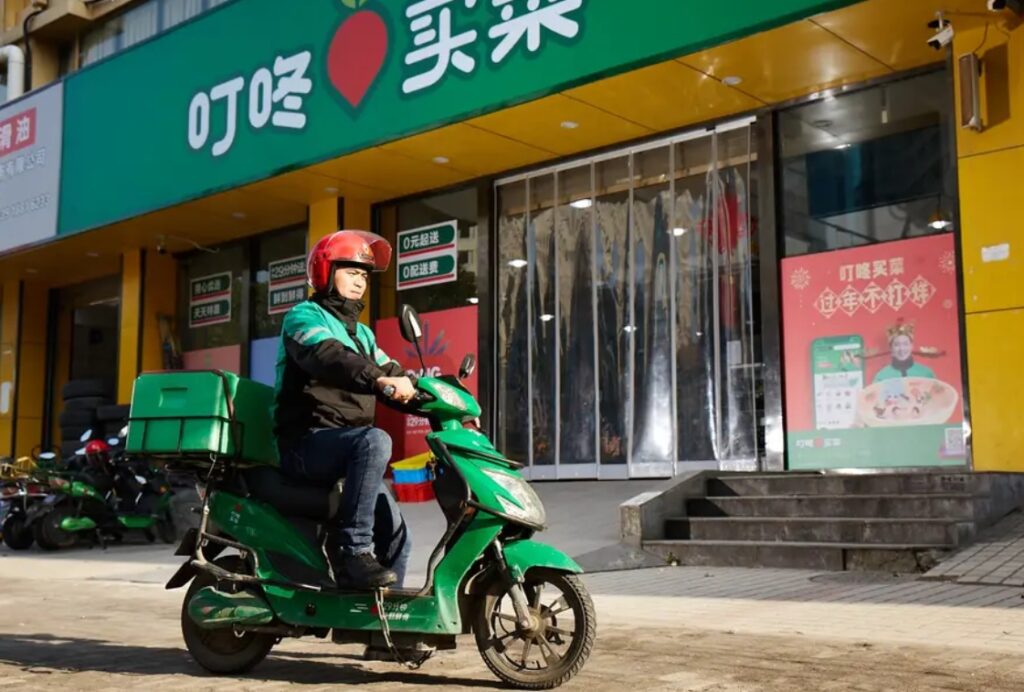
One of the country’s oldest online grocers will sell itself to its larger rival for $717 million, in one of the largest such sales to date in a fast-evolving Chinese instant commerce sector
Image Credit: Bamboo Works
Key Takeaways:
- Dingdong’s stock fell 14%, dropping its market value to $700 million, after announcing the sale of its core China business to rival Meituan for $717 million
- Founder Liang Changlin probably made the move after realizing Dingdong would be unviable as a standalone online grocer in China’s fast-evolving instant commerce space
Consolidation in China’s online sector rarely happens through this type of merger, partly because most companies are headed by fiercely independent founders who would rather see their empires go bankrupt than sell them to someone else. That was the case in 2022 when Dingdong’s former top rival Missfresh crashed and burned, even though many suitors probably would have considered buying the company while it was still doing reasonably well.
So, in that regard, we have to commend Dingdong founder Liang Changlin for seeing the writing on the wall and selling his company while there was still something of value to sell. China’s retail landscape was far different when Liang, described on Dingdong’s website as a “serial entrepreneur,” previously founded several other e-commerce companies before setting up his online grocery business in 2017.
But Alibaba, JD.com and even Meituan have taken the concept to a new level lately with instant commerce rapid delivery initiatives that included not only groceries and takeout dining, but many everyday household items that usually took days to deliver in the past. Now the group is fighting to see who can deliver the fastest, with some promising deliveries for even non-perishable items in as little as 30 minutes.
Against that backdrop, we’ll take a closer look at the Dingdong deal, which is quite simple. Both sides said Meituan will acquire Dingdong’s core China business for a total consideration of $717 million, with 90% to be paid up front and the remaining 10% to follow after the settlement of applicable taxes.
Grocery giant
Meituan’s grocery business makes up the bulk of the “new initiatives” segment of its financial reports, whose revenue rose 15.9% year-on-year to 28 billion yuan in the third quarter. The new initiatives segment also includes Meituan’s overseas Keeta takeout dining business, which has been expanding aggressively over the last year, and we suspect most or all of the new initiative revenue growth came from that.
Still, the two companies combined would have nearly 35 billion yuan in quarterly grocery-related sales, translating to 140 billion yuan annually, which is no small amount. By comparison, U.S. grocery leader Kroger (KR.US) reported $147 billion in sales in the 12 months through last September, about seven times more than Dingdong, in the far more mature U.S. market.
But again, we need to emphasize this deal is really more about instant commerce and less about groceries. Dingdong’s Liang probably understood that when he decided to sell. Thus, he realized his standalone grocer would never be able to compete with the likes of Alibaba, JD.com and Meituan, which were offering not only groceries, but takeout meals and other everyday items, from kitchenware to clothing, under their instant commerce banners.
It’s interesting to note that Dingdong didn’t sell the entire company to Meituan, but instead only sold its core China business. Dingdong pointed out it also operates an international business, which is presumably all that will be left in the publicly traded company – plus a big chunk of cash – after the sale to Meituan is completed.
That leaves us to speculate what might be next for the Dingdong name, and the publicly traded Dingdong (Cayman) company after this deal closes. We suspect the Dingdong name will be retired and merged into Meituan’s Xiaoxiang business, similar to what Alibaba is now doing by merging its Ele.me takeout dining name into its newer Taobao Instant Commerce brand.
Anyone who thinks a big dividend might be coming could hang around and wait for such a payout, and pocket some nice profits in the process. But if Liang decides to try out another business, perhaps building off Dingdong’s small base in international markets, then investors could be left holding a new mystery grocery bag of dubious value.
To subscribe to Bamboo Works weekly free newsletter, click here
Benzinga Disclaimer: This article is from an unpaid external contributor. It does not represent Benzinga’s reporting and has not been edited for content or accuracy.