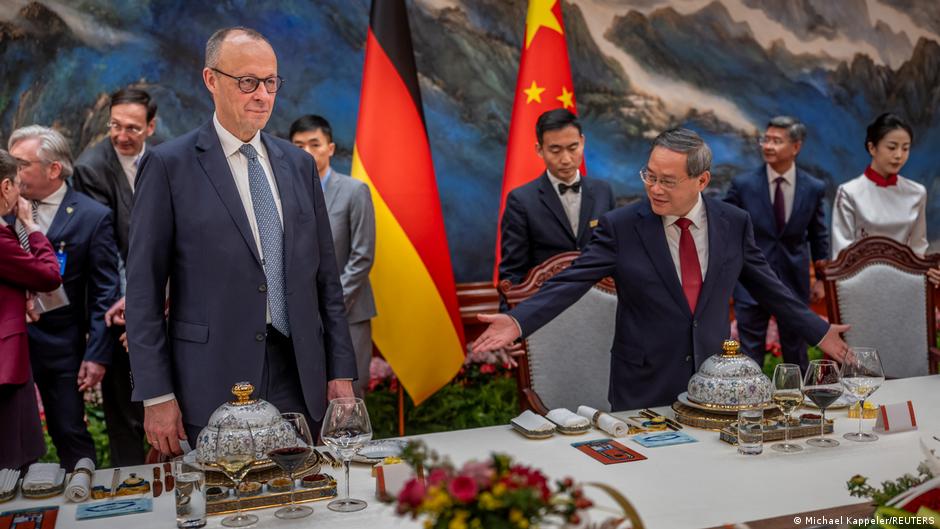
During talks with Chinese President Xi Jinping and Premier Li Qiang this week, German Chancellor Friedrich Merz emphasized expanding economic ties with China in the face of erratic US trade policy, while at the same time addressing concerns over managing competition and heavy trade imbalances.
“We have very specific concerns regarding our cooperation, which we want to improve and make fair,” Merz said during a meeting with Li on Wednesday.
Notably, he avoided referring to China as a “systemic rival,” a term used by predecessor Olaf Scholz that served to irritate Beijing.
Merz, who traveled to China with 30 German business leaders, also met leading Chinese and German business figures in Hangzhou, China’s tech hub.
China’s Foreign Ministry spokesperson Mao Ning highlighted the German business delegation as an example of “practical cooperation” that said “a lot about Germany’s expectation of and confidence in deepening practical China-Germany cooperation.”
Mao said Merz’s visit was “fruitful and bears significance.”
Germany and China manage competition
“This is not just another visit to China, it’s a visit in times where the transatlantic relationships are difficult,” Nadine Godehardt, a political scientist specializing in China at the German Institute for International and Security Affairs (SWP), told DW.
In a statement on Wednesday, Merz highlighted a commitment from China’s leadership to buy 120 additional aircraft from French manufacturer Airbus as an example of the “potential” found in high-level visits.
“This example alone shows that it is worthwhile to undertake such trips, also in order to discuss specific topics in concrete terms,” he said.
Wan-Hsin Liu a researcher at Germany’s Kiel Institute for the World Economy, told DW that the “most important aspect of the visit was to demonstrate, face to face, both sides’ willingness to maintain cooperation at a certain level.”
“In that regard, the visit was successful. It was critical that no mistakes were made,” she added.
Beijing sees the EU as a vital market for its green energy and electric vehicle exports. As the EU’s industrial heavyweight, Germany has an interest to serve as a gatekeeper and has powerful influence in Brussels’ economic policymaking.
Liu said the EU’s “above-average purchasing power” and “huge demand for decarbonization” make it an attractive market for China, which currently suffers from massive industrial overcapacity, producing far more goods than its domestic market can absorb.
Germany also signed five memoranda of understanding (MoUs) with China covering climate cooperation, animal disease prevention, the resumption of certain agricultural exports, and exchange programs in sports and media.
Liu said these agreements signal “willingness to cooperate rather than any meaningful breakthrough,” as they are peripheral compared with core concerns such as Germany’s trade deficit and China’s export controls of rare earth elements.
However, she added that Merz’s visit restored a valuable communication channel that could prevent speculation from driving decision-making.
China’s overcapacity: The elephant in the room
While China for years provided a strong market for German cars and machine parts,demand has shifted as China’s burgeoning EV industry and improved manufacturing of industrial goods comes into direct competition with sectors formerlydominated by Germany.
According to data from Germany’s Federal Statistics Office (Destatis), Germany’s trade deficit with China in 2025 ballooned to over €89 billion ($105 billion), up from nearly €67 billion in 2024.
Merz told Chinese Premier Li that the trade deficit had “quadrupled in five years” and described the trajectory as “not healthy.”
He called for fair competition for German businesses, which have long complained about Chinese state subsidies, restricted market access and opaque regulations.
“We must be able to rely upon agreed rules,” he said.
However, SWP researcher Godehardt said she does not think Merz expects immediate change.
“It is about finding a balance and clearly defining where our problems lie — where German and European interests are,” she said. “It is not necessarily about expecting China to change, but about making clear that there are limits.”
Other concerns include Beijing keeping its finger on the scale by maintaining a low RMB (Renminbi) exchange rate, and providing state subsidies to key industries, which Western governments see as distortive. From Beijing’s perspective, however, such measures are tools of industrial policy.
“If China does not believe its policies undermine fair competition, significant policy shifts are unlikely simply because Merz paid a visit,” said researcher Liu.
Edited by: Wesley Rahn