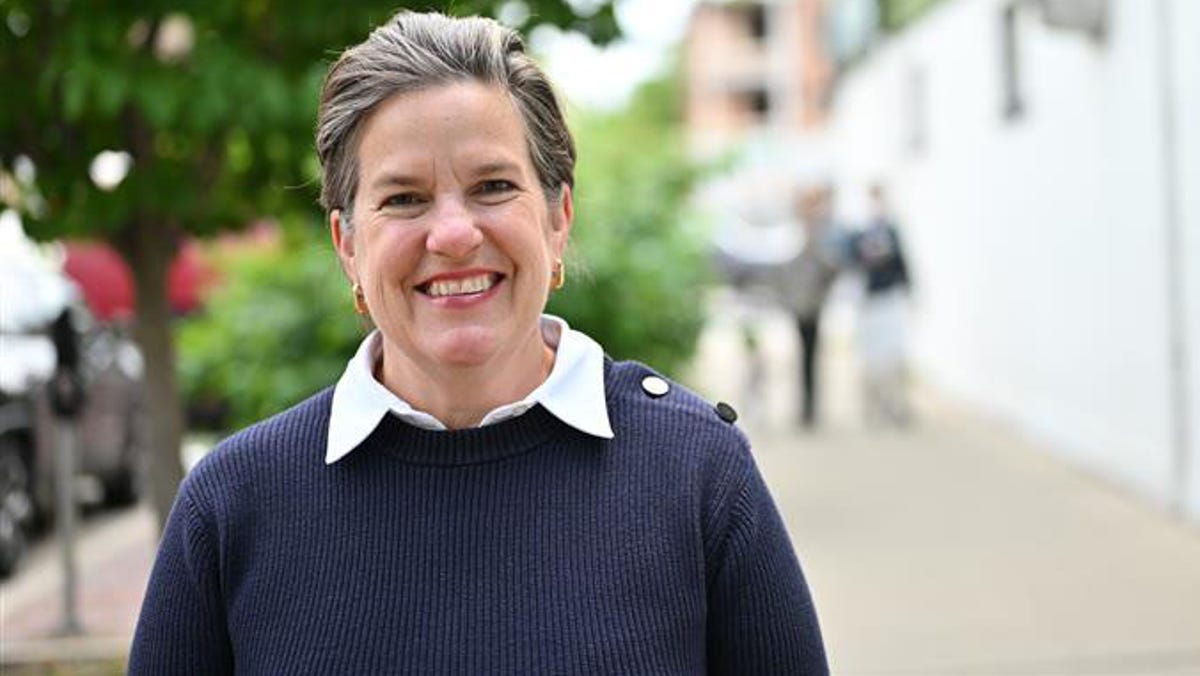
MADISON – Billing herself as the “only candidate who knows how to build an economy that works for everyone,” Democratic gubernatorial candidate Missy Hughes pledged this week to enact policies that would create 50,000 new businesses, expand access to high-skilled job training for up to 100,000 people and build 200,000 new homes.
It’s the first policy proposal from Hughes, who headed the Wisconsin Economic Development Corp. for the bulk of Democratic Gov. Tony Evers’ administration and previously served as an executive at the billion-dollar Organic Valley dairy cooperative.
Hughes said she intentionally set aggressive goals and wants voters to hold her to them.
“I’m running on building Wisconsin’s economy and making it as strong as possible for every Wisconsinite to have the opportunity to succeed,” Hughes told the Milwaukee Journal Sentinel. “I’m constantly hearing from Wisconsinites about the challenges they’re facing with making ends meet.”
Hughes said as governor, she would seek to remove barriers that are “making people feel stuck and locked in one place.”
Her proposal would draw from the state’s budget surplus, which is currently projected to be $2.5 billion at the end of the 2025-27 budget cycle, to turn “short-term investments … into long-term economic gains.”
The business creation aspect of her proposal would build on the Main Street Bounceback Program she oversaw at WEDC, which offered $10,000 grants to about 9,500 businesses that moved into vacant spaces with funding from the federal American Rescue Plan Act.
Hughes’ plan calls for using surplus funds to expand access to capital through microloans, seed grants, loan guarantees to support private bank lending, assistance with scaling small businesses and emergency bridge funding to get through periods of economic disruption.
It would also direct funds to expand capacity in technical colleges and make education debt-free for programs in high-demand fields, develop apprenticeship opportunities and link educators, employers and unions.
Hughes’ proposal would also target zoning code updates, implement new financial incentives and financing options and pre-approve fabrication plans at the state level in an effort to increase housing access and availability.
“When you have a partnership between state and local and private players, when you have the state providing resources, when you have the local community clearing the way for zoning and helping with those issues, and then when you have financing available for the local developers, you can really move the needle,” Hughes said about housing. “It’s not a moonshot. It’s something that can absolutely happen.”
Hughes said her economic proposal offers a concrete plan at the state level amid national instability.
“By having our own plan, by being in charge of our own future, we can control what happens here in the state,” Hughes said. “That’s where I think the governor is really critically important in helping to provide that stability and that plan moving forward.”
Hughes will face Lt. Gov. Sara Rodriguez, Milwaukee County Executive David Crowley, state Rep. Francesca Hong, state Sen. Kelda Roys, former Lt. Gov. Mandela Barnes and former Department of Administration Secretary Joel Brennan in the Aug. 11 primary.
Jessie Opoien can be reached at jessie.opoien@jrn.com.