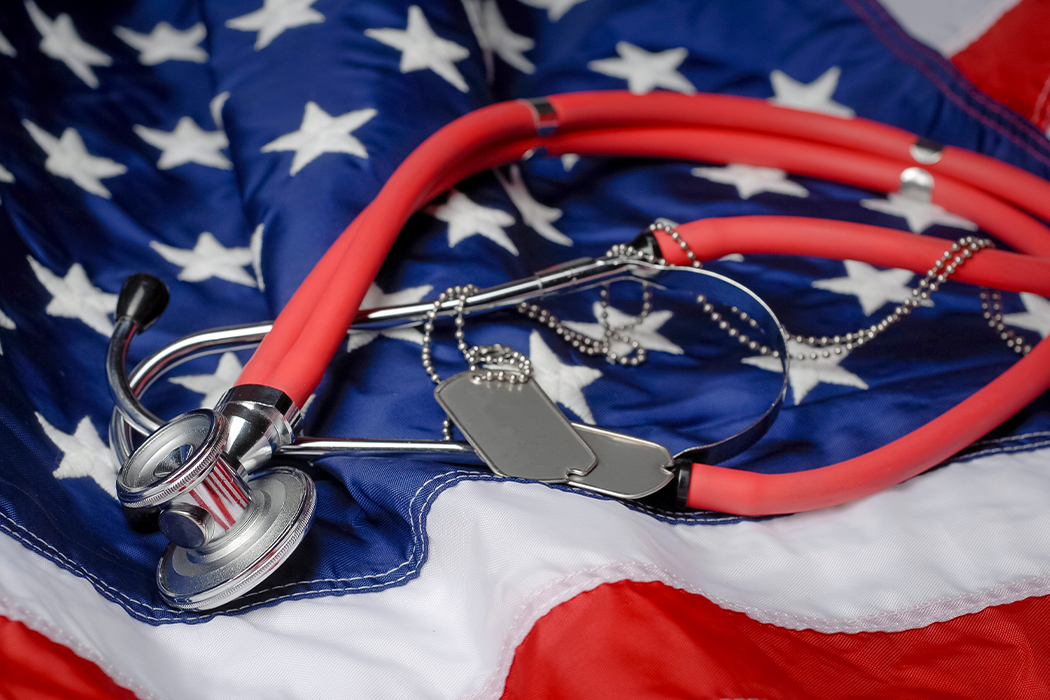
As a physician, veteran and lifestyle medicine leader, Regan A. Stiegmann, DO, MPH, has built a career defined by service. In May of 2011, Dr. Stiegmann enlisted in the United States Air Force (USAF) Reserve, where she served as a flight surgeon. In the years since, she has combined her osteopathic medical training with her military experience to champion whole-person health, advance lifestyle medicine and help shape emerging digital health solutions for the next generation of physicians and patients.
Today, Dr. Stiegmann is a clinical professor at Rocky Vista University College of Osteopathic Medicine (RVUCOM) and the University of Colorado Anschutz School of Medicine. She is also an active member of several professional medical associations and serves on the AOiA’s Digital Health Innovation Steering Committee. Her multifaceted career continues to reflect her commitment to service.
Below is an edited Q&A.
What was your path to osteopathic medicine?
I am a proud Colorado native, and both of my parents are physicians. Both are MDs, and I knew that I was not cut for the common pathway. I ended up looking around for other options that might exist outside of allopathic medical schools, and lo and behold, I found osteopathic medicine.
What I like about osteopathic medicine is how it teaches a whole-person approach to healthcare. I also loved the idea of being able to integrate osteopathic manipulative treatment (OMT) with my other medical knowledge, as sports are a huge part of my life. I used to play semi-pro soccer prior to medicine. Osteopathic medicine did not feel rote and prescriptive.
You’re a USAF veteran and served as a flight surgeon. What did that job entail? Are there any stories you can share?
Halfway through medical school, a colleague mentioned the Health Professions Scholarship Program and explained that the program entailed joining the military and becoming a military physician. I thought that sounded so cool, and I ended up throwing my hat in the ring.
At the time, it was a two-year program. I joined the Air Force Reserve in 2011 and trained in preventive and lifestyle medicine. People hear “flight surgeon” and think I was doing surgeries on planes, but that is actually not part of the job. Being a flight surgeon entails keeping the pilots, flyers and crew at tip-top shape.
I had the opportunity to deploy in the middle of COVID-19 and when I arrived in the middle of the desert, the Wing Commander came down and said, “Hey Stiegmann, I hear that you’re the kind of flight doc who does lifestyle medicine to help get people back to health.” He had noticed a lot of overweight and obese military personnel and wanted to help change that. I had some profound outcomes, and since then, we were able to launch a second-generation lifestyle medicine clinic in Qatar.
You completed specialized training in lifestyle medicine during your residency training. Lifestyle medicine is becoming more popular as we learn more about how lifestyle has a huge impact on our health. How do you practice lifestyle medicine as an osteopathic physician?
Lifestyle medicine is essentially a modality to prevent, treat and reverse some of the most common diseases that we see today. We do that through a six-pillar system: nutrition, physical activity, sleep, stress management, avoidance of risky substances and positive social connections.
As we know, the tenets of osteopathic medicine, such as the body’s natural ability to heal, are very similar.
The same logic weaves right into viewing the body as a unit. In the military, it’s referred to as cognitive lethality. This entails evaluating mental clarity and focus, ensuring servicepeople can show up at 100%, if not more, in respect to their mental function and execution of cognitive performance. That is the intimate connection that lifestyle medicine draws to the body as a unit, and I love that.
It’s undeniable we are a unit. We are connected to everything around us. It almost becomes a sport to figure out how dialed in you can get your human systems with respect to performance. I educate patients on how therapeutic lifestyle change is the number one treatment modality and a first-line intervention.
You have been in many leadership positions as a physician, and even became involved with the film ‘The Game Changers.’ How did you get involved, and what message does the film convey?
My mentor was featured in the film, and that’s how I initially was connected to the team. The film was separate from the military. Motivated by my desire to again do the right thing for patients, I stepped in as a captain, which led me to become the military liaison for the film. “The Game Changers” is the most-watched documentary on the Apple TV platform. Essentially, the film covers performance nutrition, and it highlights some of the best athletes in the MLB, the NFL, Formula One and more.
It really busts a lot of conventional myths. It dispels the belief that if you want to be big and strong, you must eat a a lot of animal protein. That links up brilliantly with lifestyle medicine approaches, especially in terms of the food aspect of performance, and what performance nutrition can look like. The research presented has been vetted over the past 100 years. Unfortunately, some people will say otherwise, but the science behind this is reliable and can be replicated.
You are also a recipient of the prestigious Fulbright scholarship. Tell us more about your Fulbright research.
I met some folks through the American College of Lifestyle Medicine who are doing very unconventional things with digital health technology, including building apps that help people track their food better and helping to get people motivated the right way.
I applied for the scholarship with colleagues who were in the same space as me, and now we’re all partners in building smarter, stronger, more versatile solutions for not only war fighters, but also for dual-use technology. What’s good for war fighters will certainly be good for civilians.
Finland was a big target because they have a conscript military, which means every young man is going to go through the military at some point, and the idea is to make them as healthy as possible. How do we do that? We pre-empt diseases and proactively invest in teaching the recruits how to sustain their own health. I worked with a few companies to build that opportunity and participated in a huge showcase this past April in Helsinki.
We brought all the appropriate stakeholders to the table: researchers and academia, along with active duty USAF, United States Navy, Royal Navy, Royal Air Force, Lithuanian Armed Forces, Finnish Defense Forces and more. When you bring all the right people to the table, you have the opportunity to delegate. We know how to achieve and reclaim health and wellness. I am actually continuing that effort in 2026 because there was so much positive reverb from that Helsinki summit in April.
You are a busy woman between balancing being a physician, a military liaison and even a chief medical officer for the digital health company LPM LAB. Can you tell us about these roles, as well as your future goals?
When you see a deficit anywhere in your professional career, especially as a physician, your reflexive reaction is to ask, “How do we fix this?” I joined LPM LAB as their chief medical officer several years ago on the heels of separating from the Air Force. We’ve been building the very first lifestyle performance medicine app for the United States Department of War.
The app consolidates users’ information so they don’t have to toggle between several different apps. It’s a very personalized experience.
Nothing will motivate you more than having access to your own data and easily seeing it through the lens of lifestyle medicine. Through the app, users can see, for example, they are five grams of fiber away from the 25-gram goal. The app will nudge users to hit that goal.
We’ve also built the very first AI coach into the LPM LAB app. We use a large language model with a lovely, proprietary back end that really distills the most relevant, up-to-date information that, again, is personalized through users’ behavior patterns and data, before making more refined suggestions to the end user. The coach essentially keeps your fire stoked and keeps your health wins top of mind on a frequent basis. The app isn’t commercially available at this time, but launching it is a big goal of ours.
Do you have any advice for osteopathic students on medicine, the Health Professions Scholarship Program (HSPS) or becoming a military physician?
We are the fire starters for our patients. With patients, I refer to myself as the best cheerleader they will ever have, but like a quarterback, I cannot finish my job unless I have good wide receivers. Motivate yourself and your patients.
For HSPS, talk to recruiters, people in the program or even me through LinkedIn. Don’t be afraid to ask questions. Shake the trees, cold call, email to get those answers you need. Do not lose that fire you always had. Motivate yourself to continue, but find a way that you can give back.
A mentor once told me, “The American medical system is dead; it just hasn’t fallen over yet.” This is so powerful; we have the opportunity to build the medical system up and make it better than before, so long as we don’t give up that passion and desire.
Editor’s note: The views expressed in this article are the subject’s own and do not necessarily represent the views of The DO or the AOA.
Related reading:
From courtside to bedside: WNBA team physician forges her own path in sports medicine
The NASA engineer who went to osteopathic medical school at age 58