
As the joint U.S.-Israeli war on Iran stretches into its third week, Louisiana maritime leaders are keenly monitoring disruptions to the global supply chain, and energy markets in particular.
The effects of the conflict on the state’s shipping industry will be largely determined by its duration, experts say. But while the shock of high fuel prices and damage dealt to Gulf Arab economies threaten to inflate costs across the board, the destruction could also offer opportunities to Louisiana industry — in the form of more market share and reconstruction contracts.
The Mac Ubery VIII container ship passes under Crescent City Connection as it heads up the Mississippi to the Port of New Orleans
“Clearly, the shorter the duration, the less disruption to the supply chain and to the global overall cost of moving cargo,” said Greg Rusovich, CEO of the logistics and freight company Transoceanic Development. “The longer the duration, the more severe the impact on the global supply chain and on a whole variety of related transportation costs.”
‘Biggest crisis’
Since the war began, oil prices have spiked to nearly $120 a barrel before falling and climbing again. The world’s largest liquified natural gas plant, in Qatar, was knocked offline by an Iranian drone strike and ceased production. Iraqi oil production is down by about 70%.

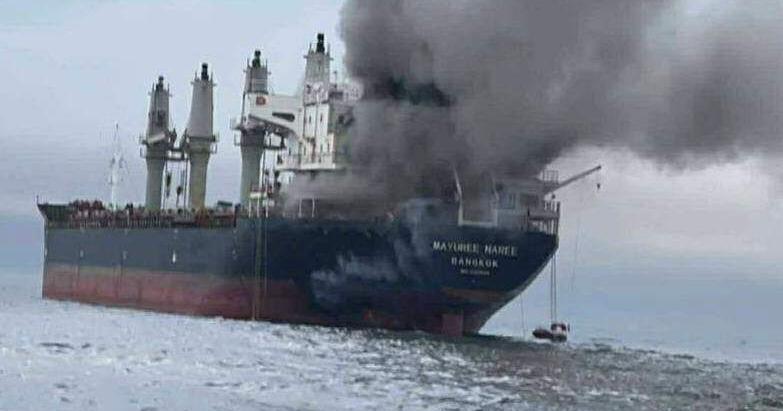
An oil tanker burns after being hit by an Iranian strike in the ship-to-ship transfer zone at Khor al-Zubair port near Basra, Iraq, late Wednesday, March 11, 2026. (AP Photo)
And the Strait of Hormuz has been effectively blockaded, cutting off the route through which about 20% of the world’s petroleum usually passes. Only 66 commercial vessels transited the strait during the first nine days of March, compared with more than 100 a day before the outbreak of war, according to the maritime intelligence firm Windward. Iranian forces on Wednesday attacked several commercial vessels in the strait, and as of Thursday, at least seven mariners have been killed in the conflict, according to The Associated Press.
Because of global supply chains in a world that is deeply interconnected through international trade, the increased energy costs will spread throughout the economy, impacting energy costs, goods and, by extension, construction costs.
“It is going to have an impact on everybody personally,” said Chett Chiasson, executive director of the Greater Lafourche Port Commission, which handles Port Fourchon and services about 95% of the Gulf’s deepwater energy production. “But it’s also going to have an impact on projects because higher fuel costs increase the cost for contractors and projects in general.”
Chett Chiasson, executive director at Port Fourchon and South Lafourche Airport, speaks during March 16, 2023, news conference at the Port of New Orleans building in New Orleans.
Chiasson said significant disruptions would have to linger for several months to spur major investment shifts, as Louisiana’s oil and gas producers lack OPEC members’ ability to quickly “turn the spigot” to increase output.
“There’s the ability to ramp up, if and when necessary,” he said. “We just have to see the operators pull those triggers.”
Import vs. export
For the Port of New Orleans, Louisiana’s only international container port, the immediate shock to the system from the stopped-up strait has been blunted — in part, experts said, because operators rerouted around the southern tip of Africa in late 2023 in response to attacks on commercial shipping by Houthi rebels.
“The shipping industry had already been largely avoiding that area unless cargo was destined for the Middle East,” said Port NOLA Chief Commercial Officer Kristi App.
While the cost of bypassing the Red Sea has already been factored in by the industry, many major carriers have recently imposed new emergency surcharges to cover increased fuel cost.
Kristi App became the chief commercial officer of the Port of New Orleans in December 2025.
“There’s been a pause button pushed from a lot of the carriers, whether they are carrying containerized cargo or bulk or breakbulk, to see if this is just going to be a few days into a few weeks — much like Venezuela was,” App said.
But the longer the Strait of Hormuz remains blocked, the more likely congestion will spread to transshipment hubs around the world, with repercussions for the entire global supply chain.
Last year, Port NOLA handled about 514,600 TEUs — the unit equivalent to standard 20-foot shipping containers — up 3% from the prior year, while the total number of container ships was up 7.7% to 394.
App predicted the conflict is unlikely to take a significant cut out of that traffic.
“We feed cargo into and out of the Middle East, but it is not our major market, so from that perspective, we’re well-insulated from any heavy or intense volume impact,” she said. “We’re diversified, which is good.”
Downriver, the Port of South Louisiana, which handles over 250 billion tons of cargo annually, is keeping in close contact with the seven grain transfer complexes, four major oil refineries, 11 petrochemical manufacturing plants and other industrial facilities within the 54-mile long port district, according to Chief Commercial Officer Micah Cormier.
“While too early to assess effects of this conflict, we are in communication with stakeholders and partners to gauge the impact to our Port and industry,” Cormier said in a statement.
Post-war profit?
Transoceanic Development CEO Greg Rusovich, pictured a 2016 file photo, speaks during a press conference at Louis Armstrong International Airport.
“There are a large number of Louisiana contractors that perform that type of work that could go in and help bring the country back under the right regime and help it become part of the global system,” Rusovich said.
On the downside, he said, the economic damage inflicted by Iran’s attacks on the United Arab Emirates and regional U.S. allies could trigger the Gulf monarchies to pull back from their commitments to significant capital investments in Louisiana.
Chiasson, the director of Louisiana’s primary base for offshore oil and gas operations, said increased oil prices will ultimately generate more revenue for the state’s producers, even if the long-term impact on the state’s maritime industry and the broader economy remains to be seen.
“We can’t make rash decisions either way because sooner or later, this is all going to be over and we’re getting back to where we thought we were going to be,” he said.
Port Fourchon, La., photographed on Saturday, June 3, 2023. (Flight courtesy of SouthWings)(Photo by Sophia Germer, NOLA.com, The Times-Picayune)