
Colorado’s economy shows resilience with rising wages and job growth outpacing the national average.
DENVER — Colorado’s economy is sending mixed but telling signals as 2026 gets underway.
While national unemployment continues to rise, the state’s labor market is tightening — even as the workforce itself shrinks.
At the same time, Denver International Airport is cementing its role as the region’s most powerful economic engine, preparing for its next phase of growth amid record passenger traffic and major infrastructure upgrades.
In November 2025, Colorado’s unemployment rate fell to 3.9%, bucking the national trend as U.S. unemployment climbed to 4.4%. It’s the first time Colorado’s rate has dipped below 4% since February 2024, signaling renewed momentum after nearly two years of lagging national job growth.
Key takeaways from the latest jobs report:
- Job gains: Colorado added 2,700 nonfarm payroll jobs in November.
- Growth edge: Year-over-year job growth reached 0.8%, outpacing the national average of 0.6%.
- Sector shifts: Job gains were led by other services and education and health services, while professional and business services posted the largest decline — a trend economists say may reflect both high interest rates and early AI-driven disruption.
- Wages: Average hourly earnings climbed to $40.47, more than $3.60 above the national average. After inflation, real wages rose 1.4% in 2025, continuing a positive trend that began early last year.
Colorado’s total labor force shrunk by 9,400 people in November, pushing the labor force participation rate down to 67.0%, its lowest level since October 2020. Economists point to an aging population and retirements — often called the “Silver Tsunami” — as a growing challenge for employers already struggling to find talent.
Dr. Phyllis Resnick of the Colorado Futures Center joined Business Buzz to break down what this tightening labor pool means for businesses trying to grow — and whether the state’s recent momentum is sustainable into the summer of 2026.
Denver International Airport: The State’s $47 Billion Powerhouse
If Colorado’s economy had a pulse, it would be felt on the runways at Denver International Airport.
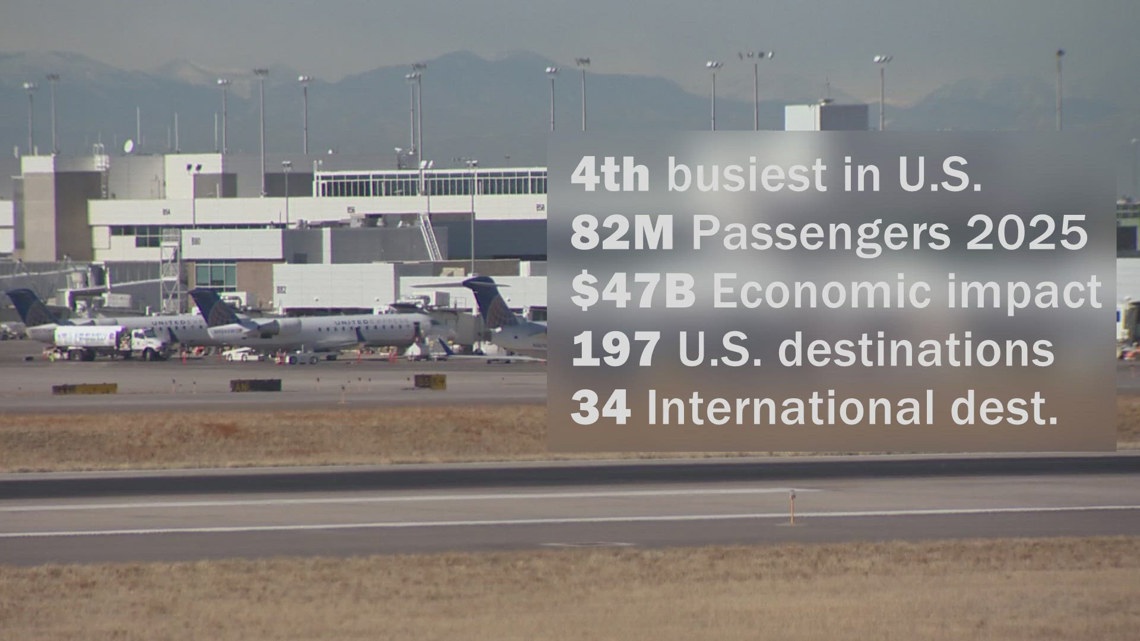
According to the latest economic impact study, DEN contributes $47.2 billion annually to Colorado’s economy — a 40.9% increase since 2020 — and supports more than 244,000 jobs statewide with a total payroll of nearly $16 billion.
The airport continues to break records:
- Passenger traffic: July 2025 was DEN’s busiest month ever, surpassing 8 million passengers for the first time. Annual traffic exceeded 80 million passengers in 2024.
- Global standing: DEN ranks as the fourth-busiest airport in North America and sixth-busiest in the world.
- Future growth: The airport’s ambitious Vision 100 plan is designed to prepare for 100 million annual passengers, with major projects already underway.
DEN CEO Phil Washington joined Business Buzz to discuss what travelers and businesses can expect next. Some of the highlights:
- The East Security Checkpoint, opened in August 2025, is already easing congestion.
- The long-running Great Hall Program remains on track for full completion in 2027.
- DEN is pilot-testing AI technology to improve TSA line management and airfield maintenance — tools designed to reduce wait times, boost efficiency, and lower long-term operating costs.
- By 2032 or sooner, Vision 100 projects are expected to push DEN’s economic impact to more than $71 billion annually.
Washington also emphasized DEN’s expanding role beyond aviation — from attracting international flights to fueling development along the Peña Boulevard “Aerotropolis,” one of the fastest-growing economic corridors in the region.
Together, the labor market and airport data tell a clear story: Colorado’s economy is resilient, but constrained. Job growth is improving, wages are rising in real terms, and DEN is booming — yet a shrinking workforce means competition for talent isn’t going away.
When the airport thrives, the state thrives. And, Colorado’s biggest economic challenge in 2026 may not be just finding jobs — but finding workers.