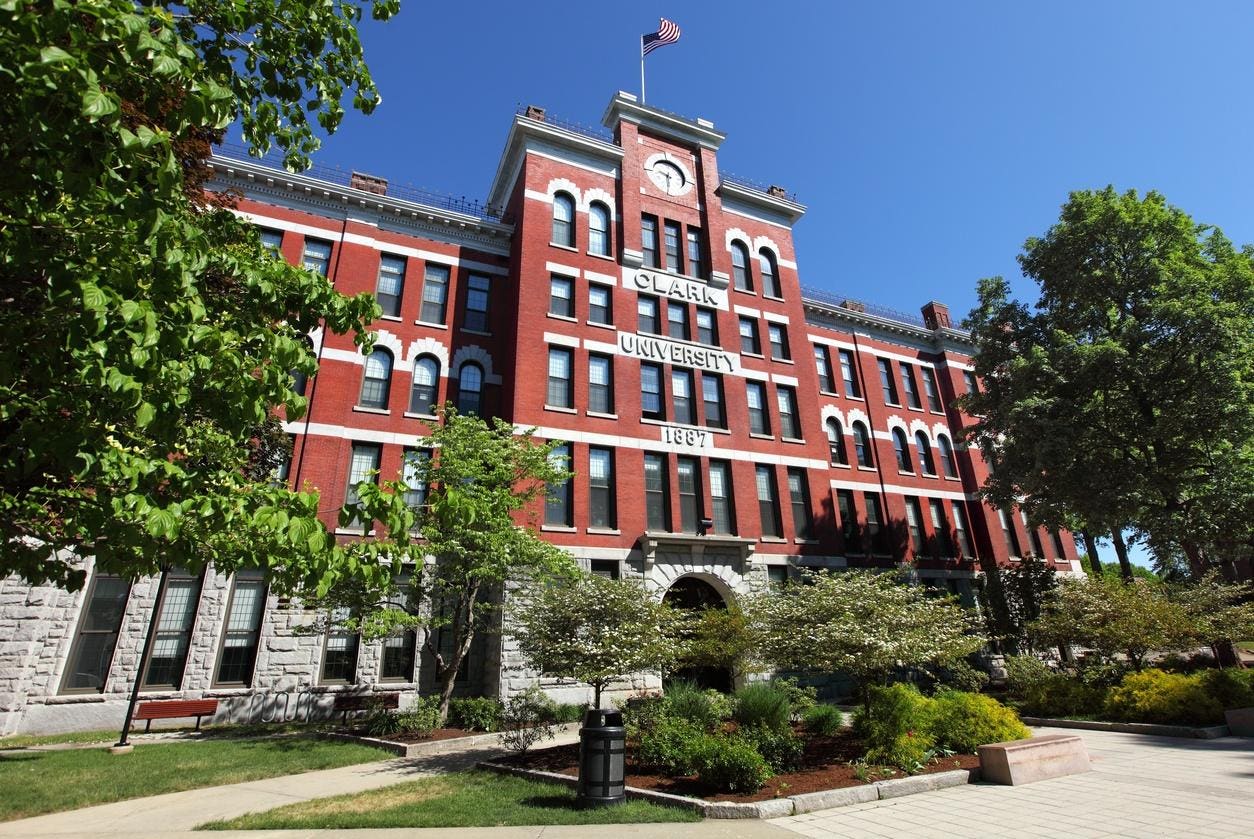
Clark University is one of the few mid-size New England colleges proactively addressing looming financial challenges based on declining enrollments hitting the region that will put many colleges at existential risk.
getty
While much of the country remains fixated on the tensions between the Trump administration and elite research universities, a more insidious threat to many other institutions of higher education is brewing.
A new in-depth study by Steve Shulman—an entrepreneur who, in the second half of his 50-year career has served as a software developer and financial consultant for several higher education institutions, including Yale, Dartmouth, NYU, Maryland and many more—examines the finances of 44 private, tuition-dependent New England colleges and universities that enroll between 1,000 and 8,000 students.
Many of these schools have relatively well-known brands, yet Shulman’s analysis indicates that 15 of them are already facing serious liquidity challenges at their current levels of enrollment—or will do so shortly.
Six more—a total of 21 of the 44—schools will find themselves in the same difficult position if their enrollments begin to decline by just 10 percent between 2025 and 2029—a decline that aligns with long-standing predictions for the industry.
The cause of the challenges isn’t one single factor, but a series of pressures from demographic changes, shifts in the public’s perception of higher education’s value, rising operating costs, emerging alternatives to traditional colleges, and, of late, changes in federal policies and programs. The net effect is that many institutions are much closer to the brink of closure than ever before.
Yes, there are arguments and competing datasets over just how steep the decline will be. Some use data from Nathan Grawe, a Carleton College professor and author of “Demographics and the Demand for Higher Education,” whereas others cite The Western Interstate Commission for Higher Education’s (“WICHE”) most recent study, “Knocking at the College Door: Projections of High School Graduates.” But Shulman’s study serves as a warning: getting into a debate over the precise decline in the traditional college-age population will cause schools to miss the point.
There’s agreement that college enrollment is shrinking, and Shulman’s analysis shows that the survival of a significant number of the schools is at risk. Business as usual for many is not an option, as his study looks at the potential financial impact of enrollment declines ranging from 0 percent to 20 percent on each of the 44 institutions.
Much attention has been paid to my 2013 prediction in the New York Times with Clayton Christensen that 25 percent of colleges would consolidate over the next 15 years—as well as to subsequent updates and explanations I’ve written about in Forbes.
But our focus has largely been on three segments of the industry where most closures and consolidations have occurred: for-profit institutions; tuition-dependent, non-profit schools with fewer than 1,000 students, which represent 35 percent of all colleges—down from 40 percent a decade ago thanks to consolidation; and regional public colleges and universities that are merging.
Shulman’s analysis provides statistical evidence that the difficulties facing higher education could cut much deeper.
Based on audited fiscal year 2024 results—and assuming business as usual with no decline in enrollment—15 of the schools will only be able to cover their typical operating expenses and other uses of cash in the normal course for a maximum of three years before they must spend beyond 5 percent to 7 percent of their unrestricted quasi-endowments to sustain operations, which risks undermining their long-term sustainability. Six have already stepped into that dangerous territory, as they are, on average, drawing down 12.7 percent of their endowment for operations—well in excess of the industry norm of roughly 5 percent.
What’s daunting is that flat enrollment is almost certainly an overly optimistic scenario.
If enrollment at the 44 schools falls by 15 percent over the next four years and business proceeds as usual, then 28 of the schools will have less than 10 years of cash and unrestricted quasi-endowments before they would become insolvent—assuming no major cuts, additional philanthropy, new debt, or asset sales. Fourteen would have less than five years before insolvency.
Even if enrollments only declined by 2.5 percent per year over four years, quasi-endowments would sustain 22 of the 44 survey schools for just 5.4 years on average. If enrollment declined by just 1.25 percent per year over four years, 15 schools would have just five years before becoming insolvent.
Put differently, many schools face predictable and severe financial strain that is existential.
Whereas most college financial health models give considerable weight to an institution’s net-asset value on paper—including overall endowments and equity in plant, property and equipment—Shulman’s model examines cash flows. It looks only at liquid assets—cash and equivalents that are available and generated in the normal course of business—along with other unrestricted investments that can fund operations, notably quasi-endowments. The model uses a simple two-part formula based on published year-end financial statements: (1) cash and equivalents on hand and (2) annual primary net cash flow.
From those numbers, he created a financial metric he refers to as “Staying Power”—a straightforward calculation projecting how long cash and equivalents on hand plus normal cash flows from operations will cover all normal outlays, including scheduled debt retirement and an estimate based on historical spending patterns of fixed-asset additions not funded by new debt.
A school with $25 million in cash and equivalents on hand and a negative net operating cash flow of $10 million, for example, would have 2.5 years of Staying Power. The calculations assume a business-as-usual posture—meaning no groundbreaking gifts, dramatic cuts, or unanticipated growth.
Although many in this group may close or merge, these numbers aren’t a prediction per se. As Shulman told me, although his methodology has predicted past closures like Birmingham Southern in Alabama based on its 2019 financial statements—three years before its auditors identified it as a going-concern risk—the release of fiscal year 2025 statements will be telling to see if some of these schools will begin tightening their belts or invading quasi-endowments. He is watching three key areas: compensation, which averages 56 percent of total expenses for the 44 Survey schools; fixed asset additions not funded by debt, which heavily influence net cash flow; and matriculation and discounting trends, which can have the same financial effect as a decline in headcount but without whatever marginal cost savings an actual enrollment decline might generate. Indeed, first-time matriculations at 27 of the 44 schools already dropped 8.8 percent on average between 2023 and 2024 according to IPEDS——which will have a cascading impact on their overall enrollment as larger classes graduate.
Shulman noted that Clark University, one of the 44 schools in his study, provides a good example of a university proactively cutting costs—even before conventional metrics signaled risk—to avoid harsher measures later.
Either way, as Bob Moesta and I detailed in our 2019 book Choosing College, colleges must learn to focus. The era of trying to be all things to all people for most schools is over. Schools will instead have to decide which Job to Be Done they want to excel at and which ones they’ll purposely forego.
That will mean learning to downsize—whether through normal attrition, as Shulman argues, or through strategic cost reductions that sharpen a school’s focus and position.
Shulman also argues that schools should explore potential mergers sooner rather than later. He has modeled out what each of the schools can gain by merging with others among the 44. Both mergers and cost reductions are likely sounder strategies than a strategy based primarily on the hope of outperforming other schools in a tough environment for higher education.
Although some schools may be pursuing these paths, Shulman notes that 38 of the 44 schools list “growth” as a main objective in their published strategic plans—usually emphasizing maintaining traditional-age enrollment at minimum along with other strategies that often carry a significant cost with no guarantee of success.
Given the demographics in New England, that’s likely a pipe dream for many. College trustees should acknowledge the reality and plan accordingly rather than just make big investments that could put the institutions even further at risk.