Brazil B2C Ecommerce Business Report 2025: Market to Grow by 9.9% to Reach $64.09 Billion
Table of Contents
Company Logo
Key opportunities in Brazil’s ecommerce market include the rise of Pix for instant payments, driving a shift from cards and boletos. Large ecosystems like Mercado Livre and Amazon dominate, focusing on logistics and payment innovations. Cross-border and social commerce offer growth, amid tightening customs regulations.
Brazilian B2C Ecommerce Market
Brazilian B2C Ecommerce Market ·GlobeNewswire Inc.
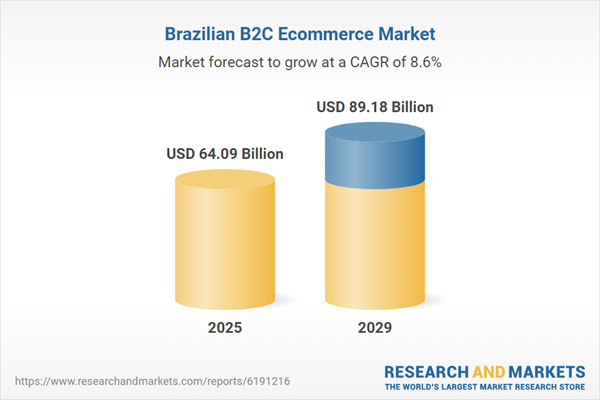
The ecommerce market in Brazil is expected to grow by 9.9% annually, reaching US$64.09 billion by 2025.
The ecommerce market in the country has experienced robust growth during 2020-2024, achieving a CAGR of 17.8%. This upward trajectory is expected to continue, with the market forecast to grow at a CAGR of 8.6% from 2025 to 2029. By the end of 2029, the ecommerce market is projected to expand from its 2024 value of US$58.31 billion to approximately US$89.18 billion.
Over the next 2-4 years, the landscape is expected to consolidate further around multi-service ecosystems marketplace, payments, logistics, and advertising, while cross-border players localize more operations to manage regulatory changes. Domestic retailers are likely to deepen marketplace and omnichannel strategies rather than compete on standalone retail. Partnerships will become more common as players seek scale advantages in fulfillment, last-mile, and seller services.
Current State of the Market
Brazil’s e-commerce sector is shaped by a concentrated set of large multi-vertical platforms competing on logistics speed, payments integration, and seller acquisition. Marketplace penetration remains high, with Mercado Livre, Amazon, Magalu, Americanas, Shopee, and Via dominating traffic and fulfillment. Competition has intensified as cross-border platforms, particularly Shopee, Shein, and AliExpress, expand their presence.
Their focus on low-ticket categories and aggressive pricing continues to put pressure on domestic operators. Payment innovation is a parallel competitive lever: the broad adoption of Pix and the launch of Pix Automatico have encouraged platforms to redesign checkout experiences and lower transaction costs. Physical retail networks are increasingly used as fulfillment hubs, supporting same-day or next-day delivery in major urban centers.
Key Players and New Entrants
Mercado Livre remains the largest marketplace, supported by Mercado Pago and Mercado Envios. Amazon continues to expand Prime benefits and logistics assets, using faster delivery as its primary differentiator. Shopee and Shein have maintained momentum in fashion and low-value general merchandise, supported by cross-border sourcing models. Magalu, Via, and Americanas continue to operate omnichannel networks, although profitability constraints have required selective rationalization. Newer entrants include Temu, which began testing the Brazilian market in late 2024, and several domestic logistics-first players that provide last-mile services to marketplace sellers.
Recent Launches, Mergers, and Acquisitions
Recent activity includes the collaboration between Magazine Luiza and Americanas to cross-list products on each other’s platforms, aimed at improving assortment and traffic recovery. Mercado Livre has continued its logistics investments, expanding regional distribution centers and lowering free shipping thresholds. Shein has pursued partnerships with domestic manufacturers to increase local sourcing. Cross-border platforms are adapting to Brazil’s tightening customs rules, pushing them to explore additional warehousing and compliance partnerships.
Key Trends and Drivers
Accelerate the shift from cards and boletos to Pix-led real-time payments
Brazil’s e-commerce checkout is rapidly moving from cards and boletos toward Pix and other instant payment features. Pix is now the default option on most major platforms, and the Central Bank is rolling out features like Pix Automatico for recurring payments, targeting subscription-heavy sectors such as streaming and software.
The Central Bank has actively promoted Pix as a low-cost, 24/7 payment rail with near-instant settlement and no fees for individuals. Pix has already overtaken cards as Brazil’s most used payment method in volume, and the new Pix Automatico feature is designed specifically to capture recurring online payments that were previously card-driven.
E-commerce players, from Mercado Livre to domestic retailers, are incentivized to push Pix to reduce interchange and chargeback costs and to reach consumers with no or low credit limits. Pix is likely to become the primary rail for both one-off and subscription e-commerce payments, further eroding boleto and part of card usage.
Use marketplace ecosystems and free-shipping plays to compete in an increasingly concentrated market.
The Brazilian e-commerce market is consolidating around a handful of large ecosystems, Mercado Livre, Amazon, Shopee, Magalu, Americanas, and Via, that combine marketplace, payments, logistics, and advertising. Competition is intensifying around shipping economics and seller services, not just traffic.
Mercado Livre has been cutting shipping costs and, in mid-2025, dropped the free-shipping threshold in Brazil to R$19, covering almost the entire catalog, explicitly to counter Shopee and Temu in low-ticket categories. These moves support strong GMV and buyer growth but put pressure on margins, forcing platforms to lean harder on payments (Mercado Pago), ads, and financial services to sustain profitability.
The market will likely concentrate further around 3-5 full-stack ecosystems (marketplace + payments + logistics + ads). Smaller players will have to plug into these ecosystems as sellers rather than try to build independent traffic at scale. Executives should assume higher customer acquisition and fulfillment costs in the short term, with monetization shifting into ads, financial services, and value-added services for sellers.
Rebalance cross-border growth as customs enforcement tightens on low-value imports
Cross-border e-commerce, especially low-ticket imports from Chinese platforms like Shopee, Shein, AliExpress and Temu, has grown quickly in recent years. Brazil is now moving from an incentive and regularization phase (Remessa Conforme) to more stringent enforcement and new tax rules on small parcels, directly affecting price-sensitive cross-border flows.
The Remessa Conforme program created a standardized regime for international parcels, allowing compliant platforms to offer low-value imports with clearer taxation, which encouraged platforms like Shopee and AliExpress to scale In 2024-25, the government moved to remove exemptions and tighten controls; for example, authorities began issuing fines on parcels from Shopee and AliExpress that fall outside the compliance program or have mis-declared values.
These changes reflect pressure from domestic retailers and manufacturers, who argue that cross-border platforms face lighter tax and compliance burdens, as well as fiscal concerns about foregone import revenue. Price gaps between cross-border and domestic offerings on ultra-low-ticket items are likely to narrow as taxes, compliance costs, and enforcement risk are baked into cross-border pricing.
Scale social, conversational, and omnichannel commerce to pull SMEs and physical retail into e-commerce
E-commerce in Brazil is expanding beyond traditional websites and apps into social and conversational commerce, while large retailers are deepening their omnichannel logistics. WhatsApp, Instagram, and other social platforms are becoming sales and payment channels, and store networks are being repurposed as fulfillment assets.
WhatsApp is widely used by micro and small businesses in Brazil as their main digital tool; recent updates to WhatsApp Business payments expand the ability to accept in-app payments, lowering the barrier for informal and small merchants to sell online without a full e-commerce stack. Social platforms and third-party providers are actively marketing “shop” and messaging-based commerce solutions to Brazilian SMBs, reflecting the fact that discovery and purchase journeys already start in chat and social feeds.
On the omnichannel side, retailers like Magazine Luiza and Via Varejo use physical stores as mini-distribution centers, enabling same-day or next-day delivery and click-and-collect options, which a 2025 logistics analysis highlights as a key enabler of Brazil’s omnichannel retail. Social and conversational commerce will formalize and scale, especially among small merchants who will rely on WhatsApp/Instagram plus Pix as their primary e-commerce stack. This will gradually shift some GMV from large marketplaces to “micro-frontends” driven by influencers, local stores, and niche sellers.
About ResearchAndMarkets.com ResearchAndMarkets.com is the world’s leading source for international market research reports and market data. We provide you with the latest data on international and regional markets, key industries, the top companies, new products and the latest trends.
Attachment
CONTACT: CONTACT: ResearchAndMarkets.com Laura Wood,Senior Press Manager press@researchandmarkets.com For E.S.T Office Hours Call 1-917-300-0470 For U.S./ CAN Toll Free Call 1-800-526-8630 For GMT Office Hours Call +353-1-416-8900
Join millions of self-starters in getting business resources, tips, and inspiring stories in your inbox.
Unsubscribe anytime. By entering your email, you agree to receive marketing emails from BigBCC. By proceeding, you agree to the Terms and Conditions and Privacy Policy.
SELL ANYWHERE WITH BigBCC
Learn on the go. Try BigBCC for free, and explore all the tools you need to start, run, and grow your business.