

If you own shares of BlackRock or have been thinking about taking a position, you probably want more than just a headline or a hot tip. After all, when a stock’s up 113.9% in five years and has kept up a winning pace so far in 2024, it’s easy to wonder how much firepower is left in the tank. At the same time, watching BlackRock slide 2.1% in just the last week raises new questions about risk. Is this a healthy dip or a signal that sentiment is turning?
Those short-term jitters have popped up against a backdrop of consistent long-term gains. Lately, though, there’s been additional buzz around BlackRock’s leadership in sustainable investing and its recent expansion into new international markets. These developments are viewed by some as major catalysts for growth, even if the initial market reaction was muted. Still, with all this in the mix, it’s tough for investors to know whether the stock is fairly valued, overhyped, or flying under the radar.
If we run the numbers, BlackRock currently scores just 1 out of 6 on a composite undervaluation check. Most traditional models are not shouting “discount” right now. But how reliable are these models, and is there a smarter way to judge what the stock is really worth? Let’s dive into the key valuation approaches, and stick around for a perspective that might give you an edge others are missing.
BlackRock scores just 1/6 on our valuation checks. See what other red flags we found in the full valuation breakdown.
Approach 1: BlackRock Excess Returns Analysis
The Excess Returns Model focuses on how efficiently a company generates value from its invested capital above its cost of equity. Rather than just looking at earnings, this approach measures how much additional profit BlackRock can create after rewarding shareholders for their risk.
For BlackRock, the average return on equity is 16.61%. This means that for every dollar of equity, the company generates a healthy profit. Analysts project a stable earnings per share (EPS) of $50.04, based on future return on equity estimates from five leading sources. The stable book value per share is $301.21, supported by consensus from three analysts. Meanwhile, the cost of equity stands at $24.82 per share. Subtracting this cost from the projected profit, the model estimates BlackRock’s excess return at $25.22 per share. This highlights a sizable buffer above the compensation required by investors.
However, when you translate these healthy returns into an intrinsic value, the model suggests BlackRock’s current share price is about 43.9% above what this method considers fair. In other words, while the company’s fundamentals are strong, the market may be pricing in more future growth than the model supports.
Result: OVERVALUED
Head to the Valuation section of our Company Report for more details on how we arrive at this Fair Value for BlackRock.
Our Excess Returns analysis suggests BlackRock may be overvalued by 43.9%. Find undervalued stocks or create your own screener to find better value opportunities.
Approach 2: BlackRock Price vs Earnings
The Price-to-Earnings (PE) ratio is a classic benchmark for valuing profitable companies like BlackRock because it connects what investors are willing to pay for each dollar of current earnings. For long-established and steadily profitable companies, the PE ratio summarizes both current performance and the market’s expectations for future profits.
Growth expectations and risk play a major role in shaping what a “normal” PE should look like. A fast-growing company or one with more stable earnings might command a higher PE, while riskier or slower-growth firms often trade at a discount. BlackRock currently trades at a PE of 28.9x. Compared to the Capital Markets industry average of 26.6x and a peer group average of 50.6x, BlackRock’s PE lands somewhere in the middle. This suggests the market sees it as a premium but not an extreme outlier.
Simply Wall St’s proprietary “Fair Ratio” goes a step further than just looking at peers or sector averages. The Fair Ratio, here calculated at 21.7x, weighs up detailed factors like BlackRock’s earnings growth, profit margins, market cap and risk profile. All of these are tuned to current industry specifics, so it offers a more tailored benchmark for fair value.
With BlackRock’s actual PE above its Fair Ratio, and the difference being more than a marginal amount, the stock appears slightly overvalued on this basis.
Result: OVERVALUED

PE ratios tell one story, but what if the real opportunity lies elsewhere? Discover companies where insiders are betting big on explosive growth.
Upgrade Your Decision Making: Choose your BlackRock Narrative
Earlier, we mentioned an even better way to understand valuation, so let’s introduce you to Narratives. A Narrative is much more than a simple number or price target; it’s a story, backed by your beliefs and expectations about where BlackRock is headed, combined with your own assumptions for future revenue, earnings, and margins. Rather than relying solely on static models, Narratives let you connect the “why” behind the business to a financial forecast, and then calculate a fair value based on your personal view or research.
Narratives are available for everyone in the Simply Wall St Community, where millions of investors build, share, and update their perspectives in one place. This tool helps you recognize exactly who is optimistic or cautious, and why, by showing how different fair value estimates stack up against the current price. It also makes it clear when someone thinks it is time to buy or take profits.
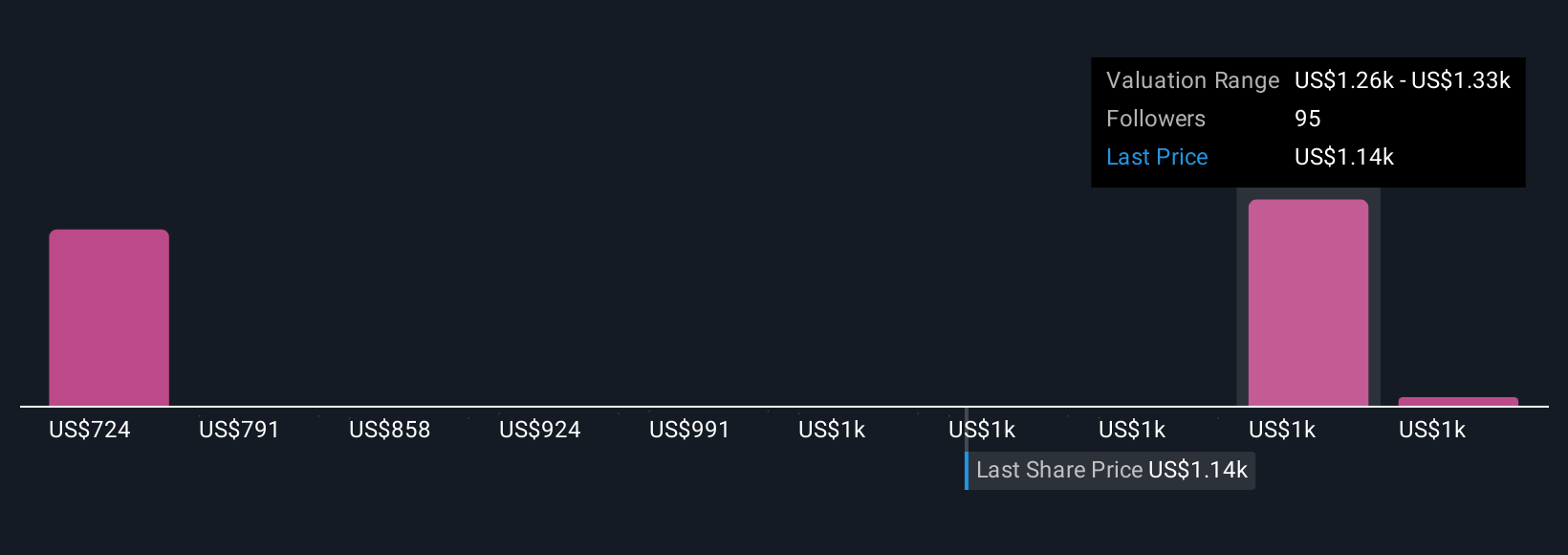
Best of all, Narratives update automatically when key information, such as earnings announcements or market-moving news, arrives. For example, some investors have set their BlackRock fair values as high as $1,300, focused on the expansion into private markets and tech innovation, while others are more conservative with targets around $1,000, worried about regulatory risks and margin pressures.
Do you think there’s more to the story for BlackRock? Create your own Narrative to let the Community know!
This article by Simply Wall St is general in nature. We provide commentary based on historical data
and analyst forecasts only using an unbiased methodology and our articles are not intended to be financial advice. It does not constitute a recommendation to buy or sell any stock, and does not take account of your objectives, or your
financial situation. We aim to bring you long-term focused analysis driven by fundamental data.
Note that our analysis may not factor in the latest price-sensitive company announcements or qualitative material.
Simply Wall St has no position in any stocks mentioned.
Valuation is complex, but we’re here to simplify it.
Discover if BlackRock might be undervalued or overvalued with our detailed analysis, featuring fair value estimates, potential risks, dividends, insider trades, and its financial condition.
Access Free Analysis
Have feedback on this article? Concerned about the content? Get in touch with us directly. Alternatively, email editorial-team@simplywallst.com