EDITOR’S NOTE: This is the first in a series about efforts to enhance flight options at Grand Forks International Airport.
GRAND FORKS — Ron Bell was among the featured speakers at the annual UAS Summit and Expo last week at the Alerus Center in Grand Forks.
He boarded a plane in Denver, touched down in Fargo, rented a car and drove the final 80 miles to Grand Forks.
Christopher Hewlett took the same route to the summit — Denver to Fargo, followed by a drive to Grand Forks. For Jason Minich, it was Cincinnati to Minneapolis to Fargo, and — like the others — a rental car for the last hour.
They represent tech companies that either have a flag planted in Grand Forks or who work in a sector that’s growing exponentially in the region. Additionally, all three personify what Mayor Brandon Bochenski believes is Grand Forks’ biggest business challenge: Limited air service at Grand Forks International Airport.
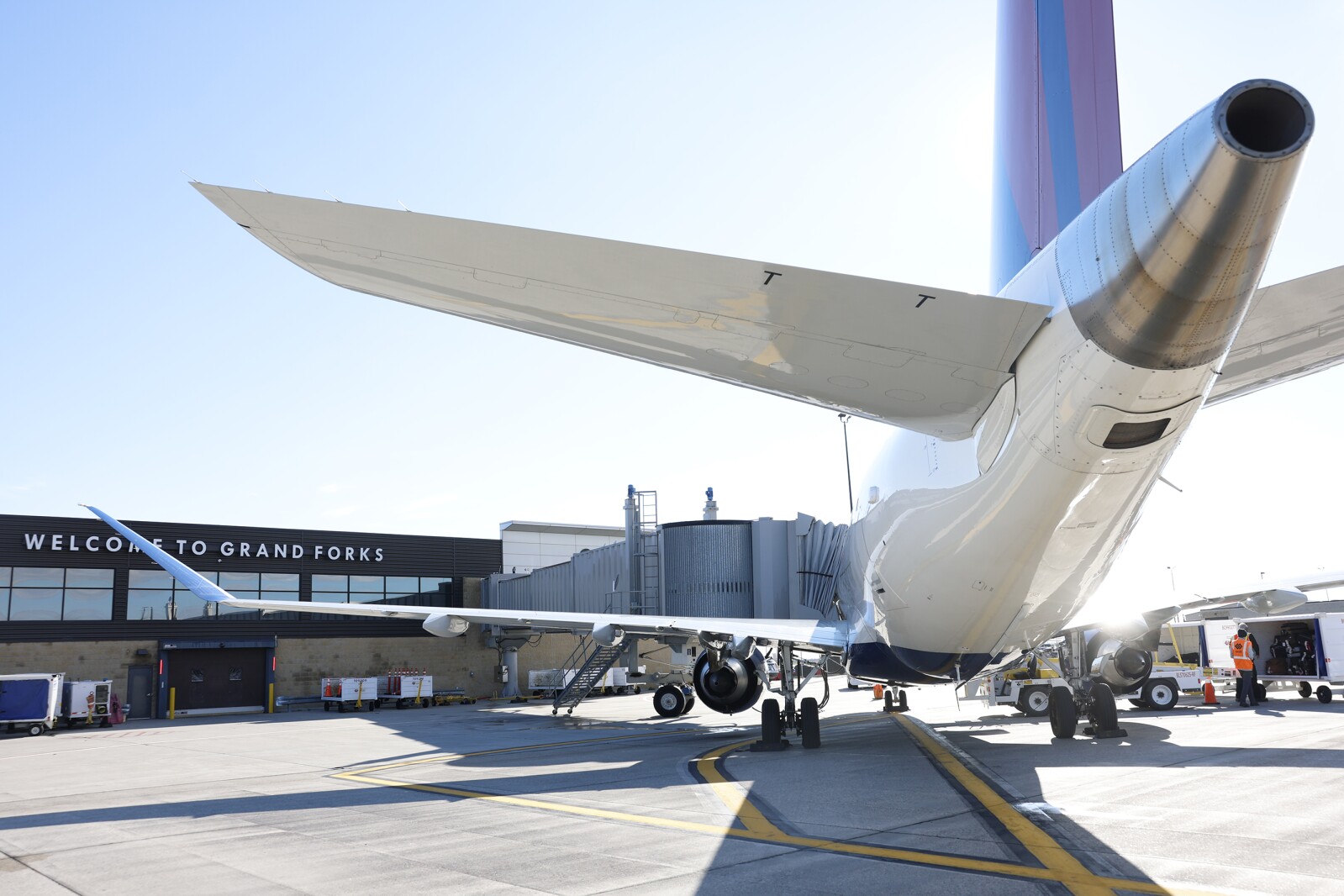
Eric Hylden / Grand Forks Herald
“My initial reaction is disappointment that our prized and growing (air) sector is contributing to Fargo’s air service statistics,” he said when asked about UAS Summit attendees who flew into Fargo.
The stories aren’t surprising to Bochenski. The mayor formed the Air Service Task Force in late 2023 to investigate the need for additional service at Grand Forks while also tracking how business is impacted by the current setup at GFK, the three-letter code for Grand Forks International Airport. The goal of the task force has been to attract another major airline to serve GFK, complementing existing service by Delta, which currently offers three trips to and from Minneapolis daily, and Allegiant, which flies to warm-weather destinations.
The well-publicized hope is to soon begin daily flights to Denver, a service that existed at GFK in the past but which stopped in 2013 when United Airlines announced the route wasn’t financially viable. Additionally, extra trips between Grand Forks and Minneapolis are on the task force’s wish list, as is a reduction in ticket prices. Cost likely will come down as more seats are made available on a daily basis, the mayor and others believe.
After two years of task force meetings, visits with airlines, more than $500,000 raised in local funds and a $1 million federal grant to be used in courting an air service provider, Bochenski hopes to get an answer in the coming months to questions that have been asked in Grand Forks for more than a decade.
Specifically: Will an airline make the commitment to re-open a direct route to Denver, or possibly to some other western hub? Can there be more than three flights daily to Minneapolis? Could Grand Forks someday even see a direct flight to Chicago?
Bochenski and task force members have engaged in a series of meetings with airlines, including Delta, United and Sky West, the latter of which wrote a letter of support for the project. The $1 million federal grant came after a number of local businesspeople backed the task force’s work, providing matching dollars and their own letters of support to the Department of Transportation.
“I feel really good (about the progress). When we initially were looking at getting the grant, we were told by aviation experts that it would take a year, two or three years to be ready to submit the grant. We sped everything up and did it in a matter of months and we won the grant. That in and of itself was huge. Getting a letter from Sky West supporting the grant application was huge. Getting these meetings — we have met with United, Sky West twice and Delta (soon). That’s more meetings than we had with airlines in the past 10 years combined,” Bochenski said. “The traction is great. Hopefully, by the end of the year, we’ll have some direction or clarity on what is coming next.”
GFK offers flights to Minneapolis three times a day, at 5 a.m., 12:19 p.m. and again at 4:30 p.m. But the limited flight options tend to drive up prices and the times can be inconvenient, the task force has determined. For instance, taking the 5 a.m. flight means arriving at the airport sometime around 3 a.m. The available options also can sometimes result in long layovers in Minneapolis.
The impact local air service has on business has been a focus of the task force throughout its existence. Bochenski believes that’s the right path, especially considering the region’s business growth — both real and hoped for — in the past decade. Much has happened in Grand Forks since the Denver flight was discontinued in 2013. Particularly, the UAS industry has blossomed here, especially with the development of the GrandSky aviation business park, located adjacent to Grand Forks Air Force Base.
“In terms of recruiting employees, I don’t believe (current air service) is a benefit or a handicap,” said Tom Swoyer, president of GrandSky. “But for people who want to come to visit, or for testing assignments, etc., I do believe it’s a handicap. It’s just not easy to get in and out.”
Consider Bell, whose Colorado company, Drone Geoscience LLC, describes itself as “a global leader in applications for drones in high-definition magnetic surveys.” A speaker at the UAS Summit and Expo, Bell chose a flight to Fargo. Cost was part of the decision, but other than that, “I didn’t give it a whole lot of thought.”
Although he shrugs at the supposed inconvenience of the non-direct flight and car rental — he also wanted to visit with friends in Fargo — he acknowledges that he would have preferred to simply fly directly into Grand Forks.
“I like direct flights — I like getting on a plane and ending up where I need to be,” Bell said. “I would love to have a direct flight to Grand Forks from Denver.”
Hewlett, of Longmont, Colorado, is more blunt.
“I want to use (the Grand Forks) airport desperately,” he said. “It’s just there are no direct flights to it. From Denver, there’s a direct flight to Fargo. Or, I can fly to Minneapolis and take a layover and then fly into Grand Forks and get in two to three hours later than if I fly to Fargo and drive north.”
As a subcontractor to Grand Forks County and GrandSky, Hewlett’s company — CScott Solutions LLC — runs Project ULTRA, a joint effort with the Department of Defense. He comes to Grand Forks monthly.
In his opinion, Grand Forks’ air service limitations are “hindering the Department of Defense and the large government agencies from being able to get to you directly.”
And it’s not just guests from the western U.S., he said. He believes the limited flight options from Minneapolis are pushing many business guests to fly to Fargo.
“The vast majority of people in federal government that I know who come (to Grand Forks) from the East Coast are flying to Fargo,” Hewlett said. “It would be amazing if we had another option, which would be Denver.
“I am just stunned and amazed that we are at this point where we’re actually trying to convince air carriers that Grand Forks is up and coming yet needs more routes.”
Minich, based in Dayton, Ohio, is a senior program manager/business development manager at Perikin Enterprises, which helps the government manage the SkyRange program at GrandSky. He often flies directly to Grand Forks, but sometimes it’s just not feasible, he said. “Especially when everyone else is flying there for (an event), it gets to be slim pickings pretty quick,” he said.
He knows of instances when tech workers flew into Minneapolis, rented cars and drove to Grand Forks. In optimal weather, that’s a nearly five-hour drive.
If more flights are added — direct to Denver and maybe another flight or two daily to Minneapolis — Minich predicts a sea change for GFK.
“Everyone would fly directly into Grand Forks, 100% of the time, for sure,” he said.
Scott Meyer, director of engagement at GrandSky, told the Herald that he knows of many UAS Summit attendees who flew into Fargo and drove to Grand Forks.
For Bochenski, the trend is “extremely frustrating.”
Companies that are “so pumped and enthused about Grand Forks will lose that excitement a little bit. … We need to make it easier for people to get here. With large companies, it’s a big deal. It just is,” he said.
Many local business leaders feel the same. To generate funds to apply for the $1 million federal grant, a fundraising effort last year raised more than $200,000 in cash directly from local businesses. The city contributed $300,000, while the city of East Grand Forks added $20,000. The airport has offered $400,000 in in-kind donations.
What previously was the task force has morphed into what’s now called the Fly Grand Coalition.
“It’s really been a bottom-up effort,” City Administrator Todd Feland said. “The business community, our institutional partners, want this now and are demanding additional air service.”