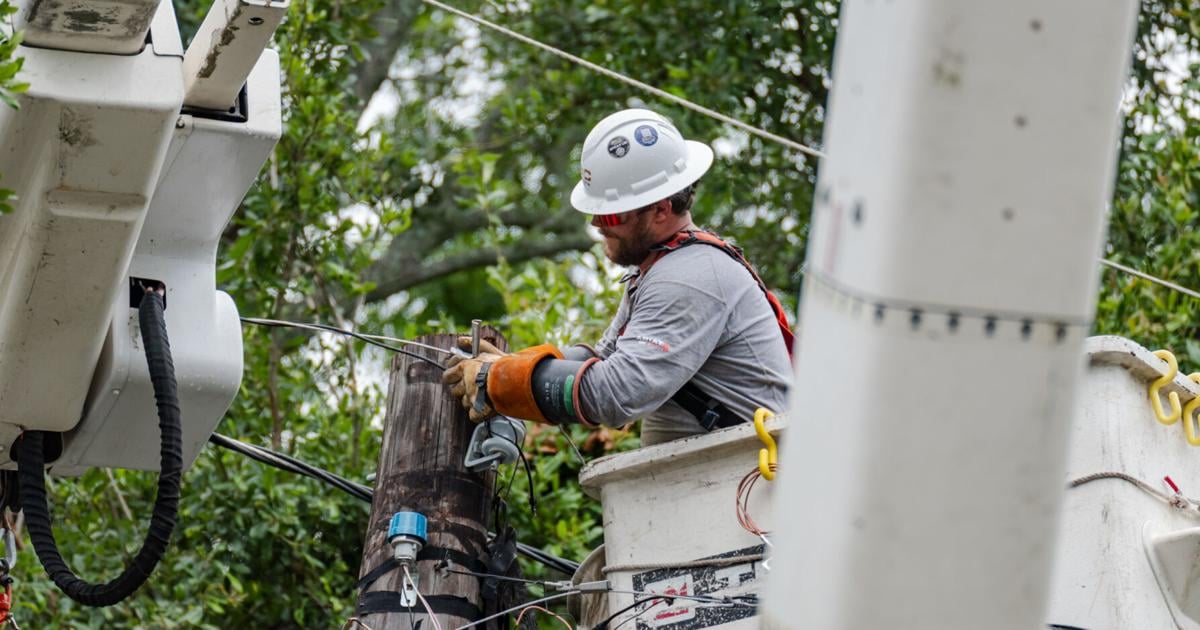
Electric wires on poles?
Most people don’t waste a second thinking about that kind of thing. They’re just glad they can plug their smartphone in at night or heat up leftovers in the microwave.
But “most people” doesn’t include the founders of Ampirical, a 20-year-old Covington engineering firm that has parlayed its expertise in power delivery to grow from a startup with six employees and a handful of small contracts into a 600-person powerhouse with revenues of roughly $500 million.
Ampirical is one of Louisiana’s under-the-radar business successes, and it’s one built on good decisions — and fortuitous timing.
The company’s founding partners hung their shingle in the early 2000s, when investment in power delivery was increasing because of efforts to upgrade the nation’s aging grid infrastructure. Also, policy was shifting toward new, cleaner types of power generation. More recently, a focus on grid resilience and a tech industry-fueled data center construction boom have made power delivery an even bigger priority, fueling growth for companies that know how to design and string together those wires on poles.
Over two decades, Ampirical has steadily expanded its geographical footprint, its team, the size of its contracts, and the products and services it offers. And, in 2024, it landed its biggest job to date: designing and overseeing construction of power transmission for the new Meta Hyperion artificial intelligence data center in north Louisiana.

Ampirical CEO Matthew Saacks stands outside the engineering firm’s Covington headquarters on Friday, Jan. 9, 2025.
Matthew Saacks, Ampirical’s co-founder and CEO, said the project reflects his company’s evolution into a national player.
“It’s unprecedented the way the grid is transforming,” Saacks said during an interview at the firm’s 4-year-old Covington headquarters last week. “It’s not the staid old industry of the 20th century, and there’s a need for people to come up with solutions.”
Two decades of growth
In the aftermath of Hurricane Katrina, three New Orleans-based Entergy Services engineers — Saacks, Mike Sulzer and Mark Stephens — decided to establish their own firm. All born and raised in Metairie, the trio worked for an unregulated division of the utility that provided power delivery solutions to industrial clients and other utilities nationwide. But that type of work was increasingly being outsourced, so the colleagues decided to go into business for themselves.
They soon were joined by three other Entergy alumni and got to work on a couple of small contracts handed off from the utility.
A substation expansion in Barataria led by Louisiana engineering firm Ampirical was designed to improve system reliability.
Operating out of a small office in Covington, the nascent firm of civil and electrical engineers started landing jobs that involved designing every step of the power delivery system process: the high-voltage power lines that move electricity long distances, the lower-voltage lines that distribute it to users and the substations that connect the two systems.
“I always use a driving analogy to explain to people what we do,” Saacks said. “The big transmission lines are like the interstate highway system, and the substations are the on ramps and off ramps. We design it all.”
Power lines run by the site where Smalling Substation is being constructed near Rayville, La., Friday, Jun 27, 2025. The substation will serve the Meta Richland Parish Data Center, which is now under construction.
An engineering job for San Antonio’s electric utility was an early win, followed by more gigs for Entergy and other customers in the Gulf South. A project in California in 2009 opened that market. Eventually the company set up permanent offices near San Diego and the Bay Area to take on various jobs, including upgrading existing towers, poles and wires to make them less likely to cause fires.
The jobs kept getting bigger, and the Ampirical staff grew steadily along with them. In addition to its 78,000-square-foot headquarters, the company also has a satellite office near Mandeville, one in Metairie and several out of state. This month, construction crews are driving piles on land adjacent to the headquarters to expand capacity.
Hitting critical mass
From the start, Ampirical’s founders aspired to provide engineering, procurement and construction services (known in the industry as “EPC”), a turnkey approach that’s similar to the role a developer has in a real estate project. Instead of acting as a hired consultant, an EPC engineer takes on financial risk and needs the cash on hand to qualify for bonds that protect customers.
Ampirical wasn’t big enough at first to take on substantial EPC jobs, but its leaders decided to reinvest profits over the years to build up the capital that could unlock those bigger contracts.
A substation expansion in Barataria led by Louisiana engineering firm Ampirical was designed to improve system reliability.
The first one of note came in 2007, when an independent power plant in Colorado hired Ampirical to design more connections to the grid. Another followed soon after near Sacramento, California.
A few years later, Louisiana electric utility Cleco hired the engineering firm for several initiatives worth tens of millions, and, by 2014, Entergy began sending even bigger jobs the company’s way. Today, the firm has completed dozens of EPC projects for the regional utility.
Matthew Saacks, Ampirical CEO, looks out a conference room window at the construction crews driving pilings for an expansion of the engineering firm’s Covington headquarters on Friday, Jan. 9, 2025.
“We used to have a project here and there, but when we connected with Entergy’s capital projects group, that’s really when our EPC work really hit critical mass,” Saacks said.
Now Ampirical’s portfolio of engineering and EPC projects stretches from California to Florida with growing activity in the Mid-Atlantic and Ohio Valley.
Buying and selling
Ampirical also has begun to grow through acquisitions.
In 2020, the company scooped up a boutique Atlanta engineering firm that designs transmission infrastructure throughout the Southeast with a focus on smaller, customer-owned utilities in the Carolinas and Virginia. That deal came just before the boom in construction of data centers along the I-95 corridor on the East Coast and led to several big jobs in the region.
“When that hit, we looked like geniuses,” Saacks said. “They needed EPC projects, which co-op utilities typically didn’t do, but now they are, and we have the capability.”
Ampirical has acquired two other companies since, but its biggest move to date came in 2024, when, after nearly two decades of bootstrapping, it sought a buyer of its own, finding interest from competitors, private equity funds, public companies and others. Ultimately, the company chose a deal with national private equity firm SkyKnight Capital, which was looking for a way into the energy infrastructure space.
Ampirical team members on a site visit
SkyKnight took a 60% stake in Ampirical, left the leadership intact, and collaborated on a five-year plan that includes more acquisitions, more bidding for big jobs, and selling proprietary software for asset management and grid monitoring.
The transaction occurred as Ampirical was securing its biggest EPC contract to date: connecting Entergy’s grid to Hyperion, Meta’s $27 billion AI data center in Richland Parish near Monroe.
Work is underway at the site for Entergy Louisiana’s Smalling Substation near Rayville, La., Friday, Jun 27, 2025. The substation will serve the Meta Richland Parish Data Center, which is now under construction.
Saacks said the job is worth “hundreds of millions,” and it is leading to more work in that category, including a project for a data center near Phoenix. He estimates investments like that could make up a quarter to a third of all of his company’s portfolio projects.
Looking ahead, Saacks sees some potential challenges, including supply chain constraints that could moderate growth, problems finding corridors for long transmission lines because of “not in my backyard” thinking, and rapid expansion putting pressure on rates.
But, overall, he says the data center jobs, grid hardening efforts, renewable power facilities — and industrial customers starting to develop their own power generation — all add up to opportunities for forward-thinking companies.
“When the grid was built and regulations were written, it was to manage power delivery to schools, homes, business and factories,” Saacks said. “It wasn’t shipping solar power across four states. We can be essential because we understand the engineering, labor and capital needs for projects like that.”