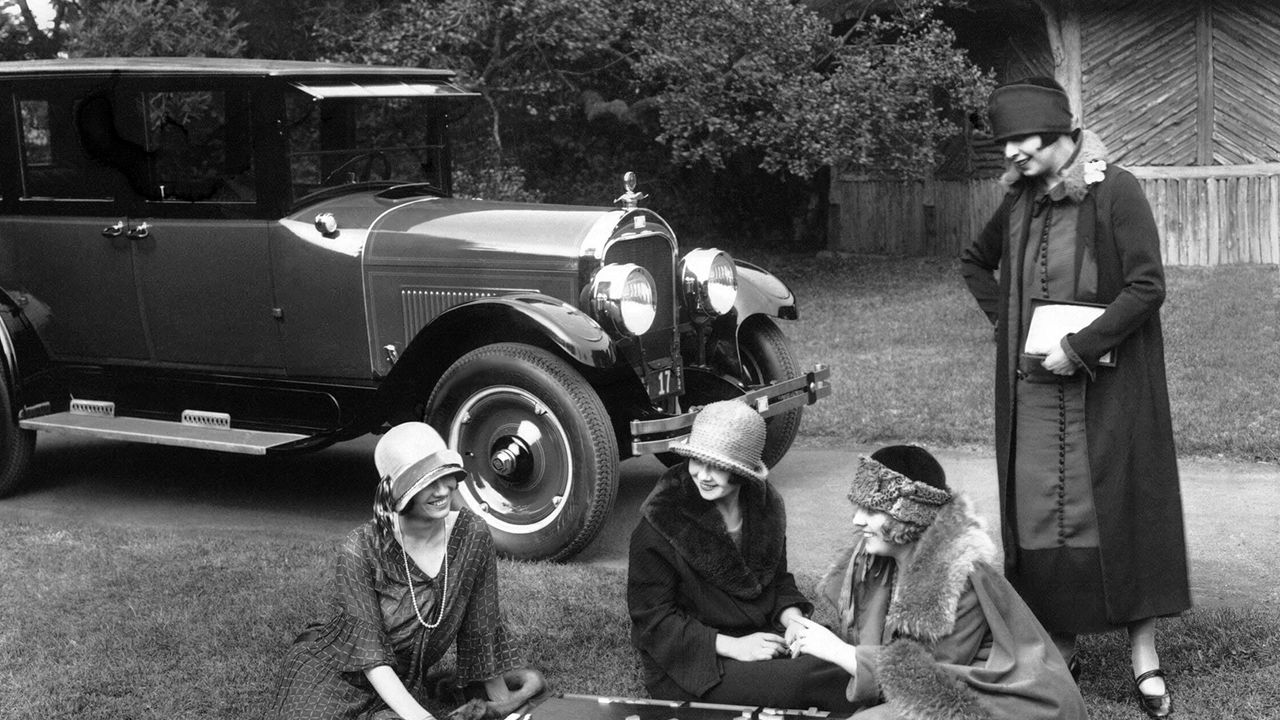
And while many are eager to claim the game as their own, as celebrities like Julia Roberts, Meghan Markle, Blake Lively, Sarah Jessica Parker, and Hilary Duff proclaim their love of mahj, it’s clear that anyone can play, regardless of their background. Beyond spreading the love of the game, there’s big money to be made in mahj—a reality just as true a century ago and in the intervening years as it is now.
In its original incarnation and indeed as it’s still played by some, mah-jongg was a gambling game. When Babcock introduced it to the US and the American style of play was born, so too was a whole new category of accessories: Mah-jongg sets were typically imported from overseas, and cheaper, lighter tiles eventually began to be produced domestically. Traditionally, tiles were larger and heavier, and could easily stand on edge on a table. The thinner, more economical tiles, however, would tip over, necessitating the use of racks, and pushers, bars that allowed rows of tiles to be pushed neatly forward and put into play, were added. When the NMJL was established, it began releasing new rule cards with different combinations of winning hands every year. In the 1950s, cards cost 25 cents; standard cards are now priced at $14. The NMJL contributes part of the proceeds from the cards to charity. Dorothy Meyerson, a founding member of the NMJL and its former vice president, made money selling her rule book, That’s It!, as well as taught lessons at department stores that sold mah-jongg sets. In American-style mah-jongg especially, there’s no limit to the trappings available for purchase to deck out a game table.
Megan Trottier, the Dallas-based founder of Oh My Mahjong, has seen—and to some degree facilitated—the new boom in the old game’s popularity firsthand. In the three years since she launched the company in her garage, selling colorful, design-y tile sets necessary to play the game, and the mats, racks, pushers, shuffling cards, personalized folios to hold rule cards, and more items to complete what OMM dubs the mah-jongg “tilescape,” OMM has surpassed $30 million in annual revenue and, by its own accounting, sells a mah-jongg mat every 10 seconds.
Courtesy of Oh My Mahjong
“Would this have happened without the pandemic?” Trottier tells Vanity Fair, of both mah-jongg’s renewed popularity and OMM’s success. “I don’t know.”
Trottier is referring partly to the in-person nature of the game, traditionally played by groups of four people around a table. Trottier credits mah-jongg with “creating these relationships with people that you maybe would never be friends with—the person you’re sitting across from. You meet someone and you have this amazing something to share that you’re playing.”
Though she initially learned to play about 20 years ago from her college roommate at Texas Tech, who herself learned from her Jewish grandmother growing up in Houston, Trottier found herself back at the mah-jongg table in May of 2020 after a long drought. She’d enjoyed playing in college and had toted her trunk of tiles from apartment to house in the intervening years, but hadn’t found anyone to play with.