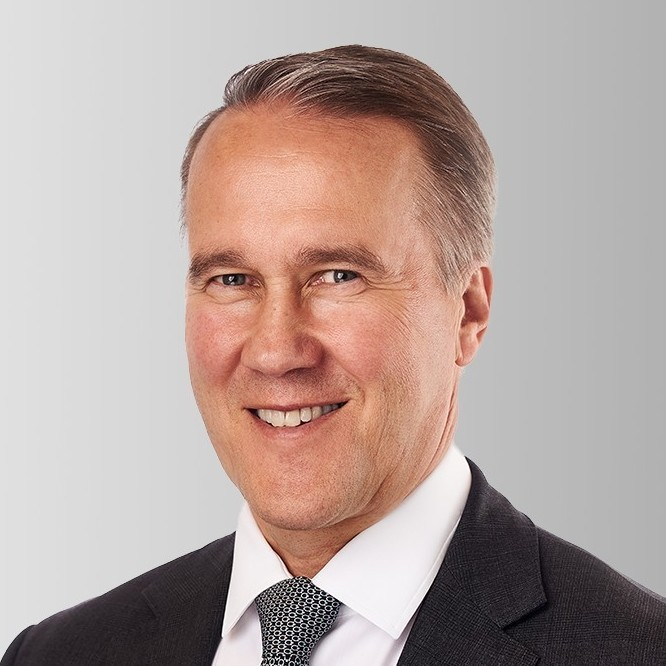

As strategy head, Chey Yoon-chung faces test of leadership in next growth phase
SK heir Chey Yoon-chung is not one to stand still.
“She likes to run and actively joins SK Biopharmaceuticals’ in-house running crew. She even competed in a company-wide rowing event,” an industry official said of Chey, the eldest daughter of SK Group Chair Chey Tae-won. “During a business trip to the BIO International Convention 2025 in Boston last year, she ran at dawn with colleagues.”
Such details offer a glimpse of a corporate heir who operates alongside employees rather than apart from them.
In a business landscape where next-generation conglomerate leaders tend to maintain a relatively low public profile, the SK Biopharmaceuticals vice president’ visible participation in day-to-day company activities has drawn quiet attention within industry circles.
Effective Jan. 1, she was appointed head of SK Biopharmaceuticals’ new strategy department, overseeing mid- to long-term planning, portfolio management, global expansion and new business development. Her expanded role comes as SK Group rides a semiconductor-driven surge led by SK hynix’s record earnings, placing her at the forefront of shaping a future growth pillar beyond the group’s chip-focused core.
Chey, born in 1989, graduated from the University of Chicago with a bachelor’s degree in biology in 2012. After completing her undergraduate studies, she worked as a researcher at the university’s neuroscience institute and later as a consultant at Bain & Company before joining SK Biopharmaceuticals in 2017.
She paused her career at SK Biopharmaceuticals in 2019 to pursue a master’s degree in bioinformatics at Stanford University. After earning her degree, she returned to the company in 2021 as a member of its strategic investment team. She later led the team and was promoted to vice president in charge of business development at the beginning of 2024.
“It’s been almost 10 years since she joined SK Biopharmaceuticals, and she has accumulated diverse hands-on experience,” a biopharmaceutical industry official said. “Her background in biology, bioinformatics and neuroscience, combined with consulting experience, makes her a well-rounded talent.”
Alongside her expanding role at SK Biopharmaceuticals, Chey was also appointed to lead the growth support division, a newly created unit at SK Inc., the group’s holding company, at the end of 2024. Industry observers said the appointment showed the weight SK Group placed on the biopharmaceutical and biotechnology sectors.
While her primary focus remains on shaping SK Biopharmaceuticals’ business future, Chey continues to deepen her scientific expertise. She began pursuing a doctorate in biological sciences at Seoul National University in early 2023.
Next for SK Biopharmaceuticals
SK Biopharmaceuticals posted record earnings last year, driven by strong US sales of cenobamate, the company’s treatment for partial-onset seizures in adult patients. The company logged 706.7 billion won ($495.6 million) in revenue and 203.9 billion won in operating profit, up 29.1 percent and 111.7 percent, respectively, from a year earlier.
With solid cenobamate sales in the US expected to sustain momentum, Chey now faces the challenge of identifying the company’s next growth driver. She explored partnership and investment opportunities at the 44th JPMorgan Healthcare Conference held in San Francisco in January this year.
“At this year’s conference, I plan to actively seek collaboration opportunities to maximize the value of global partnerships, pipelines and new modalities,” she said at the event, outlining her strategy chief agenda to build a more multifaceted growth story for SK Biopharmaceuticals.
Her forward-looking remarks were reinforced when the US Food and Drug Administration cleared SK Biopharmaceuticals to begin Phase 1 clinical trials of its radiopharmaceutical therapy candidate SKL35501 and diagnostic imaging agent SKL35502.
The investigational new drug approvals marked the first time a Korean company secured FDA clinical trial clearance in the RPT sector. According to the company, Chey has led the RPT project.
“Beyond the commercial success of its central nervous system treatment, the outcome of the RPT pipeline will serve as a key benchmark for evaluating her leadership,” a biotechnology industry official said.
Succession without shares
SK Group Chair Chey Tae-won has publicly acknowledged having a succession plan, though details remain undisclosed. His three children — Chey Yoon-chung, second daughter Chey Min-jeong (born 1991) and son Chey In-keun (born 1995) — currently hold no shares in SK Inc., the group’s holding company.
With the chair owning a 17.9 percent stake in SK Inc., a straightforward stock transfer could prove complicated in a succession scenario.
While Chey Min-jeong focuses on Integral Health, an AI health care startup she co-founded in New York in 2023, and Chey In-keun works at McKinsey & Company’s Seoul office, Chey Yoon-chung has increasingly emerged as the most obvious heir apparent.
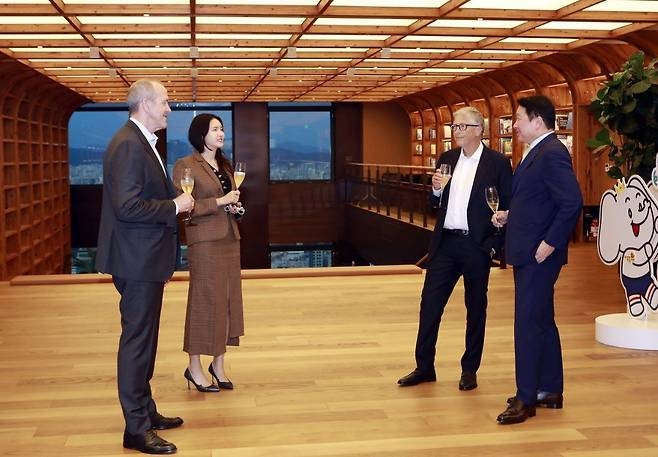
When Chey Tae-won met Nvidia CEO Jensen Huang in Santa Clara on Feb. 5 this year to discuss chip-to-AI collaboration, his eldest daughter accompanied him — another sign of her rising profile within the conglomerate. SK Group also released a photograph last year of her standing alongside her father, Bill Gates and TerraPower CEO Chris Levesque during Gates’ visit to Seoul.
“As Chey gains greater public exposure by accompanying her father in meetings with global figures, it signals both the group’s confidence in her and its strategic emphasis on biopharmaceuticals,” a securities analyst said.
“Although it remains unclear how long she will remain at SK Biopharmaceuticals or whether she will move into a higher decision-making role, her leadership performance could eventually pave the way for a board position.”
By Kan Hyeong-woo (hwkan@heraldcorp.com)