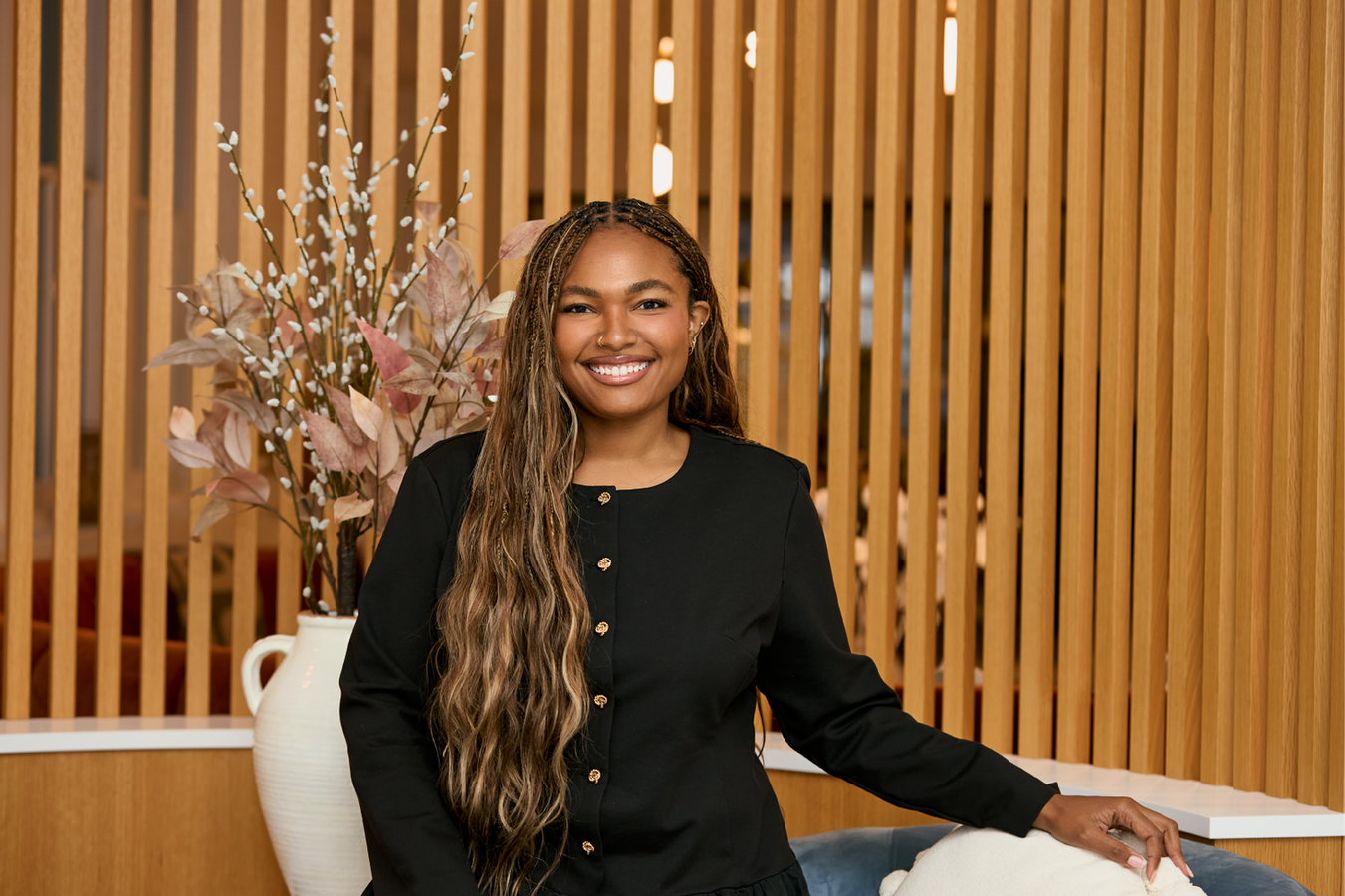
Social Setting founder Christina Westley has turned influencer marketing’s biggest struggle into a profitable venture, delivering under-the-radar talent with quantifiable ROI to CMOs tired of overpaying for reach that doesn’t convert.
D. Creative Lab LLC for Real Social LLC
The dinner table at Continent in Brooklyn seated eighteen. On one side sat marketing executives from Fenty Beauty, Netflix, and Disaronno. On the other, content creators with followings ranging from 50,000 to 500,000, each handpicked for engagement rates and authentic voice. Managers, agents and plus-ones were persona non grata.
This is Social Setting, where founder Christina Westley has turned influencer marketing’s biggest struggle into a profitable venture, delivering under-the-radar talent with quantifiable ROI to CMOs tired of overpaying for reach that doesn’t convert. While others are stuck in an ecosystem obsessed with automation and algorithmic sameness, Westley runs a high-stakes arbitrage play rooted in human judgement. She’s betting the most undervalued asset in the creator economy isn’t the person with the biggest follower count, but the one the industry systematically overlooks because they don’t fit the standard “creator archetype.”
For CMOs tired of bidding wars over the same top 1% of talent, Westley offers a different value proposition: look beyond your usual suspects.
A Content Creator Wake-Up Call at Kate Spade
Iris Coker, who now leads corporate partnerships for the Hetrick-Martin Institute but previously directed global influencer strategy for Kate Spade, recalled the moment she realized the brand’s creator roster was failing them.
At the time, Kate Spade was overcoming an “upper-east-side preppy” perception while investing in women’s mental health initiatives following the namesake designer’s suicide. The brand had partnered with Taraji P. Henson’s Boris Lawrence Henson Foundation to create “Safe Spaces” on HBCU campuses, aiming to reach 100,000 women in one year. They succeeded in three months. But the influencer roster didn’t reflect that expansion.
Coker made diversifying her mission, selecting for “content quality and coolness” across different perspectives, women of color, and trans women. The aha moment came at New York Fashion Week, when influencer Taryn Delanie approached her and said, “I so appreciate the number of Black faces I see here. I haven’t seen this from a brand, especially not from Kate Spade.”
Coker reviewed the company’s historic influencer work. “All white, uninteresting, not where any brand should be,” she told me over Zoom, as did everyone interviewed. “It was really like a cookie cutter. The same creator over and over again, different font.”
It was a wake up call. “This is gross,” she thought. “We’re not making an effort.” She connected with Christina Westley after discovering her LinkedIn post about underrepresented creators.
“Christina helped with creator discovery and casting for campaigns,” Coker said. “She understood brand positioning—and we had a tricky one with the mental health layer—and delivered creators I continued to hire over and over again.”
Diverse creator content for a spring handbag launch “killed in paid media,” outperforming brand assets on Meta and TikTok and proving the business case for diversifying their influencer relations. The ROI told her people want to see themselves reflected and solidified Coker’s new formula. She would now spend $50,000 on fifteen smaller creators plus $50,000 on paid promotion, rather than $100,000 on one macro influencer.
By expanding beyond the cookie cutter, Kate Spade unlocked talent competitors had overlooked, while gaining higher engagement, more goodwill, and more flexibility than the over-bought talent everyone else pursued.
A Social Setting dinner as content creators network, collaborate and unearth new brand partnerships and opportunities.
@mafwa Richie for Real Social LLC
A Content Creator Ecosystem Without Intermediaries
“I knew early on that I had as many connections and trust on the influencer side as I did from the brand side,” Westley told me. She’s a Wharton graduate who chose marketing over finance because she cared about people, not spreadsheets. She’s also an ex-PepsiCo executive who spent four years navigating the sluggishness of corporate risk aversion.
“When it came to identifying influencers, if I wasn’t in the room, I knew that certain people would not be pitched correctly or fully,” Westley said. “That persisted even as head of influencer at a major company. I identified it as an industry-level challenge.”
She’s a market maker, identifying high-skill, high-trust creators who are “under the radar” simply because they lack the “look” populating most PR databases. Across three pillars, Westley’s business model monetizes the delta between what brands say they want (fresh storytelling, authentic community, “cultural nuance”) and who they actually hire. Social Setting provides face-to-face networking over dinner in luxury settings. Her Beehiiv newsletter Social Feed attracted 700 corporate subscribers after just three posts. Social Consult offers fractional influencer marketing services.
Westley controls every invitation for her Social Setting dinners, drawing from creators she personally follows or has researched and the network of CMOs she’s carefully built. No one knows who else will attend. “I don’t let any plus ones at my dinner. So all of these influencers come with no management, they come with no friend.”
The rule deliberately removes intermediaries and ensures every content creator in the room can negotiate their own value and build direct relationships with brand decision-makers.
“My heart always drops when an influencer has an agent,” Coker shared. “Agents want their 20 percent and add a difficulty layer. I push harder on deliverables, with higher expectations. Micros don’t have agents, and they’re excited to work with you.”
By eliminating pitch decks, gatekeepers, and prolonged negotiation cycles, Westley creates conditions where partnerships form organically as trust is established long before a contract is discussed.
How the Right Content Creator Built Disaronno A Strategic Moat
Tamica Fields knows the standard influencer playbook fails Disaronno. As integrated marketing communications manager for the 500-year-old Italian brand , Fields primary challenge is translating the Dolce Vita heritage for a younger, multicultural audience without diluting the aspirational positioning of the premium pricing.
“We usually don’t go with larger influencers because, A, the budget is too much,” Fields said. “And B, what we’ve learned is that some of these micro and smaller influencers are really excited.”
Through a Social Setting dinner in Atlanta, Fields met Kenneth Kyrell, a former Macy’s corporate buyer turned full-time content creator. He offered exactly the cultural fluency Disaronno needed.
“What he did that was so interesting compared to all the others is that he’s a DJ as well,” Fields recalled. “The content was him making a cocktail, with all the bottles part of his setup. How engaging and very at ease he was just from looking at his content.”
For Kyrell, the partnership worked because the introduction wasn’t transactional. “What was so special about [the Social Setting dinner] was that half the table was brand managers and the other half was just influencers,” he said. “This was the first time I’ve ever had that direct contact with someone in that type of setting.” Kyrell could articulate how he integrates brand storytelling into his DJ work. Fields could assess whether his aesthetic genuinely aligned with Disaronno’s positioning.
“He integrates it into his music,” Fields said of the holiday campaign Kyrell ultimately produced. “He’s a trumpet player, and he comes up with these concepts—it’s just so very classy, and it aligns with the brand.”
Such alignment is the difference between renting a face and leveraging authority. “I look at them as ambassadors of the brand,” Fields explains. When creators hit certain KPIs and demonstrate strong engagement, Disaronno threads them through multiple campaigns rather than treating each activation as a one-off transaction.
Kyrell understands the exchange clearly. “This is a business transaction,” he says. “Pay me my worth, I will make sure I create the best content possible, meet all the requirements, and let’s get this thing on the ‘gram.”
Respecting the brief while maintaining creative control is what Fields looks for when she vets content creators. She’ll scroll through feeds, check engagement authenticity, and measures response when she reaches out on Instagram.
“To me, that’s how I get a gauge of their response,” Fields says. “Are they really a fan of the brand, instead of just trying to promote themselves only?”
The Social Setting dinner answered that question immediately. Kyrell left with a partnership; Fields left with a creator who easily interpreted “Dolce Vita” sensibility to an audience Disaronno hadn’t previously encountered.
The Content Creator as Educator and Storyteller
Christopher Griffin, who goes by Plant Kween online, spent a decade in higher education as assistant director for the LGBTQ+ Center at NYU and leading diversity programs at Headspace before becoming a full-time creator. They built their platform deliberately while working full-time, only leaping once the infrastructure was sustainable. Now partnering with brands including Delta, Amazon, Google, Adobe, and HBO Max, Griffin deciphers corporate initiatives into relatable narratives.
“I’m a storyteller,” Griffin said. “I enjoy figuring out various different mediums and methods to tell that story. That’s expansive across any brand—whether it’s a product, an initiative, or a community they’re building.” Their background makes them uniquely qualified for brands requiring nuanced education more than simple product placement.
“I’m excited to work with brands who want to educate their community around a particular topic that goes unseen,” Griffin added, noting sustainability and behind-the-scenes work as key areas. This is the creator Westley’s strategy-first framework surfaces. A brand seeking “a plant influencer” defaults to follower count. A brand seeking “an educator for sustainability initiatives” finds Griffin.
“What Christina has created has manifested for me a level of accessibility to these various brands,” Griffin said of the Social Setting dinners. “I’ve gained some partnership deals through networking at her events. And seeing her as a Black woman, knowing her journey navigating corporate America and then manifesting a need—she saw something, she was like, I’m going to do it, and she created it.”
Conversations over the dinners reveal a strategic fit that can’t be determined at surface level. Griffin explains their educational approach; executives assess communication style. Brands that start with strategy find creators like Griffin. Those that start with spreadsheets sorted by follower counts keep renting the same faces.
Westley engages with brand leaders and CMOs during a Social Setting event
@mafwa Richie for Real Social LLC
The Playbook For Turning Content Creators Into Strategic Assets
“Most brands skip to picking influencers without strategy,” Westley noted. “You must define types of people based on tone, brand fit, and affinities, not specific names. Then determine your main objective: Reach? Niche community? Content assets? Each requires different tiers and types.”
The influencer marketing industry has optimized for the wrong metrics, misunderstanding the pursuit of luxury isn’t exclusive to one demographic. Other demographics note when brands fail to appreciate their vast pocketbooks. Target is a prime example of the consequences of that failure. For CMOs looking to do things a better way, here’s the playbook Westley’s client brands have monetized.
- Prioritize strategy over spreadsheets
Defining the business problem first leads to very different content creators than starting with follower count. - Audit your “default” roster.
If your influencer list looks identical to your competitors’, you’re paying a premium for sameness. Diversify not just for optics, but for performance and reach into untapped audiences. - Diversify beyond the algorithm’s suggestions.
The creators your competitors overlook because they don’t fit the standard archetype are often the ones your audience most wants to see. - Trade reach for resonance.
Smaller creators with authentic engagement outperform rented celebrity faces because their audiences actually trust them. - Embrace human judgment alongside tech.
Tools aid scaling, but cultural insight and personal networks reveal high-engagement micros overlooked by algorithms. - Treat creators as ambassadors, not vendors.
When you find alignment, invest in the relationship. Loyalty compounds. - Create conditions for organic trust.
Face-to-face environments surface fit faster than any brief, dashboard or cursory look at a social media feed. - Professionalism matters more than polish.
The creators who perform best understand the value exchange and execute accordingly. Examine the relationship progress from beginning to end, allowing yourself an out for those influencers who misunderstand the business nature of the relationship.
The influencer economy has spent a decade optimizing for scale, building databases sorted by follower count and engagement rate while treating content creators as interchangeable inventory. Westley’s bet is that human judgment still matters, that a dinner table in Brooklyn can surface partnerships no algorithm would suggest. Social Settings unearths better questions, better rooms, and the discernment to recognize value before the rest of the market catches up.