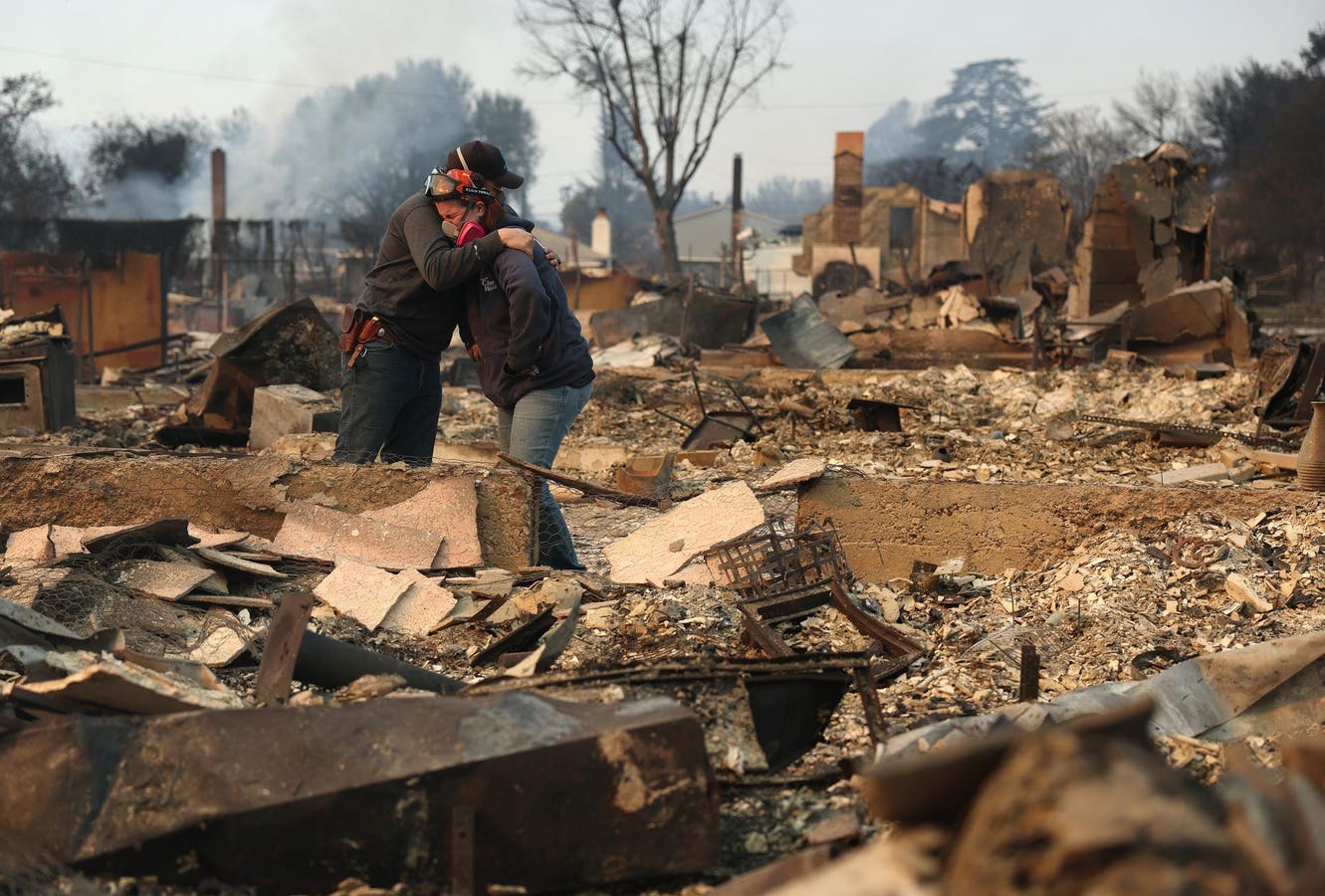
ALTADENA, CALIFORNIA – JANUARY 09: Khaled Fouad (L) and Mimi Laine (R) embrace as they inspect a family member’s property that was destroyed by Eaton Fire on January 09, 2025 in Altadena, California. Fueled by intense Santa Ana Winds, the Eaton Fire has grown to over 10,000 acres and has destroyed many homes and businesses. (Photo by Justin Sullivan/Getty Images)
Getty Images
With wildfire and hurricane seasons nearly behind us and the status of FEMA still in flux, questions about traditional disaster recovery systems remain. Some would argue they were not built for today’s pace of climate risk and this is a moment to think about what comes next. With communities facing longer rebuilding timelines, technology is emerging as a force multiplier. A growing set of companies are using AI, satellite intelligence, drones and digital twins to reduce recovery delays and rebuild infrastructure faster and more efficiently.
These events now cause hundreds of billions of dollars in damage every year in the United States, and recovery timelines are growing longer. That has major economic implications. When communities wait months for damage assessments, stalled construction and business closure ripple into local tax losses, workforce disruption and supply chain slowdowns. As climate risk becomes a permanent market factor, technology is starting to redefine how recovery is financed, managed and executed.
Can technology cure the disaster recover delay problem?
Federal disaster recovery programs were built for slower risks and smaller disasters. They still rely heavily on manual assessments, paper-based claims, disconnected databases and limited real-time data. The result is delay. The U.S. Government Accountability Office reports that major disaster recovery often stretches beyond six years before communities return to stable operation. In that gap, businesses close, debt rises and insurance challenges multiply. Technology is not a solution to climate risk itself, but it is becoming a key factor in reducing the economic drag of rebuilding.
A growing market of companies is building technology that compresses recovery timelines and increases financial efficiency. These tools do not eliminate disaster loss, but they reduce delays and make better use of available funding. Investors and corporate strategy teams increasingly view disaster tech as part of the resilience economy. This sector is drawing serious capital from both public infrastructure budgets and private innovation funds.
BAT CAVE, NORTH CAROLINA – OCTOBER 08: An aerial view of destroyed and damaged buildings in the aftermath of Hurricane Helene flooding on October 8, 2024 in Bat Cave, North Carolina. Bat Cave was particularly hard hit by flooding. Recovery efforts continue as the death toll has risen to over 230 while the powerful Hurricane Milton is on track to make landfall in Florida. (Photo by Mario Tama/Getty Images)
Getty Images
One of the most significant uses of technology is accelerating damage assessments. After a major disaster, delays usually begin in the first 72 hours. Traditional inspections require teams to manually assess damage structure by structure, a process slowed by blocked roads, hazardous debris and workforce shortages. AI-driven damage analysis now uses aerial imagery and machine learning to identify structural damage and triage recovery work orders. Companies such as Zesty.ai, One Concern and Moderna AI Solutions use predictive models to analyze building integrity and categorize risk far faster than manual inspection alone.
Drone technology has also become standard in post-disaster inspection, especially for wildfires that threaten utility infrastructure. California utility operators now contract drone companies to inspect transmission lines and substations before sending repair crews into hazardous zones. U.S.-based Skydio, for example, provides autonomous drones that can map and inspect thousands of acres in a fraction of the time of ground crews. Grid restoration that once took weeks now begins in days. That reduces outage time, accelerates business reopening and limits regional economic losses.
Florida Power and Light unveils its new fixed-wing drone designed to fly into tropical storm force winds to help expedite power restoration. The drone, named FPLAir One, resembles a small plane that is remotely operated, allowing the company to scan and capture visuals for up to 1,000 miles on a single flight. (AP Photo/Cody Jackson)
Copyright 2022 The Associated Press. All rights reserved
Satellite and geospatial intelligence also play a growing role. Operators such as Maxar and Planet Labs provide high-resolution satellite imagery before and after wildfires, hurricanes and floods. This data has transformed situational awareness for insurers, local governments, real estate firms and construction companies. Instead of waiting for site access, recovery teams now make preliminary assessments remotely, identify blocked logistics routes and plan debris removal strategies with greater accuracy. Insurance analysts use satellite imagery to forecast claims exposure and streamline verification processes.
Digital twins, virtual models of physical environments, are becoming influential in recovery from hurricanes that damage complex infrastructure like ports, bridge networks and utilities. These models simulate recovery pathways, construction staging and material needs. Several Gulf Coast engineering firms now use digital twins to plan recovery work across transportation corridors damaged by storm surge. This allows faster procurement decisions, earlier contractor mobilization and greater transparency in cost projections. Public infrastructure projects historically plagued by change orders and overruns now have better tools for accountability.
Data fusion platforms are also entering disaster recovery operations. These platforms combine social vulnerability data, property records, hazard models and infrastructure maps into unified decision systems. Insurance carriers and commercial real estate investors use these analytics to evaluate climate-adjusted portfolio risk. Municipalities use them to prioritize which neighborhoods receive rebuilding support first. These tools also strengthen applications for federal recovery funds by producing clear evidence of damage, need and cost-benefit analysis.
Technology And The Case For Mitigation
The economic case for disaster tech is increasingly strong. The National Institute of Building Sciences has long reported that every $1 invested in mitigation saves up to $13 in avoided recovery costs. Newer disaster tech firms now apply that same logic to speed. Shorter outages mean less business interruption. Faster debris removal means quicker rebuilding. Accelerated claims processing means families and business owners return to stable housing faster, reducing secondary economic shocks. Recovery speed is no longer just a humanitarian metric, it is a financial one.
“Recovery is a logistics and finance problem as much as a construction problem,” said one climate risk technology executive whose platform supports disaster logistics. “You cannot rebuild if you do not have verified data, material access, insurance clarity and a functioning operations plan. Technology changes the speed of all four.”
The resilience tech industry is growing along with climate risk. Venture and infrastructure investment have helped scale companies focused on wildfire prediction, flood modeling, emergency communications, disaster supply chain management and post-disaster reconstruction. Climate adaptation is now a recognized investment category, with private capital entering a space long dominated by government programs. Construction firms, insurers and utilities are becoming major enterprise buyers of disaster intelligence platforms.
The Urban-Rural Divide Challenge
However, technology is not evenly adopted, raising concerns about recovery inequality. Rural communities are less likely to have drone coverage, advanced mapping or access to digital claims processing. While Planet Labs allows some local municipalities and organizations to access its images and data free, most other companies charge hefty subscriptions that outweigh the budgets of these users. Broadband and power outages limit digital recovery tools and widen the gap between communities with tech capacity and those without. Recovery technology also carries ethical concerns around data privacy, AI bias and surveillance. Without public standards, communities risk becoming dependent on proprietary systems rather than resilient systems.
To translate innovation into impact, disaster technology must be tied to real-world execution. Businesses that operate in disaster-prone regions increasingly view resilience planning as a form of risk management. The companies that rebound fastest from climate shocks are those with pre-disaster mapping, continuity plans, diversified suppliers and capital strategies tied to climate impact scenarios. The integration of technology into recovery means leaders must think beyond emergency response and invest in digital infrastructure that supports stability and continuity.
The next phase of disaster recovery will not be defined by response organizations alone. It will be shaped by partnerships between construction firms, insurers, infrastructure investors, logistics networks and technology providers. Communities that build cross-sector resilience now will recover faster later. As climate risk continues to expand, recovery speed will become a competitive advantage for regions and businesses.